
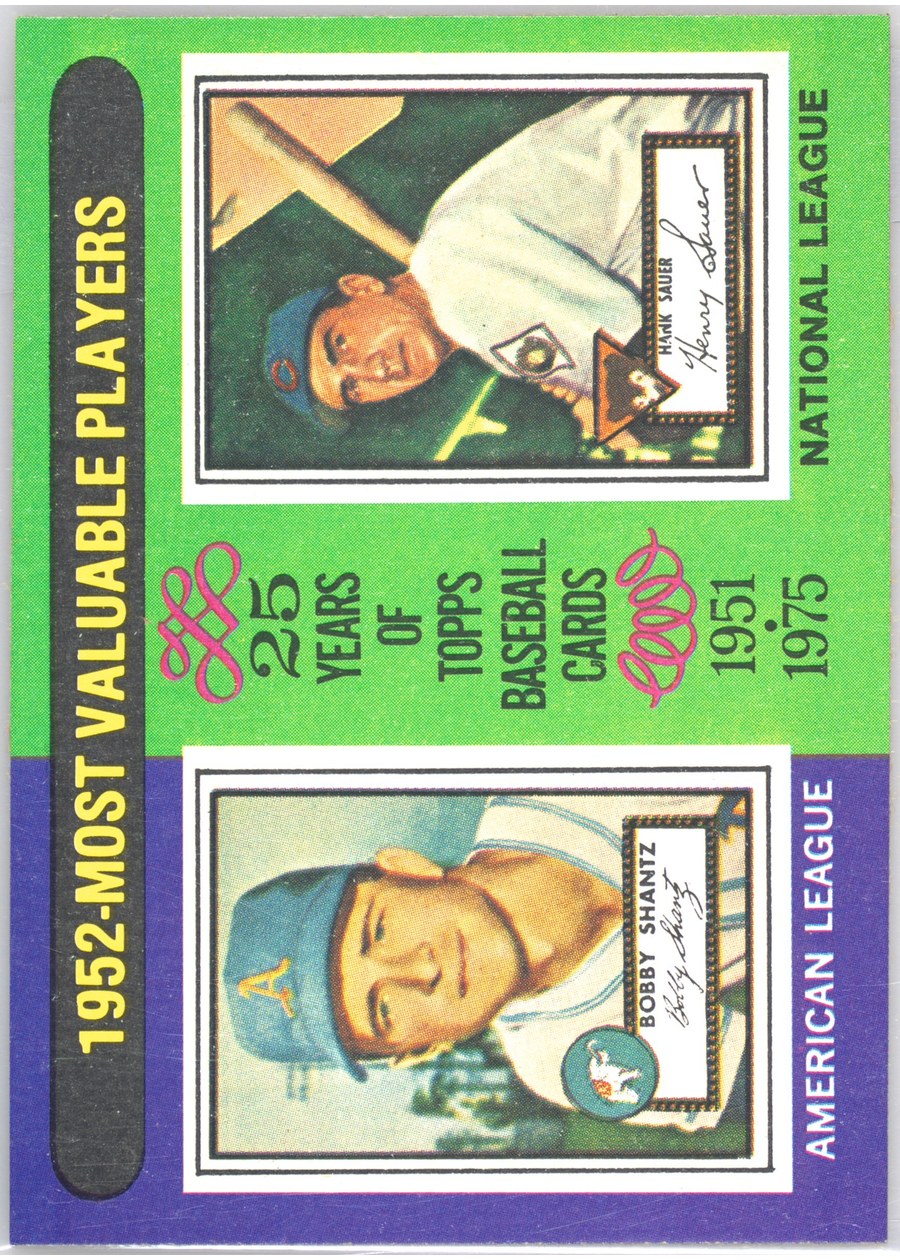
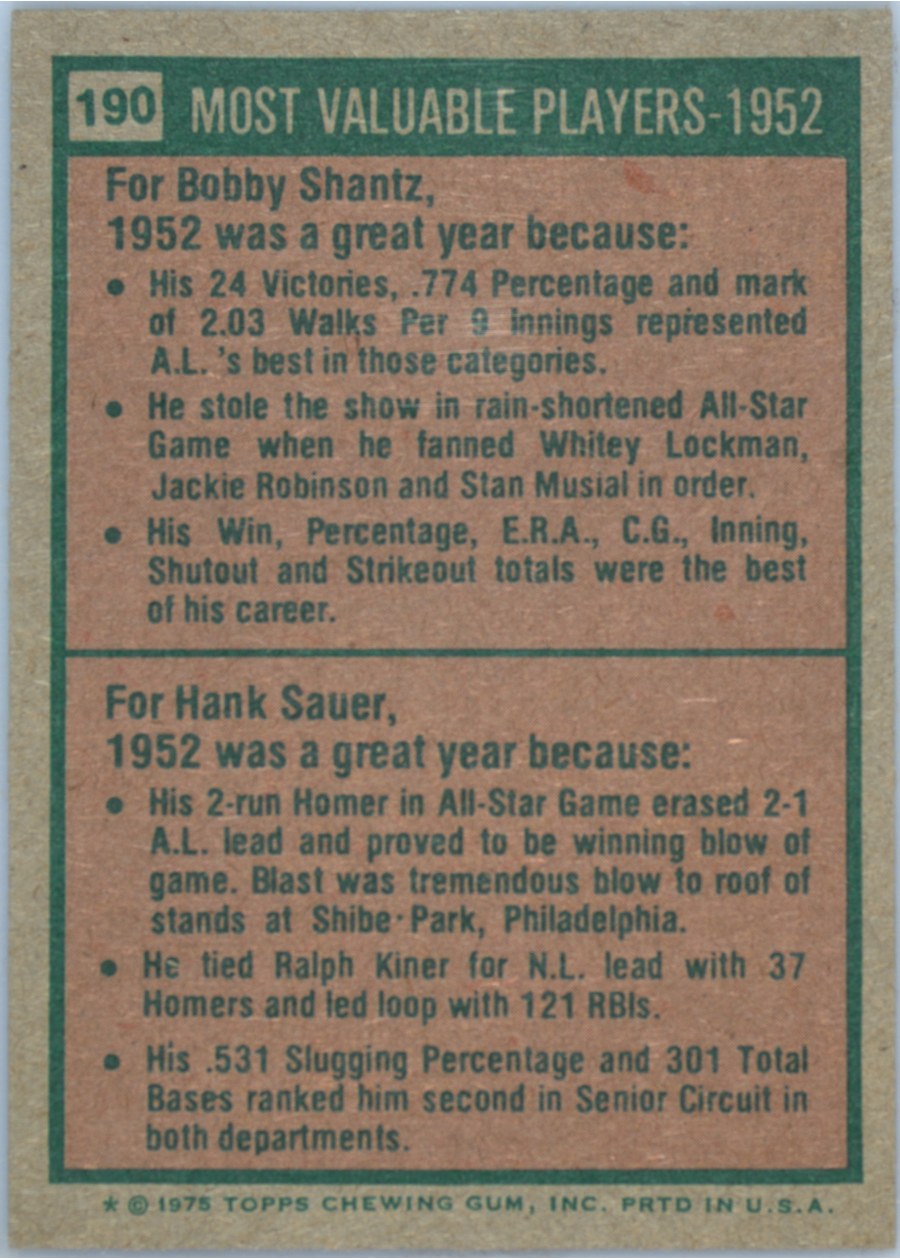
1975 Topps #190 1952 MVPs
Part of the MVP subset (#189-212) — both league MVPs of one season, rendered in that year's Topps design.
About this card
Cards #189-212 are the MVP subset: twenty-four cards, each pairing the American and National League Most Valuable Players of one season from 1951 through 1974, reproducing their cards from that year.
About the players on this card
Bobby Shantz
Robert Clayton Shantz was born September 26, 1925, in Pottstown, Pennsylvania, and stood just 5-foot-6, a frame scouts considered too small for pro pitching until one signed him with the Philadelphia Athletics in 1948. The left-hander debuted in the majors on May 1, 1949, and by 1951 had added a knuckleball to a mix of curveballs, fastballs, and changeups built on pinpoint control. His signature season came in 1952: Shantz led the American League with 24 wins, posted a 2.48 ERA, and captured the AL Most Valuable Player Award, the Athletics' last winning season in Philadelphia. Card #190 pairs him with his National League counterpart in Topps' 1952 MVPs subset. A broken wrist and shoulder injuries nearly derailed his career, but a 1957 trade to the Yankees revived it — he led the league in ERA that year, made three All-Star teams in all, won a World Series in 1958, and earned eight consecutive Gold Gloves (1957-1964) as the game's top-fielding pitcher. He closed out a 16-year career in 1964, fittingly, back home with the Phillies in Philadelphia.
Sources: Wikipedia · SABR BioProject · Baseball-Reference
Hank Sauer
Hank Sauer signed with the New York Yankees' organization in 1937 out of Bellevue, Pennsylvania, and spent a decade in the minors, capped by a 50-homer, .336 season with Triple-A Syracuse in 1947 that made him the International League's MVP and Minor League Player of the Year. Cincinnati brought him up for good in 1948, then traded him to the Chicago Cubs in June 1949, where the right-handed slugger became the club's biggest draw during a lean stretch of last-place finishes. He topped 30 home runs five times in a Cubs uniform, made the All-Star team in 1950 and 1952, and in 1952 led the National League in homers (37, tied with Ralph Kiner) and RBI (121) en route to NL MVP honors. Twice, in 1950 and 1952, he victimized Phillies lefty Curt Simmons with three-homer games, a feat matched against one pitcher only by him and Johnny Bench. Beloved for his power and modesty, he earned the nickname "the Mayor of Wrigley Field" after an 11-homer opening month with the Cubs in 1949 won over the fans. He finished with a .266 average, 288 home runs and 876 RBI, and headlines the "1952 MVPs" subset card #190 in the 1975 Topps set.
Sources: Wikipedia · SABR BioProject · Baseball-Reference
Graded population (PSA & SGC)
| Grader | Total | 10 | 9 | 8 | 7 | 6 | 5 | 1-4 | Auth |
|---|---|---|---|---|---|---|---|---|---|
| PSA | 416 | 4 | 81 | 254 | 49 | 8 | 13 | 6 | 1 |
| SGC | 15 | 0 | 4 | 8 | 1 | 1 | 0 | 1 | 0 |
Graded population — a scarcity guide, not a price. Snapshot 2026-08-19. Half grades fold down for both graders (8.5→8); PSA qualified slabs (OC, ST, PD, MC and the like) are not counted. The graders do not split the 1975 Topps Mini or O-Pee-Chee issues into this set.
Find this card
Search T206 Cards Live auctions Buy It Now Sold prices
As an eBay Partner Network affiliate, T206Cards.com may earn from qualifying purchases.
Frequently asked questions
What is the 1975 Topps #190 card?
It is card #190 of the 660-card 1975 Topps Baseball set, picturing Bobby Shantz, Hank Sauer. Cards #189-212 are the MVP subset: twenty-four cards, each pairing the American and National League Most Valuable Players of one season from 1951 through 1974, reproducing their cards from that year.
How many cards are in the 1975 Topps Baseball set?
660 cards, numbered 1-660, with no variations and no short prints - PSA reports the cards were printed in equal quantities. The 1975 Topps Mini and the 1975 O-Pee-Chee issues are separate products with their own checklists.
Sources: Trading Card Database, Cardboard Connection, the PSA price guide, Baseball-Reference, the SABR BioProject and the National Baseball Hall of Fame, PSA & SGC population reports. Card data compiled and maintained by T206Cards.com. Page last updated 2026-10-05.