
1956 Topps #19 Chuck Diering
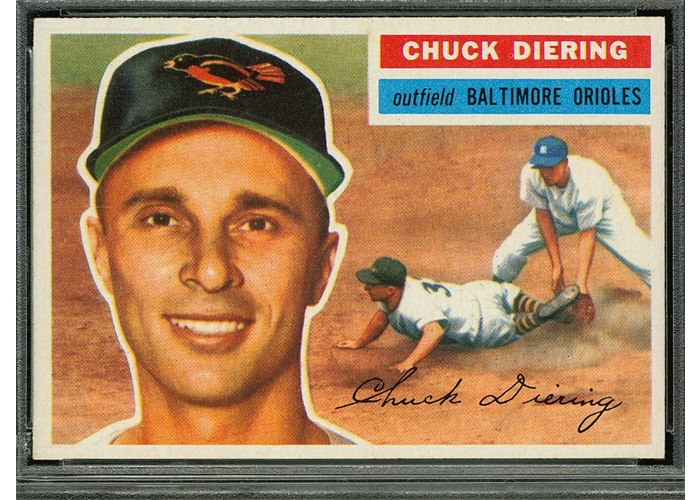
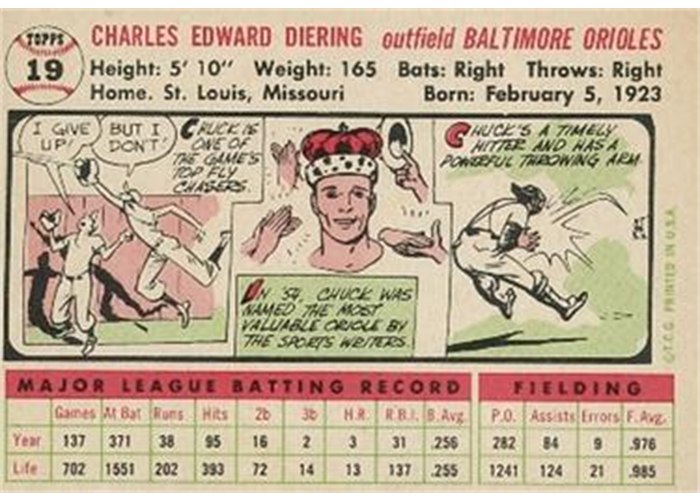
About Chuck Diering
Chuck Diering (February 5, 1923 - November 23, 2012), a St. Louis native, began his professional career in the St. Louis Cardinals' organization in 1941 and, after serving in World War II from 1943 to 1945, made his major-league debut on April 15, 1947. A right-handed outfielder celebrated for his glove, he drew praise from Boston manager Billy Southworth as "a great ballhawk" and served as the Cardinals' starting center fielder in 1949, backing up Hall of Famers Stan Musial and Enos Slaughter during his five years in St. Louis (1947-1951). Traded to the New York Giants with Max Lanier for Eddie Stanky in December 1951, he saw little action before being selected by the new Baltimore Orioles in the 1953 Rule 5 draft. Reclaiming a regular role in center field, Diering was named the transplanted franchise's first-ever Most Valuable Oriole in 1954. Over nine seasons and 752 games he batted .249 with 411 hits, 14 home runs, and 141 RBI, and later owned a car dealership in Alton, Illinois. On this 1956 Topps card, a double-print, #19 exists with both the common white and the scarcer gray back stock found on lower-numbered cards in the set.
Sources: Wikipedia · Baseball-Reference · SABR
Variations & how to tell them apart
White Back / Gray Back Series 1 & 2 (cards 1-180)
Every card #1-180 exists with the reverse printed on white/cream card stock OR on gray card stock. Cards #181-340 are gray-back only. The scarcity FLIPS at #100: on cards 1-100 the gray back is slightly scarcer (a modest premium); on cards 101-180 the gray backs are far more common (about 12-15 to 1), so the WHITE back is the scarce, premium variation - often +50% or more, and disproportionately so in high grade, since the white-stock cards tend to be more brittle.
- White Back: Printed on white/cream card stock. The standard/common look on cards 1-100; the SCARCE, premium variation on cards 101-180.
- Gray Back: Printed on gray card stock. The scarcer variation on cards 1-100 (modest premium); the common look on cards 101-180; the ONLY back on cards 181-340.
Double Print
An uncut Series-1 sheet (110 cards, 10x11) shows 20 cards were double-printed - modestly more plentiful than their series-mates. The list happily includes #30 Jackie Robinson and #31 Hank Aaron. The only print-quantity designation in the set (there is no recognized short-print run).
Graded population (PSA & SGC)
| Grader | Total | 10 | 9 | 8 | 7 | 6 | 5 | 1-4 | Auth |
|---|---|---|---|---|---|---|---|---|---|
| PSA | 997 | 2 | 25 | 271 | 320 | 207 | 95 | 77 | 0 |
| SGC | 85 | 0 | 3 | 18 | 16 | 14 | 18 | 15 | 1 |
PSA by variation: Gray Back 227 · White Back 770
SGC by variation: Gray Back 45 · Gray Back (Overprint - Cardinals) 1 · White Back 39
Graded population — a scarcity guide, not a price. Snapshot 2026-06-30. Half grades fold down for both graders (8.5→8); PSA qualified slabs (OC, ST, PD, MC and the like) are not counted. Totals are summed across each grader's listed variations.
Find this card
Search T206 Cards Live auctions Buy It Now Sold prices
As an eBay Partner Network affiliate, T206Cards.com may earn from qualifying purchases.
More Baltimore Orioles cards
- Fred Marsh
- Ray Moore
- Hal Smith
- Gus Triandos
- Baltimore Orioles Team
- Willy Miranda
- Dave Pope
- Harry Dorish
- Bob Nelson
- Jim Wilson
- Erv Palica
- Dave Philley
- Harry Brecheen
- Bob Hale
Frequently asked questions
What is the 1956 Topps Chuck Diering card?
It is card #19 of 340 in the 1956 Topps set - Topps' first set after buying out rival Bowman, and one of the most attractive issues in the hobby. It pictures the Baltimore Orioles player.
Does the 1956 Topps Chuck Diering have back variations?
Yes. Every card #1-180 exists with the reverse printed on white/cream card stock OR on gray card stock. Cards #181-340 are gray-back only. The scarcity FLIPS at #100: on cards 1-100 the gray back is slightly scarcer (a modest premium); on cards 101-180 the gray backs are far more common (about 12-15 to 1), so the WHITE back is the scarce, premium variation - often +50% or more, and disproportionately so in high grade, since the white-stock cards tend to be more brittle.
Is the 1956 Topps Chuck Diering valuable?
Value depends on grade and (where it applies) the back or front variation. Use the links above to check current T206 Cards inventory and live eBay listings.
Sources: Trading Card Database, Baseball-Reference, BaseballCardPedia, PSA & SGC population reports, and Baseball-Almanac. Card data, images & population compiled and maintained by T206Cards.com. Page last updated 2026-10-05.