
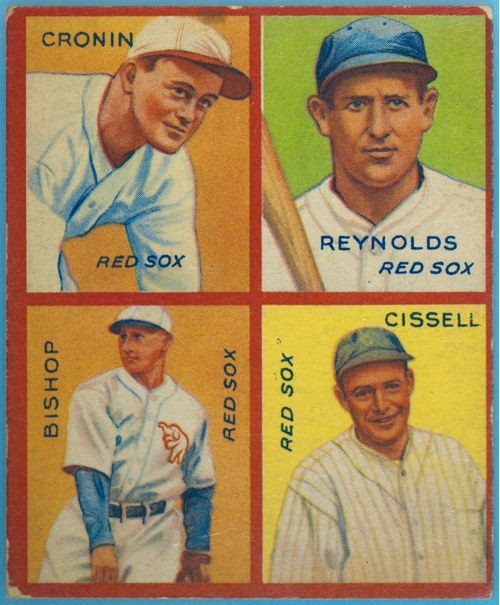
1935 Goudey 4-in-1 #6 — Joe Cronin / Carl Reynolds / Max Bishop / Bill Cissell
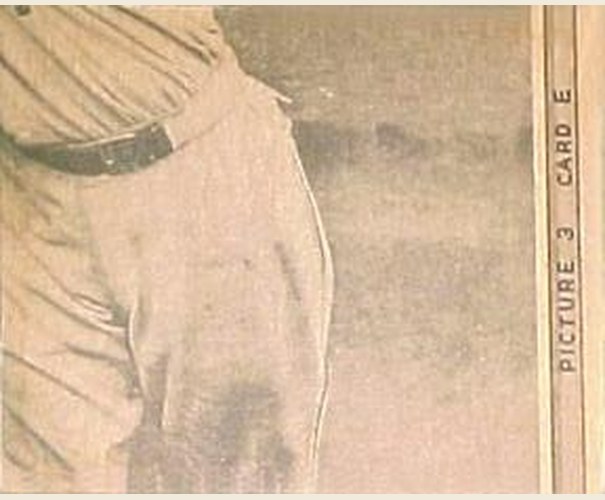
The backs of 1935 Goudey cards are puzzle pieces, not player bios: each is marked "PICTURE N — CARD X" and builds one of the set's nine puzzles. This front was printed with 4 different backs (1G, 3E, 5E, 6E), so it counts 4 entries toward the 114-combination master set.
Every back combination of this front comes from the scarcer of the two printings of its puzzles — all 4 combos are short prints (per Beckett's tags and the Dec 1995 VCBC press-panel analysis).
The card & its puzzle backs



About Joe Cronin
Joe Cronin reached the majors as a 19-year-old with the 1926 Pittsburgh Pirates, but he became a star after Washington bought him from Kansas City in mid-1928. The Senators' shortstop hit .346 with 126 RBI in 1930, when the baseball writers voted him the American League's MVP, and in 1933, handed the manager's job at just 26, he batted .309 and steered the Senators to their final pennant, still the youngest manager in World Series history. Then came the shock: honeymooning with owner Clark Griffith's niece Mildred in October 1934, Cronin learned Tom Yawkey had bought him for shortstop Lyn Lary plus a staggering $250,000, with a five-year deal to run the Red Sox. Goudey's 1935 4-in-1 issue caught that moment: the upper-left panel of card #6, shared with Carl Reynolds, Max Bishop, and Bill Cissell, pictures Cronin as a Red Sox in his first season as Boston's player-manager, an All-Star year at .295 with 95 RBI. A seven-time All-Star, he retired at .301 with 2,285 hits and 1,424 RBI, managed Boston's 1946 pennant winner, and served as American League president from 1959 to 1973. Cooperstown called in 1956; the Red Sox retired his No. 4 in 1984.
Sources: Wikipedia · Baseball-Reference · SABR
About Carl Reynolds
A four-sport star at Texas’s Southwestern University, Carl Nettles Reynolds was signed by White Sox husband-and-wife scouts Roy and Bessie Largent and debuted in September 1927. Across 13 seasons with the White Sox, Senators, Browns, Red Sox, and Cubs, the strong-armed outfielder batted .300 six times and finished at .302. His 1930 was enormous — .359, 202 hits, 22 homers, 104 RBIs — capped by a July 2 game where he homered in each of the first three innings, a major-league first. On July 4, 1932, Bill Dickey’s punch broke his jaw after a home-plate collision, costing the Yankees catcher a $1,000 fine and 30-day suspension. Reynolds hit .303 with 86 RBIs for Boston in 1934, and this quadrant — shared with Joe Cronin, Max Bishop, and old White Sox teammate Bill Cissell — captures his final Red Sox season; he was dealt for Heinie Manush that December. He batted .302 for the pennant-winning 1938 Cubs, pinch-hit for Dizzy Dean in the World Series, and entered the Texas Sports Hall of Fame in 1971.
Sources: Wikipedia · Baseball-Reference · SABR
About Max Bishop
Jack Dunn signed Max Bishop off the Baltimore City College diamond, and he helped Dunn’s International League Orioles to five straight pennants before Connie Mack paid $20,000 for him in December 1923. For ten seasons (1924–33) Bishop was the Philadelphia Athletics’ leadoff second baseman, setting the table for Cochrane, Simmons, and Foxx as the A’s won three straight pennants (1929–31) and the 1929 and 1930 World Series — he played all 18 Series games without an error. Nicknamed “Camera Eye” for his command of the strike zone — patience he developed deliberately at Mack’s urging — he stands with Ted Williams and Barry Bonds as the only players ever to walk in 20 percent of their plate appearances, posting a .423 career on-base percentage against a .271 average, scoring more runs (117) than hits (111) in 1930, and twice drawing a record eight walks in a doubleheader. Sent to Boston with Lefty Grove in Mack’s Depression sell-off, Bishop played his final big-league season in 1935, just as this red-border, all-Red Sox panel groups him with player-manager Joe Cronin, Carl Reynolds, and Bill Cissell. He then coached Navy baseball for 25 years; the Academy’s ballpark is named Max Bishop Stadium.
Sources: Wikipedia · Baseball-Reference · SABR
About Bill Cissell
Bought out of the Army cavalry in 1925, Missouri farm boy Bill Cissell rocketed through Des Moines and Portland to become “baseball’s costliest player” when the White Sox sent the Beavers a reported $123,000 in cash and players. Chicago’s shortstop from 1928, he never carried the price tag comfortably; his best season followed an April 1932 trade to Cleveland that moved him to second base — .315, 184 hits, and a career-high 98 RBIs. He batted .267 in his lone Red Sox season, 1934, the uniform Goudey gives him on this 4-in-1 panel beside Joe Cronin, Carl Reynolds, and Max Bishop. By the time these cards reached candy counters, Boston had already dealt him back to Portland, where he spent 1935 hitting .316 and managing the Beavers. A tough customer who tagged Ty Cobb between the eyes as a rookie, Cissell resurfaced with the 1937 Athletics and 1938 Giants, finishing with 990 hits in 956 games. He died in 1949 at just 45; the White Sox paid for his funeral.
Sources: Wikipedia · Baseball-Reference · SABR
Graded population (PSA & SGC)
| Grader | Total | 10 | 9 | 8 | 7 | 6 | 5 | 1-4 | Auth |
|---|---|---|---|---|---|---|---|---|---|
| PSA | 137 | 0 | 0 | 4 | 2 | 18 | 26 | 86 | 1 |
| SGC | 44 | 0 | 0 | 0 | 0 | 2 | 8 | 34 | 0 |
Graded population — a scarcity guide, not a price. Snapshot 2026-08-06. PSA counts are straight grades only; PSA half-grade and qualified slabs are not included. SGC half grades fold down (8.5→8). Totals are summed across this front's graded back combinations.
PSA by back: 1G (SP) 16 · 3E (SP) 19 · 5E (SP) 40 · 6E (SP) 62
SGC by back: 1G (SP) 3 · 3E (SP) 2 · 5E (SP) 12 · 6E (SP) 27
Find this card
Search T206 Cards Buy It Now on eBay eBay auctions ending soon Sold prices
As an eBay Partner Network affiliate, T206Cards.com may earn from qualifying purchases.
Related cards
More Boston Red Sox cards:
Other fronts in the same puzzle pictures:
- #4 Mickey Cochrane / Charlie Gehringer / Tommy Bridges / Billy Rogell
- #8 George Earnshaw / Jimmy Dykes / Luke Sewell / Luke Appling
- #10 Frankie Frisch / Dizzy Dean / Ernie Orsatti / Tex Carleton
- #11 Burleigh Grimes / Chuck Klein / Kiki Cuyler / Woody English
- #14 Willis Hudlin / Glenn Myatt / Adam Comorosky / Jim Bottomley
- #16 Willie Kamm / Oral Hildebrand / Earl Averill / Hal Trosky
- #19 Sam Leslie / Lonny Frey / Joe Stripp / Watty Clark
- #20 Roy Mahaffey / Jimmie Foxx / Dib Williams / Pinky Higgins
Frequently asked questions
What is the 1935 Goudey 4-in-1 Cronin/Reynolds/Bishop/Cissell card?
It is one of the 36 unnumbered fronts of the 1935 Goudey 4-in-1 set (R321), picturing Joe Cronin / Carl Reynolds / Max Bishop / Bill Cissell. The 2-3/8 by 2-7/8 inch card carries four color portraits on the front and a puzzle piece on the back. Checklists that number the set (Old Cardboard / the Burdick Collection convention, alphabetical by the upper-left player) list it as #6 of 36.
How many backs does this card have?
4: 1G, 3E, 5E, 6E. Every 1935 Goudey front was printed with two to four different puzzle-piece backs, and collectors chasing the 114-combination master set track each front/back pairing separately. The 1G, 3E, 5E, 6E printings are short prints per Beckett and the VCBC press-panel analysis.
How many cards are in the 1935 Goudey 4-in-1 set?
36 fronts, each with four players (144 panels picturing 138 different men). Counting the two-to-four puzzle backs each front was printed with, the master set runs to 114 front/back combinations, 42 of them short prints. A complete set of all nine puzzles requires 72 different backs.
Sources: Trading Card Database, Old Cardboard, the Burdick Collection catalog (Metropolitan Museum of Art), SABR Baseball Cards research, Baseball-Reference, PSA & SGC population reports, and the Dec 1995 VCBC press-panel analysis. Card data compiled and maintained by T206Cards.com. Page last updated 2026-10-05.