
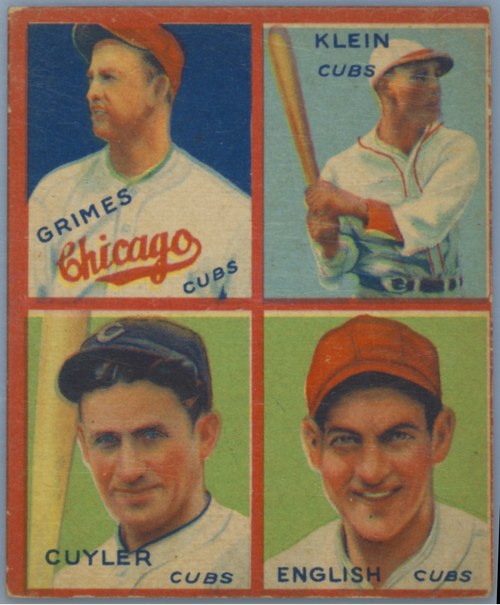
1935 Goudey 4-in-1 #11 — Burleigh Grimes / Chuck Klein / Kiki Cuyler / Woody English
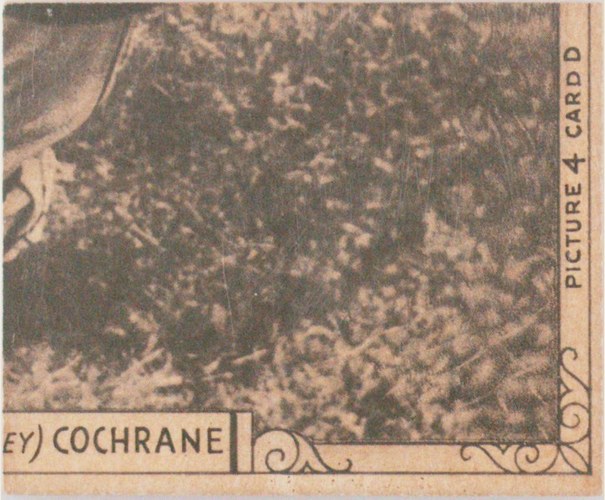
The backs of 1935 Goudey cards are puzzle pieces, not player bios: each is marked "PICTURE N — CARD X" and builds one of the set's nine puzzles. This front was printed with 4 different backs (1F, 3D, 4D, 5D), so it counts 4 entries toward the 114-combination master set.
Puzzles 1-7 were each printed twice with different front panels, and one side of each pairing is much scarcer: for this front, 4D is the short-printed combo (per Beckett's tags and the Dec 1995 VCBC press-panel analysis).
The card & its puzzle backs



About Burleigh Grimes
Burleigh Arland Grimes clawed out of Wisconsin's lumber camps and into pro ball with Eau Claire in 1912, reached Pittsburgh in 1916, then blossomed after Brooklyn landed him as a throw-in in the January 1918 Al Mamaux trade. When baseball outlawed the spitball in 1920, Grimes was one of 17 pitchers grandfathered to keep throwing it — and he outlasted them all as the last legal spitballer. The slippery elm he chewed to load the pitch irritated his skin, so he skipped shaving on days he pitched; the glowering stubble earned him the nickname "Ol' Stubblebeard." Across 19 seasons and seven clubs he went 270-212 with five 20-win years, won more games in the 1920s (190) than any other pitcher, and reached four World Series with Brooklyn (1920), St. Louis (1930-31), and the Cubs (1932) — gutting out 8 1/3 innings on a dislocated vertebra to win Game 7 of the 1931 classic for the Cardinals. This 4-in-1 slots him into an all-Cubs quartet with Chuck Klein, Kiki Cuyler, and Woody English, showing him with his 1932-33 club just after his final big-league pitch in September 1934. He managed the Dodgers in 1937-38 and entered the Hall of Fame in 1964.
Sources: Wikipedia · Baseball-Reference · SABR
About Chuck Klein
Charles Herbert Klein swung his way out of an Indianapolis steel mill, where three years heaving 200-pound ingots forged the power that had Philadelphia sportswriters calling him the “Babe Ruth of the National League” by 1929. Purchased from Fort Wayne in July 1928 after Commissioner Landis broke up the Cardinals’ farm arrangement, the lefty-swinging right fielder gave the Phillies five staggering seasons: an NL-record 43 home runs in 1929, a .386, 250-hit, 170-RBI 1930, four home run crowns, the 1932 MVP, and the 1933 Triple Crown (.368, 28 homers, 120 RBI). Dealt to Chicago for three players and $65,000, he shares this 4-in-1 panel with Burleigh Grimes, Kiki Cuyler, and Woody English as a Cub in his final full Chicago season — 1935, when the Cubs stormed to the pennant and his two-run homer off Schoolboy Rowe won Game 5 of the World Series, 3-1. Traded back to Philadelphia in May 1936, he hit four home runs in a game at Forbes Field that July 10, just the fourth player ever. Klein retired in 1944 at .320 with 2,076 hits and 300 home runs; the Veterans Committee sent him to Cooperstown in 1980.
Sources: Wikipedia · Baseball-Reference · SABR
About Kiki Cuyler
Hazen Shirley “Kiki” Cuyler — the nickname rhymes with “eye-eye,” born in Nashville in 1923 when the shortstop's cry of “Cuy!” was echoed around the infield until fans and newspapers doubled it — was the National League's great marriage of speed and line-drive power. A .321 lifetime hitter with 2,299 hits, he topped .350 four times and led the league in steals four times on his way to 328. His 1925 season carried Pittsburgh to a championship: .357, a post-1900 NL-record 144 runs, 26 triples, and finally a bases-loaded, two-run double off Walter Johnson in the eighth inning of World Series Game 7 — the hit that won it, 9-7. Mysteriously benched by Donie Bush in 1927, he was traded to Chicago and anchored Cubs pennant winners in 1929 and 1932. This 4-in-1 panel pictures him as a Cub beside Woody English — the teammate he singled home in Game 3 of the '29 Series — plus Burleigh Grimes and Chuck Klein, and the timing stings: Chicago released Cuyler in mid-1935, and he promptly hit .326 for Cincinnati in 1936. He retired after 1938 with Brooklyn and entered the Hall of Fame in 1968.
Sources: Wikipedia · Baseball-Reference · SABR
About Woody English
An Ohio farm kid, Elwood “Woody” English hit .301 for Toledo under Casey Stengel's tutelage, and the Cubs paid $50,000 to make him their shortstop by mid-1927. The 155-pound leadoff man scored 131 runs for the 1929 pennant winners, then peaked in 1930: .335 with 214 hits, 100 walks, 152 runs, and 755 plate appearances — a big-league record until 1938. Named Cubs captain in 1932, he was playing third base for Babe Ruth's World Series “called shot” and insisted ever after that Ruth merely held up two fingers — “That's only two strikes.” He called the inaugural 1933 All-Star Game his biggest thrill. Goudey's four-in-one panel places English beside three future Hall of Famers — Kiki Cuyler, Chuck Klein, and Burleigh Grimes — just as 1935 injuries held him to 34 games and kept him out of that fall's World Series. Grimes proved prophetic, telling English after 1936 he'd be a Dodger, then managing him in Brooklyn in 1937. English retired in 1938 with a .286 average and 1,356 hits, and later managed the Grand Rapids Chicks to the 1953 All-American Girls Professional Baseball League title.
Sources: Wikipedia · Baseball-Reference · SABR
Graded population (PSA & SGC)
| Grader | Total | 10 | 9 | 8 | 7 | 6 | 5 | 1-4 | Auth |
|---|---|---|---|---|---|---|---|---|---|
| PSA | 163 | 0 | 0 | 2 | 7 | 9 | 27 | 115 | 3 |
| SGC | 59 | 0 | 0 | 0 | 0 | 0 | 5 | 51 | 3 |
Graded population — a scarcity guide, not a price. Snapshot 2026-08-06. PSA counts are straight grades only; PSA half-grade and qualified slabs are not included. SGC half grades fold down (8.5→8). Totals are summed across this front's graded back combinations.
PSA by back: 1F 52 · 3D 57 · 4D (SP) 24 · 5D 30
SGC by back: 1F 29 · 3D 22 · 4D (SP) 4 · 5D 4
Find this card
Search T206 Cards Buy It Now on eBay eBay auctions ending soon Sold prices
As an eBay Partner Network affiliate, T206Cards.com may earn from qualifying purchases.
Related cards
Other fronts in the same puzzle pictures:
- #1 Charlie Berry / Bobby Burke / Red Kress / Dazzy Vance
- #4 Mickey Cochrane / Charlie Gehringer / Tommy Bridges / Billy Rogell
- #5 Hughie Critz / Dick Bartell / Mel Ott / Gus Mancuso
- #6 Joe Cronin / Carl Reynolds / Max Bishop / Bill Cissell
- #8 George Earnshaw / Jimmy Dykes / Luke Sewell / Luke Appling
- #10 Frankie Frisch / Dizzy Dean / Ernie Orsatti / Tex Carleton
- #14 Willis Hudlin / Glenn Myatt / Adam Comorosky / Jim Bottomley
- #16 Willie Kamm / Oral Hildebrand / Earl Averill / Hal Trosky
Frequently asked questions
What is the 1935 Goudey 4-in-1 Grimes/Klein/Cuyler/English card?
It is one of the 36 unnumbered fronts of the 1935 Goudey 4-in-1 set (R321), picturing Burleigh Grimes / Chuck Klein / Kiki Cuyler / Woody English. The 2-3/8 by 2-7/8 inch card carries four color portraits on the front and a puzzle piece on the back. Checklists that number the set (Old Cardboard / the Burdick Collection convention, alphabetical by the upper-left player) list it as #11 of 36.
How many backs does this card have?
4: 1F, 3D, 4D, 5D. Every 1935 Goudey front was printed with two to four different puzzle-piece backs, and collectors chasing the 114-combination master set track each front/back pairing separately. The 4D printing is short prints per Beckett and the VCBC press-panel analysis.
How many cards are in the 1935 Goudey 4-in-1 set?
36 fronts, each with four players (144 panels picturing 138 different men). Counting the two-to-four puzzle backs each front was printed with, the master set runs to 114 front/back combinations, 42 of them short prints. A complete set of all nine puzzles requires 72 different backs.
Sources: Trading Card Database, Old Cardboard, the Burdick Collection catalog (Metropolitan Museum of Art), SABR Baseball Cards research, Baseball-Reference, PSA & SGC population reports, and the Dec 1995 VCBC press-panel analysis. Card data compiled and maintained by T206Cards.com. Page last updated 2026-10-05.