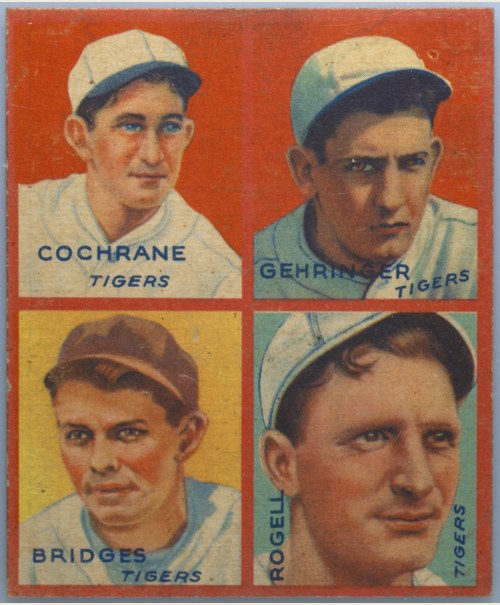
1935 Goudey 4-in-1 #4 — Mickey Cochrane / Charlie Gehringer / Tommy Bridges / Billy Rogell
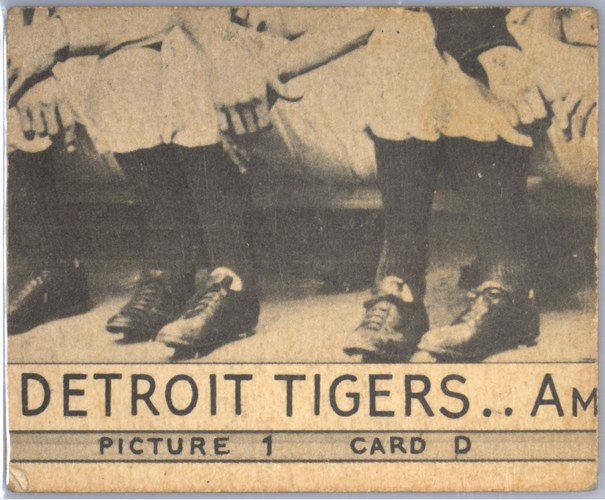
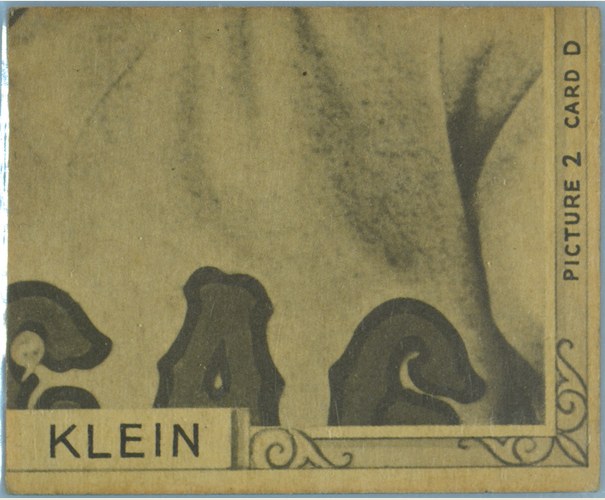
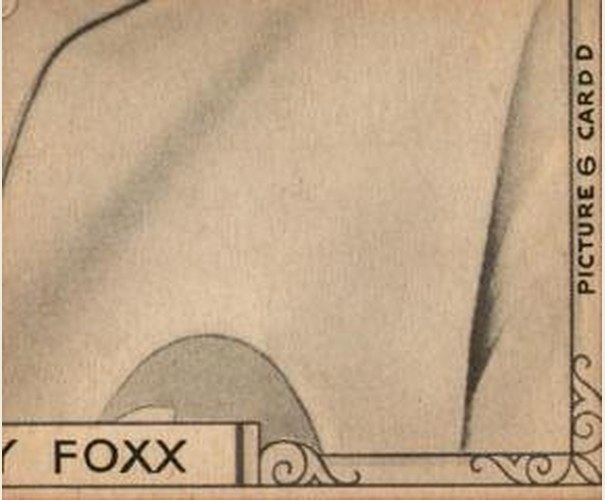
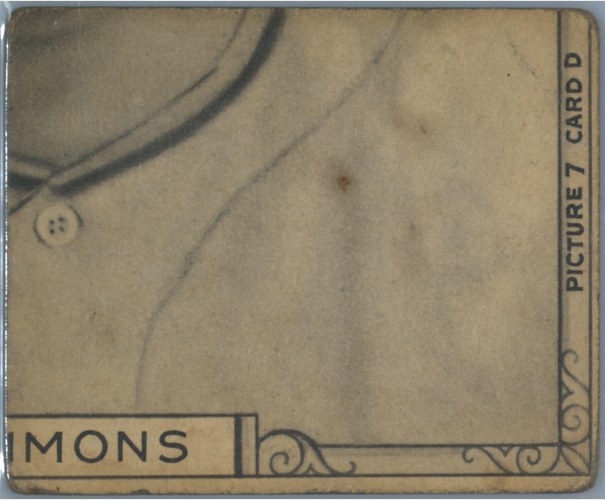
The backs of 1935 Goudey cards are puzzle pieces, not player bios: each is marked "PICTURE N — CARD X" and builds one of the set's nine puzzles. This front was printed with 4 different backs (1D, 2D, 6D, 7D), so it counts 4 entries toward the 114-combination master set.
Puzzles 1-7 were each printed twice with different front panels, and one side of each pairing is much scarcer: for this front, 2D, 7D are the short-printed combos (per Beckett's tags and the Dec 1995 VCBC press-panel analysis).
The card & its puzzle backs
About Mickey Cochrane
Gordon Stanley Cochrane got “Mickey” in 1923 when Portland signed him out of Boston University and took the Scottish kid for an Irish “mick”; his fiery temperament added the darker “Black Mike.” One minor-league season later he was Connie Mack’s catcher — a .331 rookie in 1925, the 1928 AL MVP, and anchor of three straight pennant winners from 1929–31, world champions the first two. Sold to Detroit in Mack’s Depression-era selloff, the new player-manager won a second MVP driving the 1934 Tigers to 101 wins and a first pennant in 25 years, then delivered Detroit’s first world championship in 1935, scoring the Series-winning run himself on Goose Goslin’s ninth-inning single in Game 6. His .320 career average remains the best ever by a catcher. One of just six players with two fronts in this 36-card set, he shares card #4 with Gehringer, Rogell, and Game 6 hero Tommy Bridges, and #25’s three-team panel with old A’s mate Al Simmons — all four #25 back combos short prints. A near-fatal Bump Hadley beaning ended his career in May 1937; in 1947 he became the first catcher the baseball writers elected to the Hall of Fame. Mickey Mantle was named for him.
Sources: Wikipedia · Baseball-Reference · SABR
About Charlie Gehringer
The "Mechanical Man" anchored second base for the Detroit Tigers for 19 seasons, 1924–42 — a nickname Gehringer credited to Yankees pitcher Lefty Gomez, who quipped that you wind him up in the spring, shut him off in the fall, and in between he hits .340. Tigers outfielder Bobby Veach arranged his 1923 Navin Field tryout, where Ty Cobb was so impressed he rushed upstairs still in uniform to have owner Frank Navin sign the University of Michigan product on the spot. After minor-league seasoning at London and Toronto, Gehringer became the game’s model of consistency: a .320 lifetime average, 2,839 hits, seven 200-hit seasons, and a start in each of the first six All-Star Games. He batted .356 for the 1934 pennant winners, hit .375 in the 1935 World Series win over the Cubs — Detroit’s first championship — and took the 1937 AL MVP and batting title at .371. This 4-in-1 panel doubles as a championship-Tigers keepsake, grouping him with player-manager Mickey Cochrane, Tommy Bridges, and Billy Rogell, his double-play partner for over 1,000 games. Cooperstown called in 1949, and Detroit retired his No. 2 in 1983.
Sources: Wikipedia · Baseball-Reference · SABR
About Tommy Bridges
Thomas Jefferson Davis Bridges packed the American League's best curveball into a 5-foot-10, 155-pound frame. Signed away from the University of Tennessee by Tigers scout Billy Doyle in 1929, the Gordonsville, Tennessee righthander debuted in August 1930 by retiring Babe Ruth on a pop fly, and never pitched for another big-league club, going 194–138 with 1,674 strikeouts across sixteen Detroit seasons. He reeled off three straight 20-win years in 1934–36, led the AL with 23 victories in 1936, took back-to-back strikeout crowns in 1935–36, and made six All-Star teams. In 1932 he came within one out of a perfect game before pinch-hitter Dave Harris singled. His masterpiece was Game 6 of the 1935 World Series: with the ninth inning tied 3–3, he stranded Stan Hack's leadoff triple, and Goose Goslin's two-out single then crowned Detroit champions — manager Mickey Cochrane saluted “150 pounds of courage.” This 4-in-1 panel is that title team in miniature, grouping Bridges with Cochrane, Gehringer, and Rogell in the very season of the Tigers' first championship. Army service claimed 1944, but he returned in time for a second ring in 1945.
Sources: Wikipedia · Baseball-Reference · SABR
About Billy Rogell
Up from Chicago’s semipro sandlots via the Southwestern League, Billy Rogell debuted with the Red Sox in 1925, but the switch-hitting shortstop found his home in Detroit (1930–39) before closing with the 1940 Cubs. Nicknamed “The Fire Chief” for his combative intensity, he anchored the “Battalion of Death” infield beside Hank Greenberg, Charlie Gehringer, and Marv Owen, driving in a career-high 99 runs in 1934 and playing that World Series on a broken ankle — his relay throw famously felled pinch-runner Dizzy Dean, prompting the quip, “If I’d have known his head was there, I would have thrown the ball harder.” He led AL shortstops in fielding percentage 1935–37 and batted .292 as Detroit won its first title in the 1935 Series. Goudey’s all-Tigers panel sets him lower-right beside Cochrane, Bridges, and double-play partner Gehringer — a quadrant of champions issued in their title year. A .267 hitter with 1,375 hits over 14 seasons, Rogell then served 36 years on Detroit’s City Council; the drive into the airport he helped build still bears his name.
Sources: Wikipedia · Baseball-Reference · SABR
Graded population (PSA & SGC)
| Grader | Total | 10 | 9 | 8 | 7 | 6 | 5 | 1-4 | Auth |
|---|---|---|---|---|---|---|---|---|---|
| PSA | 170 | 0 | 0 | 3 | 6 | 14 | 18 | 127 | 2 |
| SGC | 93 | 0 | 0 | 0 | 0 | 1 | 10 | 74 | 8 |
Graded population — a scarcity guide, not a price. Snapshot 2026-08-06. PSA counts are straight grades only; PSA half-grade and qualified slabs are not included. SGC half grades fold down (8.5→8). Totals are summed across this front's graded back combinations.
PSA by back: 1D 75 · 2D (SP) 67 · 6D 12 · 7D (SP) 16
SGC by back: 1D 48 · 2D (SP) 41 · 6D 3 · 7D (SP) 1
Find this card
Search T206 Cards Buy It Now on eBay eBay auctions ending soon Sold prices
As an eBay Partner Network affiliate, T206Cards.com may earn from qualifying purchases.
Related cards
Mickey Cochrane also appears on: #25 Muddy Ruel / Al Simmons / Willie Kamm / Mickey Cochrane
More Detroit Tigers cards:
- #9 Pete Fox / Hank Greenberg / Gee Walker / Schoolboy Rowe
- #25 Muddy Ruel / Al Simmons / Willie Kamm / Mickey Cochrane
- #28 Heinie Schuble / Firpo Marberry / Goose Goslin / Alvin Crowder
Other fronts in the same puzzle pictures:
- #1 Charlie Berry / Bobby Burke / Red Kress / Dazzy Vance
- #5 Hughie Critz / Dick Bartell / Mel Ott / Gus Mancuso
- #6 Joe Cronin / Carl Reynolds / Max Bishop / Bill Cissell
- #8 George Earnshaw / Jimmy Dykes / Luke Sewell / Luke Appling
- #10 Frankie Frisch / Dizzy Dean / Ernie Orsatti / Tex Carleton
- #11 Burleigh Grimes / Chuck Klein / Kiki Cuyler / Woody English
- #14 Willis Hudlin / Glenn Myatt / Adam Comorosky / Jim Bottomley
- #16 Willie Kamm / Oral Hildebrand / Earl Averill / Hal Trosky
Frequently asked questions
What is the 1935 Goudey 4-in-1 Cochrane/Gehringer/Bridges/Rogell card?
It is one of the 36 unnumbered fronts of the 1935 Goudey 4-in-1 set (R321), picturing Mickey Cochrane / Charlie Gehringer / Tommy Bridges / Billy Rogell. The 2-3/8 by 2-7/8 inch card carries four color portraits on the front and a puzzle piece on the back. Checklists that number the set (Old Cardboard / the Burdick Collection convention, alphabetical by the upper-left player) list it as #4 of 36.
How many backs does this card have?
4: 1D, 2D, 6D, 7D. Every 1935 Goudey front was printed with two to four different puzzle-piece backs, and collectors chasing the 114-combination master set track each front/back pairing separately. The 2D, 7D printings are short prints per Beckett and the VCBC press-panel analysis.
How many cards are in the 1935 Goudey 4-in-1 set?
36 fronts, each with four players (144 panels picturing 138 different men). Counting the two-to-four puzzle backs each front was printed with, the master set runs to 114 front/back combinations, 42 of them short prints. A complete set of all nine puzzles requires 72 different backs.
Sources: Trading Card Database, Old Cardboard, the Burdick Collection catalog (Metropolitan Museum of Art), SABR Baseball Cards research, Baseball-Reference, PSA & SGC population reports, and the Dec 1995 VCBC press-panel analysis. Card data compiled and maintained by T206Cards.com. Page last updated 2026-10-05.