
1952 Topps #153 Bob Rush

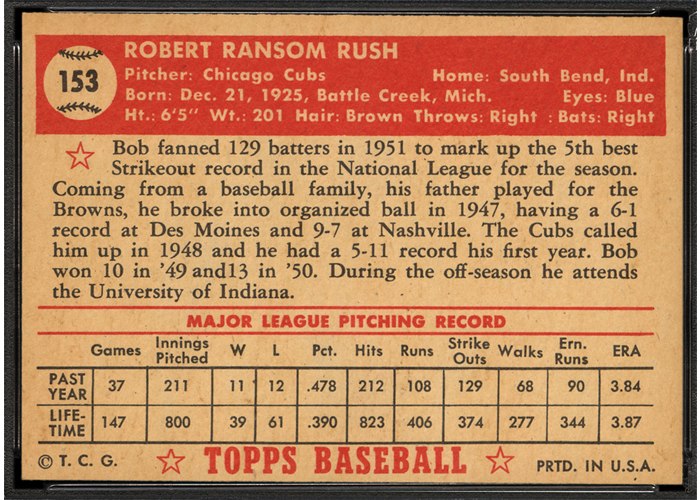
About Bob Rush
A World War II combat veteran who served in Europe under General Patton's Third Army, Bob Rush signed with the Chicago Cubs and needed only one season in the minors before reaching the majors in 1948. The 6-foot-4 right-handed pitcher spent ten years as a Cubs starter (1948-1957) before finishing with the Milwaukee Braves (1958-1960) and briefly the Chicago White Sox in 1960. Over 13 seasons he went 127-152 with a 3.65 ERA, 1,244 strikeouts, 118 complete games and 16 shutouts across 2,410.2 innings. He earned two National League All-Star selections, in 1950 and 1952, with his finest year coming in 1952, when he won 17 games with a 2.70 ERA and completed every one of his victories. Though he anchored second-division Cubs staffs for a decade, Rush did not reach the postseason until Milwaukee, starting Game 3 of the 1958 World Series at Yankee Stadium and yielding just three hits over six innings in a 4-0 loss. He died in Mesa, Arizona, in 2011 at age 85. On this classic first-year Topps flagship card, #153 appears in the third series and is a common with a documented back-stock variation, found with both white and gray card backs.
Sources: Wikipedia · Baseball-Reference · SABR
Variations & how to tell them apart
White Back / Gray Back Series 3 (cards 131-190)
The third series exists on two different card stocks. The standard issue is on white/cream stock; a much scarcer parallel was printed on gray cardboard. The gray stock was used at the END of the series-3 run — leftover stock run through the same press, not a separate or foreign printing. Gray backs have a duller, gloss-less front and are never found with gum stains.
- White Back: Standard issue. White/cream card stock, normal red-ink back. Sharper, glossier front.
- Gray Back — scarcer: Scarce parallel on gray card stock. Duller, gloss-less front; never gum-stained. #189 Pete Reiser is the rarest of the run; #146 Frank House appears with a pale/yellow Tiger logo. NOTE: long mislabeled 'Canadian' (borrowed from the genuinely-Canadian 1954 Topps issue) — there is no evidence the 1952 grays were a Canadian release. TCDB catalogs these as 'Grey Back' against the normal 'Red Back'.
Graded population (PSA & SGC)
| Grader | Total | 10 | 9 | 8 | 7 | 6 | 5 | 1-4 | Auth |
|---|---|---|---|---|---|---|---|---|---|
| PSA | 765 | 0 | 4 | 45 | 126 | 200 | 158 | 228 | 4 |
| SGC | 108 | 0 | 0 | 2 | 8 | 13 | 35 | 49 | 1 |
SGC by variation: Standard 105 · Gray Back 3
Graded population — a scarcity guide, not a price. Snapshot 2026-06-22. Half grades fold down for both graders (8.5→8); PSA qualified slabs (OC, ST, PD, MC and the like) are not counted. Totals are summed across each grader's listed variations.
Find this card
Search T206 Cards Live auctions Buy It Now Sold prices
As an eBay Partner Network affiliate, T206Cards.com may earn from qualifying purchases.
More Chicago Cubs cards
- Gene Hermanski
- Hank Sauer
- John Pramesa
- Dutch Leonard
- Willard Ramsdell
- Paul Minner
- Johnny Klippstein
- Bob Usher
- Walt Dubiel
- Eddie Miksis
- Roy Smalley
- Bob Ramazzotti
- Joe Hatten
- Ron Northey
Frequently asked questions
What is the 1952 Topps Bob Rush card?
It is card #153 of 407 in the 1952 Topps set - Topps' first flagship issue and the cornerstone of the postwar hobby. It pictures the Chicago Cubs player.
Does the 1952 Topps Bob Rush have back variations?
Yes. The third series exists on two different card stocks. The standard issue is on white/cream stock; a much scarcer parallel was printed on gray cardboard. The gray stock was used at the END of the series-3 run — leftover stock run through the same press, not a separate or foreign printing. Gray backs have a duller, gloss-less front and are never found with gum stains.
Is the 1952 Topps Bob Rush valuable?
Value depends on grade and (where it applies) the back variation. Use the links above to check current T206 Cards inventory and live eBay listings.
Sources: the Trading Card Database, Baseball-Reference, and PSA & SGC population reports. Card data & population compiled and maintained by T206Cards.com. Page last updated 2026-10-05.