
1952 Topps #134 Joe Tipton
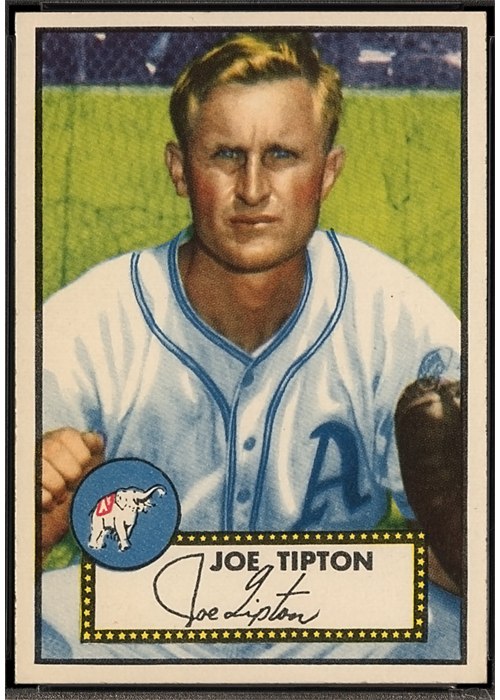

About Joe Tipton
Joe Tipton was a right-handed catcher discovered on the McCaysville, Georgia sandlots by Cleveland scout Art Decatur, signing in 1941 and converting from shortstop to catcher in the minors before Navy service aboard the USS Kadashan Bay in the Pacific during World War II. He debuted with the Cleveland Indians in 1948, batting .310 in 19 games and earning a ring as Cleveland won the World Series, then played seven big-league seasons (1948-1954) with the Indians, Chicago White Sox, Philadelphia Athletics, and Washington Senators. A backup for most of his career, Tipton hit .236 with 29 home runs and 125 RBI over 417 games, showing a strong arm behind the plate. He is best remembered as the answer to a trivia question no player wants: in an October 1949 deal, White Sox GM "Trader" Frank Lane sent Tipton to the Athletics for a little-known infielder named Nellie Fox — who became a 12-time All-Star and Hall of Famer, making it one of the most lopsided trades in baseball history. Known for his volatile temperament and relentless bench-jockeying, Tipton so needled Ted Williams that Williams reportedly urged the A's to "take Tipton with you" when they left town. This #134 card falls in the low-number series, and like other early-run 1952 Topps cards it exists with both white and gray back stock.
Sources: Wikipedia · Baseball-Reference · SABR
Variations & how to tell them apart
White Back / Gray Back Series 3 (cards 131-190)
The third series exists on two different card stocks. The standard issue is on white/cream stock; a much scarcer parallel was printed on gray cardboard. The gray stock was used at the END of the series-3 run — leftover stock run through the same press, not a separate or foreign printing. Gray backs have a duller, gloss-less front and are never found with gum stains.
- White Back: Standard issue. White/cream card stock, normal red-ink back. Sharper, glossier front.
- Gray Back — scarcer: Scarce parallel on gray card stock. Duller, gloss-less front; never gum-stained. #189 Pete Reiser is the rarest of the run; #146 Frank House appears with a pale/yellow Tiger logo. NOTE: long mislabeled 'Canadian' (borrowed from the genuinely-Canadian 1954 Topps issue) — there is no evidence the 1952 grays were a Canadian release. TCDB catalogs these as 'Grey Back' against the normal 'Red Back'.
Graded population (PSA & SGC)
| Grader | Total | 10 | 9 | 8 | 7 | 6 | 5 | 1-4 | Auth |
|---|---|---|---|---|---|---|---|---|---|
| PSA | 745 | 0 | 1 | 57 | 138 | 152 | 157 | 236 | 4 |
| SGC | 85 | 0 | 0 | 2 | 6 | 11 | 30 | 33 | 3 |
SGC by variation: Standard 84 · Gray Back 1
Graded population — a scarcity guide, not a price. Snapshot 2026-06-22. Half grades fold down for both graders (8.5→8); PSA qualified slabs (OC, ST, PD, MC and the like) are not counted. Totals are summed across each grader's listed variations.
Find this card
Search T206 Cards Live auctions Buy It Now Sold prices
As an eBay Partner Network affiliate, T206Cards.com may earn from qualifying purchases.
More Philadelphia Athletics cards
- Ferris Fain
- Gus Zernial
- Elmer Valo
- Bob Wellman
- Eddie Joost
- Hank Majeski
- Carl Scheib
- Morrie Martin
- Billy Hitchcock
- Alex Kellner
- Dick Fowler
- Bobby Shantz
- Dave Philley
- Sam Zoldak
Frequently asked questions
What is the 1952 Topps Joe Tipton card?
It is card #134 of 407 in the 1952 Topps set - Topps' first flagship issue and the cornerstone of the postwar hobby. It pictures the Philadelphia Athletics player.
Does the 1952 Topps Joe Tipton have back variations?
Yes. The third series exists on two different card stocks. The standard issue is on white/cream stock; a much scarcer parallel was printed on gray cardboard. The gray stock was used at the END of the series-3 run — leftover stock run through the same press, not a separate or foreign printing. Gray backs have a duller, gloss-less front and are never found with gum stains.
Is the 1952 Topps Joe Tipton valuable?
Value depends on grade and (where it applies) the back variation. Use the links above to check current T206 Cards inventory and live eBay listings.
Sources: the Trading Card Database, Baseball-Reference, and PSA & SGC population reports. Card data & population compiled and maintained by T206Cards.com. Page last updated 2026-10-05.