
1952 Topps #21 Ferris Fain
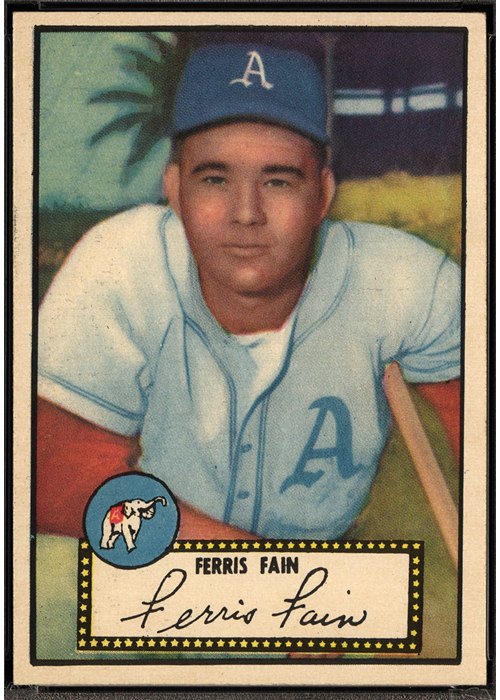
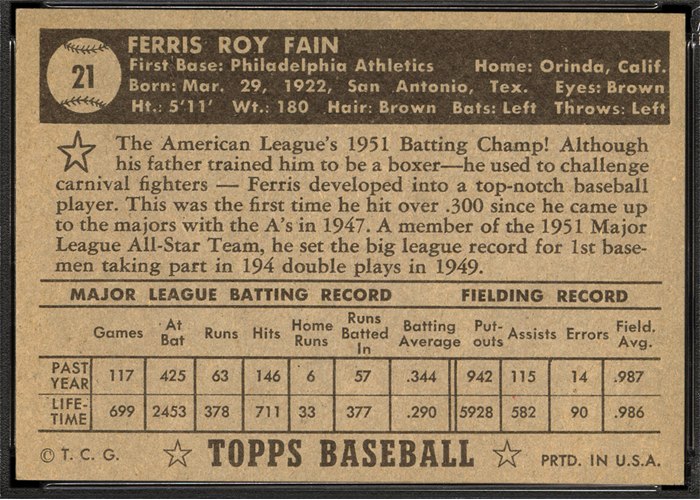
About Ferris Fain
Ferris Roy Fain was a left-handed first baseman who first signed with the Pacific Coast League's San Francisco Seals in 1939 before Connie Mack purchased his contract for the Philadelphia Athletics, with whom he debuted as a 26-year-old rookie in 1947. Over nine major-league seasons (1947-1955) he played for the Athletics, Chicago White Sox, Detroit Tigers, and Cleveland Indians, earning five consecutive All-Star selections from 1950 through 1954. Fain's calling card was his batting eye: he won back-to-back American League batting titles, hitting .344 in 1951 and .327 in 1952, and his career .424 on-base percentage still ranks among the highest in big-league history. He batted .290 for his career with 1,139 hits, 48 home runs, and 570 RBI, and was widely regarded as one of the finest fielding first basemen of his era, praised for his catlike range and aggressive play around the bag. Nicknamed "Burrhead" for his short, kinky hair (and earlier "Cocky" in the minors for his brash confidence), the hot-tempered Fain famously broke his hand in a 1952 tavern fight and hid the injury from manager Jimmie Dykes. When the cash-strapped Athletics dealt him to the White Sox after that season, he became the first reigning batting champion ever traded in AL history. This Series 1 card exists with two back-color variations, black and red, and is not part of the scarce #311-407 high-number series. Fain died in 2001.
Sources: Wikipedia · Baseball-Reference · SABR
Variations & how to tell them apart
Black Back / Red Back Series 1 (cards 1-80)
Every card in the first series exists with the back printed in either black or red ink. The black backs are the first printing and are scarcer; red backs (the second printing onward) are more common.
- Black Back — scarcer: First printing. Reverse printed in black ink. Scarcer, and typically carries a small premium over the red back.
- Red Back: Second printing onward. Reverse printed in red ink. The more common of the two.
Graded population (PSA & SGC)
| Grader | Total | 10 | 9 | 8 | 7 | 6 | 5 | 1-4 | Auth |
|---|---|---|---|---|---|---|---|---|---|
| PSA | 882 | 0 | 2 | 40 | 113 | 179 | 198 | 345 | 5 |
| SGC | 119 | 0 | 0 | 1 | 7 | 11 | 23 | 75 | 2 |
SGC by variation: Black Back 63 · Red Back 56
Graded population — a scarcity guide, not a price. Snapshot 2026-06-22. Half grades fold down for both graders (8.5→8); PSA qualified slabs (OC, ST, PD, MC and the like) are not counted. Totals are summed across each grader's listed variations.
Find this card
Search T206 Cards Live auctions Buy It Now Sold prices
As an eBay Partner Network affiliate, T206Cards.com may earn from qualifying purchases.
More Philadelphia Athletics cards
- Gus Zernial
- Elmer Valo
- Bob Wellman
- Eddie Joost
- Hank Majeski
- Carl Scheib
- Morrie Martin
- Joe Tipton
- Billy Hitchcock
- Alex Kellner
- Dick Fowler
- Bobby Shantz
- Dave Philley
- Sam Zoldak
Frequently asked questions
What is the 1952 Topps Ferris Fain card?
It is card #21 of 407 in the 1952 Topps set - Topps' first flagship issue and the cornerstone of the postwar hobby. It pictures the Philadelphia Athletics player.
Does the 1952 Topps Ferris Fain have back variations?
Yes. Every card in the first series exists with the back printed in either black or red ink. The black backs are the first printing and are scarcer; red backs (the second printing onward) are more common.
Is the 1952 Topps Ferris Fain valuable?
Value depends on grade and (where it applies) the back variation. Use the links above to check current T206 Cards inventory and live eBay listings.
Sources: the Trading Card Database, Baseball-Reference, and PSA & SGC population reports. Card data & population compiled and maintained by T206Cards.com. Page last updated 2026-10-05.