
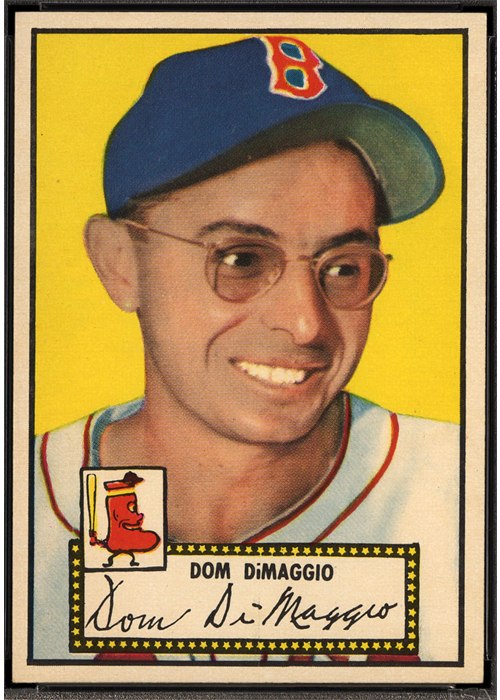
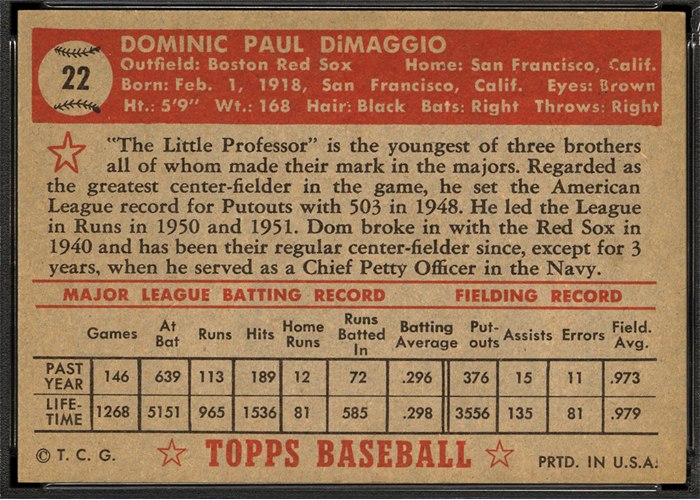
1952 Topps #22 Dom DiMaggio
About Dom DiMaggio
Dominic Paul DiMaggio, the youngest of three brothers who each became big-league center fielders (Hall of Famer Joe and Vince), broke in with the hometown San Francisco Seals of the Pacific Coast League in 1937; after a standout 1939 season (a .361 average and PCL MVP), the Boston Red Sox purchased his contract for $75,000. He spent his entire 11-year career with Boston (1940-1942, 1946-1953), losing three prime seasons to U.S. Navy service in World War II, and finished with a .298 average and 1,680 hits over 1,399 games. A seven-time All-Star (1941, 1942, 1946, 1949-1952), he led the American League in runs scored twice and set a still-standing Red Sox record with a 34-game hitting streak in 1949. Nicknamed "The Little Professor" for his 5-foot-9 frame, serious demeanor, and eyeglasses, he starred in the 1946 World Series but pulled a hamstring on a game-tying double in Game 7; his replacement in center couldn't cut off the throw as Enos Slaughter made his famous "Mad Dash" to score the Series-winning run for St. Louis. Long considered a Hall of Fame near-miss, DiMaggio was elected to the Red Sox Hall of Fame in 1995 but never inducted at Cooperstown. On card #22 in the landmark first Topps flagship set, DiMaggio appears in the low-number Series 1, well clear of the scarce, sought-after high-number series (#311-407) that includes the iconic Mickey Mantle #311.
Sources: Wikipedia · Baseball-Reference · SABR
Variations & how to tell them apart
Black Back / Red Back Series 1 (cards 1-80)
Every card in the first series exists with the back printed in either black or red ink. The black backs are the first printing and are scarcer; red backs (the second printing onward) are more common.
- Black Back — scarcer: First printing. Reverse printed in black ink. Scarcer, and typically carries a small premium over the red back.
- Red Back: Second printing onward. Reverse printed in red ink. The more common of the two.
Graded population (PSA & SGC)
| Grader | Total | 10 | 9 | 8 | 7 | 6 | 5 | 1-4 | Auth |
|---|---|---|---|---|---|---|---|---|---|
| PSA | 1,067 | 0 | 5 | 31 | 55 | 138 | 192 | 641 | 5 |
| SGC | 278 | 0 | 0 | 1 | 6 | 8 | 42 | 213 | 8 |
SGC by variation: Black Back 125 · Red Back 153
Graded population — a scarcity guide, not a price. Snapshot 2026-06-22. Half grades fold down for both graders (8.5→8); PSA qualified slabs (OC, ST, PD, MC and the like) are not counted. Totals are summed across each grader's listed variations.
Find this card
Search T206 Cards Live auctions Buy It Now Sold prices
As an eBay Partner Network affiliate, T206Cards.com may earn from qualifying purchases.
More Boston Red Sox cards
- Don Lenhardt
- Johnny Pesky
- Billy Goodman
- Mel Parnell
- Ray Scarborough
- Leo Kiely
- Karl Olson
- Ellis Kinder
- Vern Stephens
- Maurice McDermott
- Gus Niarhos
- Ken Wood
- Al Evans
- Bill Wight
Frequently asked questions
What is the 1952 Topps Dom DiMaggio card?
It is card #22 of 407 in the 1952 Topps set - Topps' first flagship issue and the cornerstone of the postwar hobby. It pictures the Boston Red Sox player.
Does the 1952 Topps Dom DiMaggio have back variations?
Yes. Every card in the first series exists with the back printed in either black or red ink. The black backs are the first printing and are scarcer; red backs (the second printing onward) are more common.
Is the 1952 Topps Dom DiMaggio valuable?
Value depends on grade and (where it applies) the back variation. Use the links above to check current T206 Cards inventory and live eBay listings.
Sources: the Trading Card Database, Baseball-Reference, and PSA & SGC population reports. Card data & population compiled and maintained by T206Cards.com. Page last updated 2026-10-05.