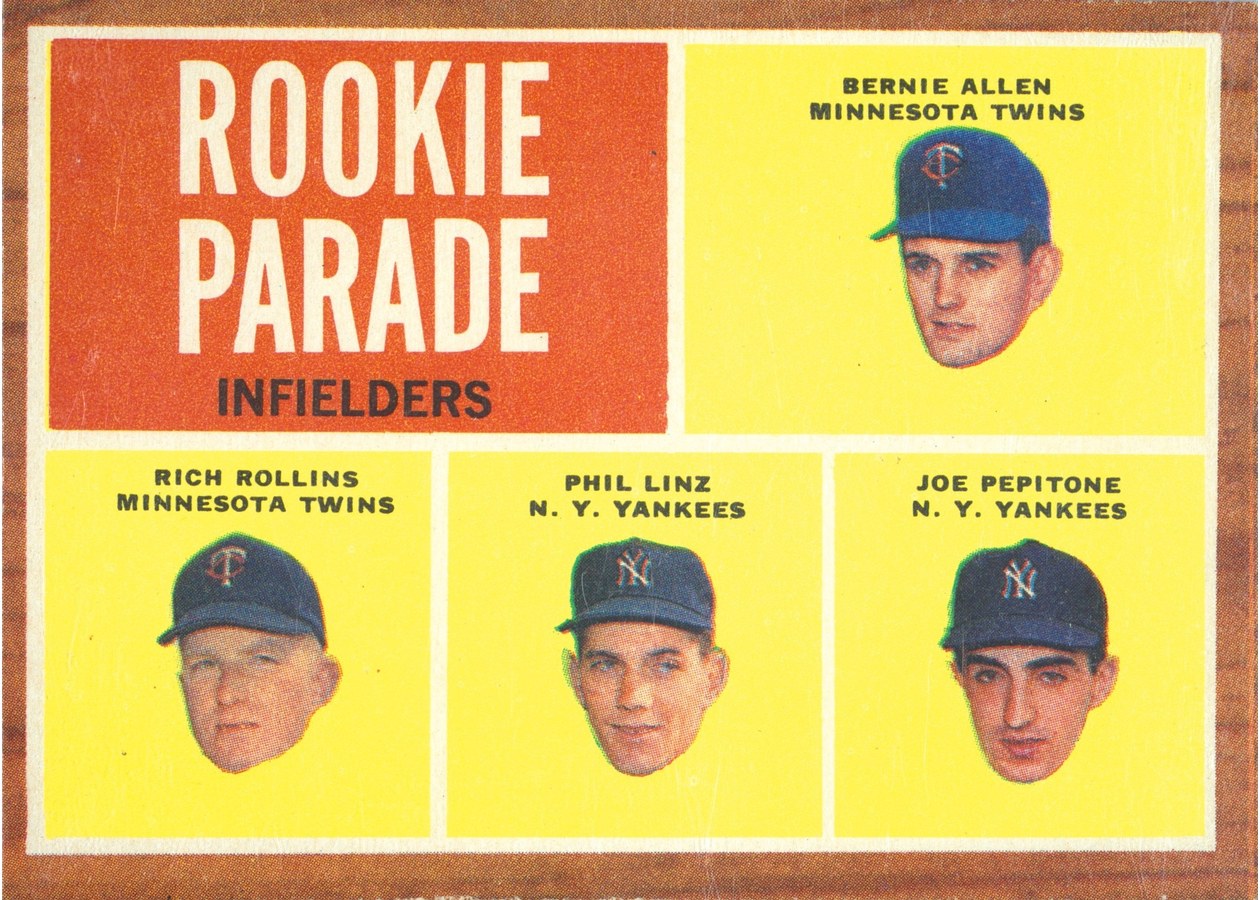
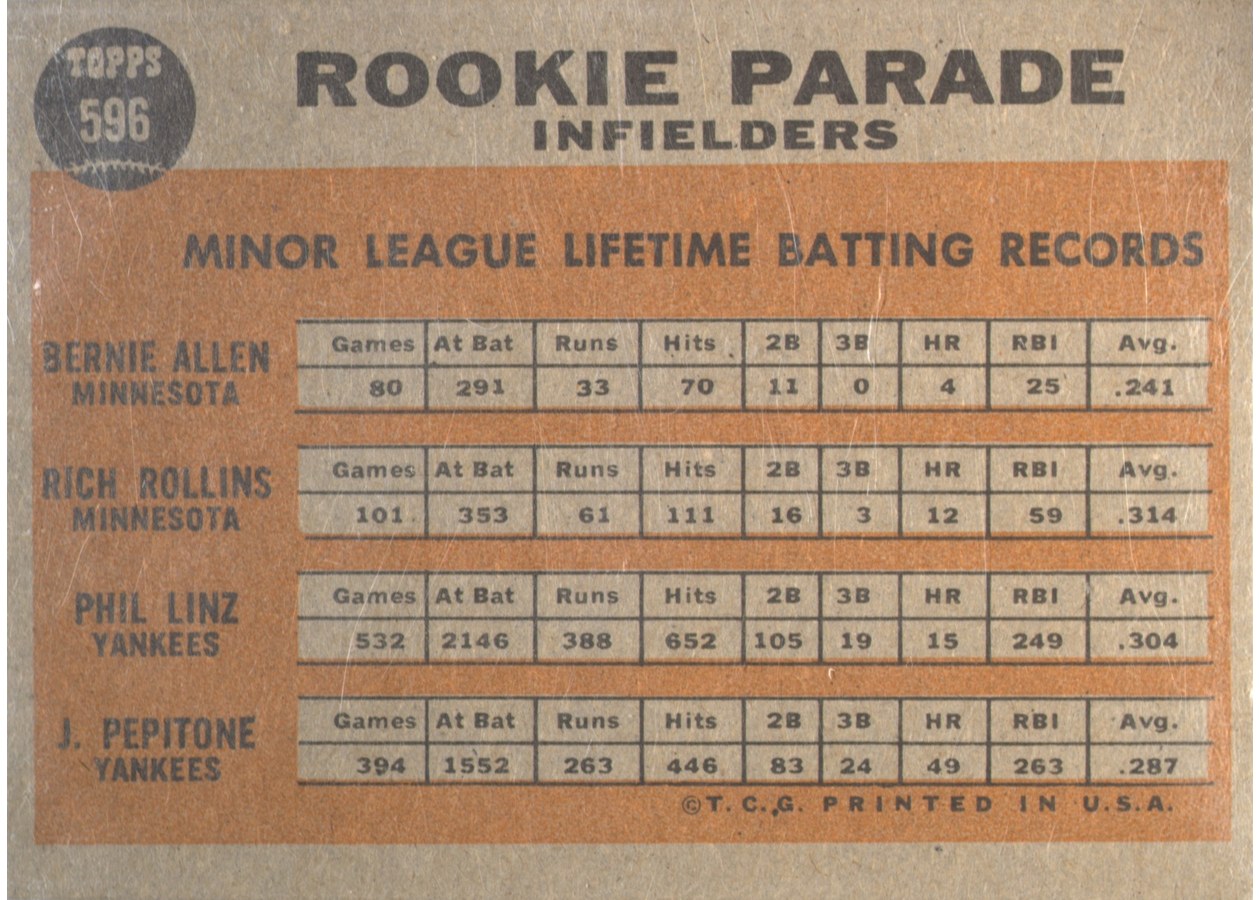
1962 Topps #596 Rookie Parade Infielders
On this card: Bernie Allen, Rich Rollins, Phil Linz, Joe Pepitone
About this card
Cards #591-598 are the eight-card Rookie Parade that closes the set - three cards of pitchers, one of catchers, three of infielders and one of outfielders - printed in the scarce seventh series and short-printed on every number. Bob Uecker (#594), Sam McDowell and Dick Radatz (#591), Jim Bouton (#592), Bob Veale (#593) and Joe Pepitone, Phil Linz and Rich Rollins (#596) are among the names.
The story on this card
Allen won the Minnesota second-base job in spring training and started on Opening Day, April 10, replacing the released Billy Martin. He never had a better year: 159 games, a .269 average, 27 doubles, seven triples, 12 home runs and 64 RBIs, all career highs, plus a .983 fielding percentage that ranked fifth among American League second basemen. He finished third in American League Rookie of the Year voting behind Tom Tresh and Buck Rodgers. Card #596 is his recognized rookie card, a four-player Rookie Parade panel he shares with Rich Rollins, Phil Linz and Joe Pepitone. It sits in the short-printed seventh series, a genuine high number and the toughest way into a Bernie Allen collection. Purdue's starting quarterback turned Twins second baseman, Bernie Allen had his best year as a 1962 rookie, wrecked a knee in 1964, and stretched twelve big-league seasons across the Twins, Senators, Yankees and Expos.
Topps put Rollins on card #596, a Rookie Parade subset entry shared with rookie infielders Bernie Allen, Phil Linz and Joe Pepitone. It is a recognised rookie card and a short-printed high number out of the 1962 set's seventh series. The card caught him mid-breakout: after a spring split between shortstop and third base, owner Calvin Griffith pushed him into the third-base job ahead of Harmon Killebrew and John Goryl, and Rollins opened at .486 through ten games. He played all 159 games, drew more All-Star votes than any other American Leaguer, and finished eighth in the AL MVP balloting - though his 28 errors were the most by any third baseman in the league. Rich Rollins was the Minnesota Twins' All-Star third baseman of the early 1960s, a Kent State product who hit .298 with 96 RBIs in his 1962 breakout season and later played for the Seattle Pilots and Cleveland Indians.
Linz's rookie card is #596, one of three 'Rookie Parade Infielders' panels inside the eight-card run that closes the 1962 set, sharing the front with Bernie Allen, Rich Rollins and Joe Pepitone rather than carrying a club of his own. It is a series-7 high number and a short print, the scarcest stretch of the issue. Linz had made the big-league roster out of spring training after five farm seasons, debuting April 13, 1962 at twenty-two and used at first only as a pinch hitter and pinch runner. Phil Linz was the Yankees' 'Supersub,' a utility infielder who covered shortstop, second, third and the outfield, played every game of the 1964 World Series at short with Tony Kubek hurt, and set off the harmonica incident that cost Yogi Berra his job.
Card #596 belongs to the short-printed seventh series of 1962 Topps, a Rookie Parade panel that puts Pepitone alongside three other newcomers: Bernie Allen, Rich Rollins, and Phil Linz. He reached the Yankees that April as a 21-year-old, sat behind Moose Skowron at first base, and batted .239 with seven home runs and 17 RBIs in 63 games, spending part of the summer back in the minors at Richmond. Brooklyn-born first baseman who anchored the Yankees infield through the 1960s, earning three All-Star nods and three Gold Gloves, spending two seasons out in center field, and finishing a twelve-year career with a brief stop in Japan.
Sources: Wikipedia (Bernie Allen) · Wikipedia (Rich Rollins) · Wikipedia (Phil Linz) · Wikipedia (Joe Pepitone) · SABR BioProject (Bernie Allen) · SABR BioProject (Rich Rollins) · SABR BioProject (Phil Linz) · SABR BioProject (Joe Pepitone)
Graded population (PSA & SGC)
| Grader | Total | 10 | 9 | 8 | 7 | 6 | 5 | 1-4 | Auth |
|---|---|---|---|---|---|---|---|---|---|
| PSA | 762 | 0 | 6 | 99 | 220 | 180 | 126 | 124 | 7 |
| SGC | 179 | 0 | 2 | 13 | 38 | 37 | 38 | 41 | 10 |
Graded population — a scarcity guide, not a price. Snapshot 2026-09-24. Half-grades fold down (8.5→8), and PSA's qualified grades are counted separately from the straight-grade rows shown here. Slabs of the three cards printed #139 are joined by description, never by number alone. PSA registers the green tints as a separate set; a tint's population is listed under that state of the card it belongs to.
Find this card
Search T206 Cards Live auctions Buy It Now on eBay Sold prices
As an eBay Partner Network affiliate, T206Cards.com may earn from qualifying purchases.
Frequently asked questions
What is the 1962 Topps #596 card?
It is card #596 of the 600-card 1962 Topps Baseball set, picturing Bernie Allen, Rich Rollins, Phil Linz and Joe Pepitone. Cards #591-598 are the eight-card Rookie Parade that closes the set - three cards of pitchers, one of catchers, three of infielders and one of outfielders - printed in the scarce seventh series and short-printed on every number. Bob Uecker (#594), Sam McDowell and Dick Radatz (#591), Jim Bouton (#592), Bob Veale (#593) and Joe Pepitone, Phil Linz and Rich Rollins (#596) are among the names.
Is 1962 Topps #596 a rookie card?
Yes - #596 is a rookie card for every player pictured on it: Bernie Allen, Rich Rollins, Phil Linz and Joe Pepitone.
Why is #596 harder to find?
It is a high number card (cards 523-598) from the seventh print series, distributed last and in the smallest quantity - the toughest cards in the set and home to all 42 short prints and the Rookie Parade. It is also a short print card (42 cards, all in 523-598). Printed in smaller quantity than the rest of the seventh series.
How many cards are in the 1962 Topps Baseball set?
600 cards, tracked as 708 collectible states. The numbers run from 1 to 598 with no gaps, but three different cards were printed #139 - two Hal Reniff poses, catalogued 139a and 139b, and the Babe Hits 60 Babe Ruth Special, 139c - so 598 numbers make 600 cards; 93 cards carry catalogued print variations, the series-2 green tints among them, that the master set counts separately.
Sources: Baseball Almanac, Trading Card Database, PSA CardFacts, Cardboard Connection, BaseballCardPedia, The Topps Archives, Baseball-Reference, the SABR BioProject and the National Baseball Hall of Fame, PSA & SGC population reports. Card data compiled and maintained by T206Cards.com. Page last updated 2026-10-03.