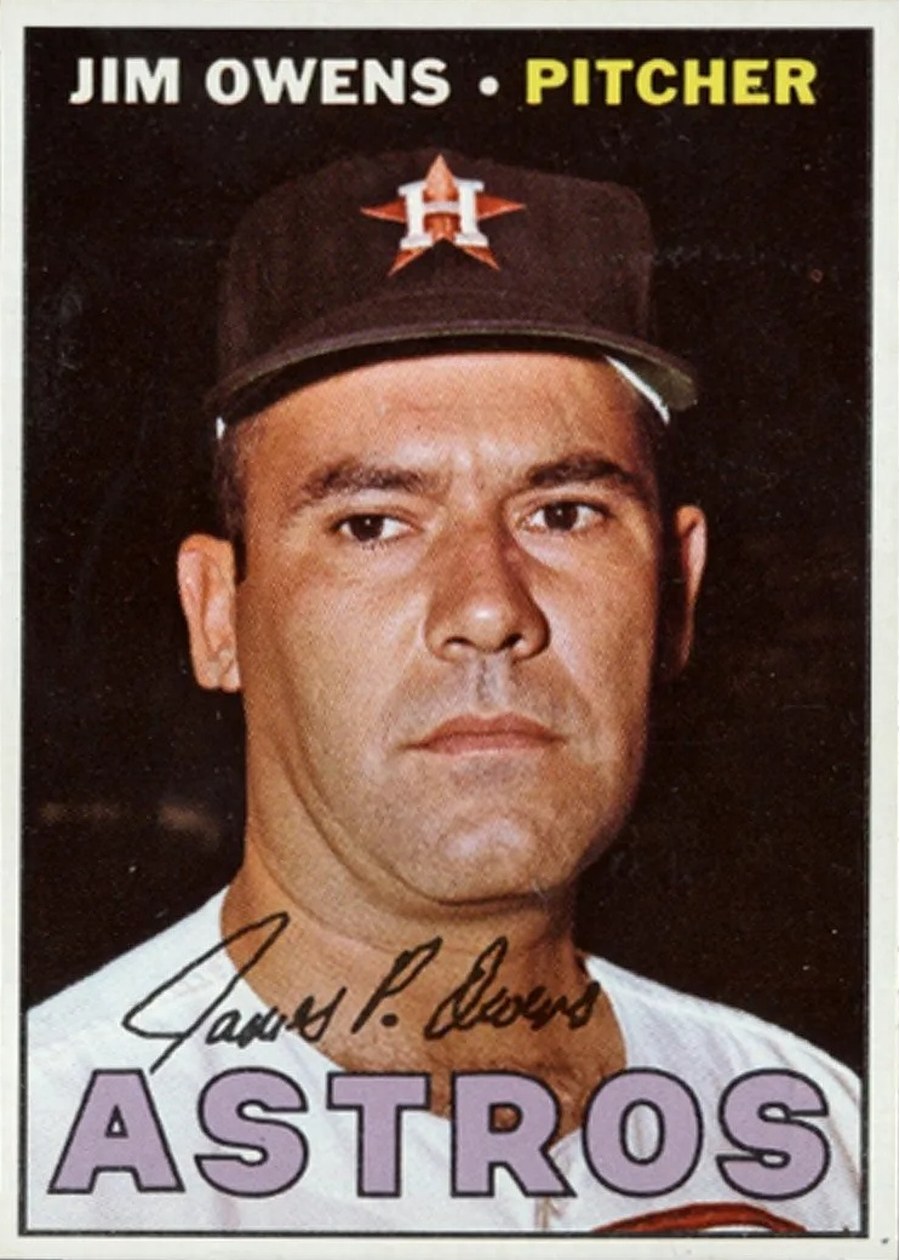
1967 Topps #582 Jim Owens
One of the small group of cards Topps double-printed inside the 1967 high-number series, which makes it easier to find than most of the seventh series.
About Jim Owens
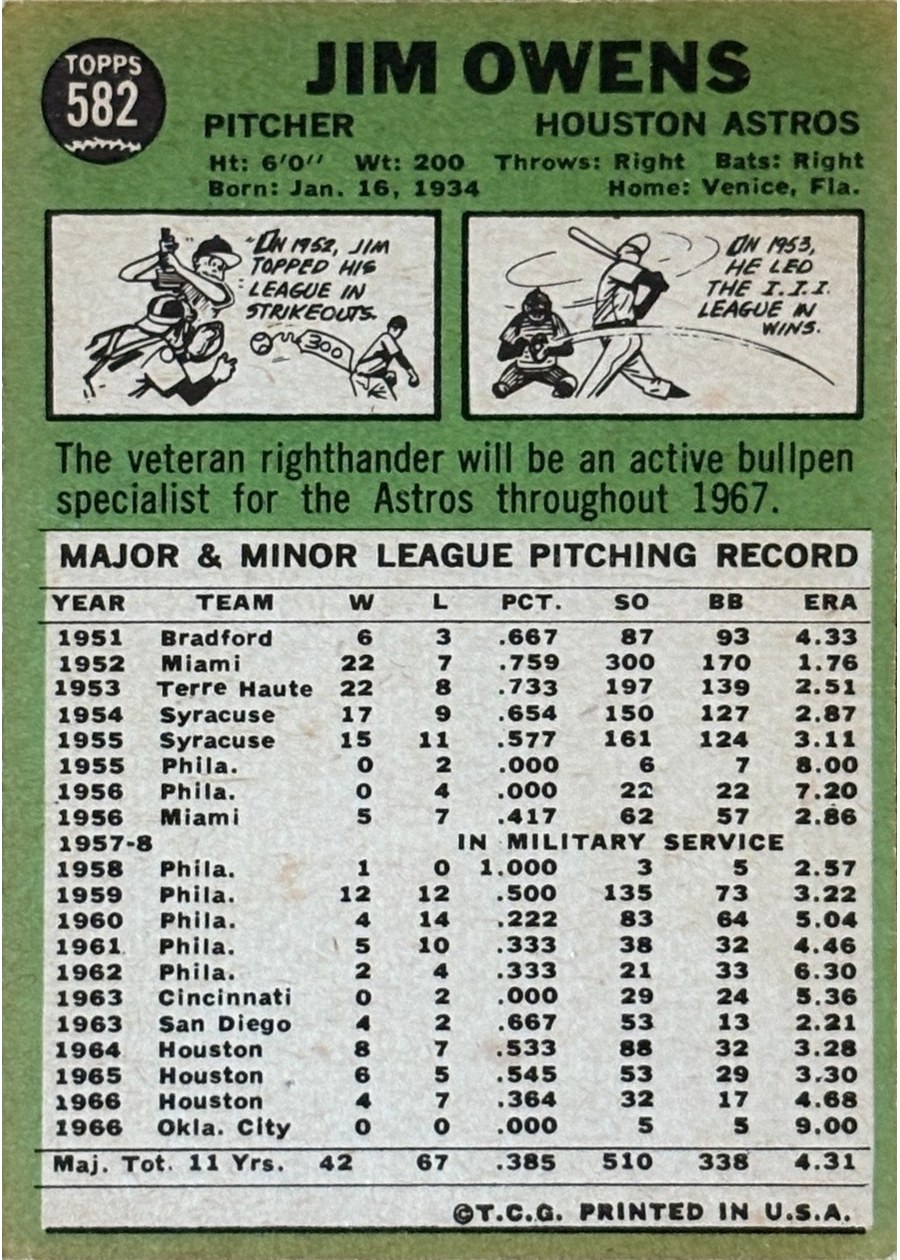
Card #582 is a high number from the seventh series, though Topps double-printed it along with a small group of others in that run, so it surfaces more readily than most of its neighbors. The back reports 1966: 4-7 with a 4.68 ERA in 40 appearances and 50 innings, Claude Raymond having taken over the late work before an August option to Oklahoma City. On April 24 that year Owens served up Willie Mays's 511th home run, tying Mel Ott's National League record.
James Philip Owens, nicknamed "Bear" for his stocky build and round face, was a right-handed pitcher who spent parts of twelve seasons between 1955 and 1967 with the Phillies, Cincinnati Reds and Houston Colt .45s/Astros. Born in Gifford, Pennsylvania, he signed with Philadelphia out of Bradford High School in 1951, won 22 games in the low minors in 1952 and 22 more for Class B Terre Haute in 1953, and was named the International League's Rookie of the Year in 1954, arriving with what Phillies general manager Roy Hamey called the best curveball in baseball. An Army hitch cost him all of 1957 and all but one game of 1958. His one strong year came in 1959: 12-12 with a 3.21 ERA, 11 complete games, 135 strikeouts and the only shutout of his career for a last-place club. He was also a charter member of the hard-drinking group of Phillies that Sports Illustrated made notorious as the "Dalton Gang" in 1960, and that reputation trailed him for good. He finished 42-68 with a 4.31 ERA, 21 saves and 516 strikeouts in 286 games, then coached Houston's pitchers for six seasons, working with Larry Dierker, Mike Cuellar and Don Wilson.
Sources: Wikipedia · SABR BioProject · Baseball-Reference · Baseball Almanac (1) · Baseball Almanac (2) · BaseballCardPedia
Graded population (PSA & SGC)
| Grader | Total | 10 | 9 | 8 | 7 | 6 | 5 | 1-4 | Auth |
|---|---|---|---|---|---|---|---|---|---|
| PSA | 444 | 1 | 28 | 225 | 122 | 48 | 14 | 6 | 0 |
| SGC | 37 | 0 | 1 | 10 | 17 | 3 | 3 | 3 | 0 |
Graded population — a scarcity guide, not a price. Data as of 2026-09-04. Half grades fold down for both graders (8.5→8); PSA qualified slabs (OC, ST, PD, MC and the like) are not counted. PSA registers a row for every one of the 624 states; SGC lists no separate row for the #149 white-streak state.
Find this card
Search T206 Cards Shop 1967 Topps cards Live auctions Buy It Now on eBay Sold prices
As an eBay Partner Network affiliate, T206Cards.com may earn from qualifying purchases.
Related cards
More Houston Astros cards:
- #8 Chuck Harrison
- #28 Barry Latman
- #51 Astros 1967 Rookie Stars
- #73 Rusty Staub
- #97 Mike Cuellar
- #136 Carroll Sembera
- #166 Ed Mathews
- #172 Bill Heath
- #190 Turk Farrell
- #212 Chris Zachary
- #231 John Bateman
- #234 National League 1966 ERA Leaders
- #274 Bob Aspromonte
- #298 Ron Davis
Frequently asked questions
What is the 1967 Topps #582 card?
It is card #582 of the 609-card 1967 Topps Baseball set, picturing Jim Owens of the Houston Astros.
Is 1967 Topps #582 a scarce card?
It is a high number card from the seventh and last print series, #534-609 - the scarce end of the set, holding both Hall of Fame rookies (Carew #569, Seaver #581). Twenty-two of the 76 are accepted double prints, so scarcity varies card by card inside the run. It is also a double print card (26 cards: #1, #30, #100, the #531 checklist and 22 high numbers). Cards printed twice on the sheet, so more plentiful than their neighbours: #1 The Champs, #30 Al Kaline, #100 Frank Robinson, the #531 seventh-series checklist, and 22 of the 76 high numbers (#534, 537, 539, 542, 547, 548, 550, 551, 554, 556, 559, 562, 564, 566, 569, 582, 588, 589, 596, 599, 601, 608), Carew #569 included. A high number that is also a double print is easier than its series suggests.
How many cards are in the 1967 Topps Baseball set?
609 cards, tracked as 624 collectible states. Numbers run from 1 to 609 without a gap - no number was skipped and none was used twice - and 15 cards carry catalogued print variations that the master set counts separately.
Sources: Trading Card Database, PSA CardFacts, Cardboard Connection, Baseball Almanac, BaseballCardPedia, Baseball-Reference, the SABR BioProject and the National Baseball Hall of Fame, PSA & SGC population reports. Card data compiled and maintained by T206Cards.com. Page last updated 2026-10-12.