
1962 Topps #298 Bill Tuttle
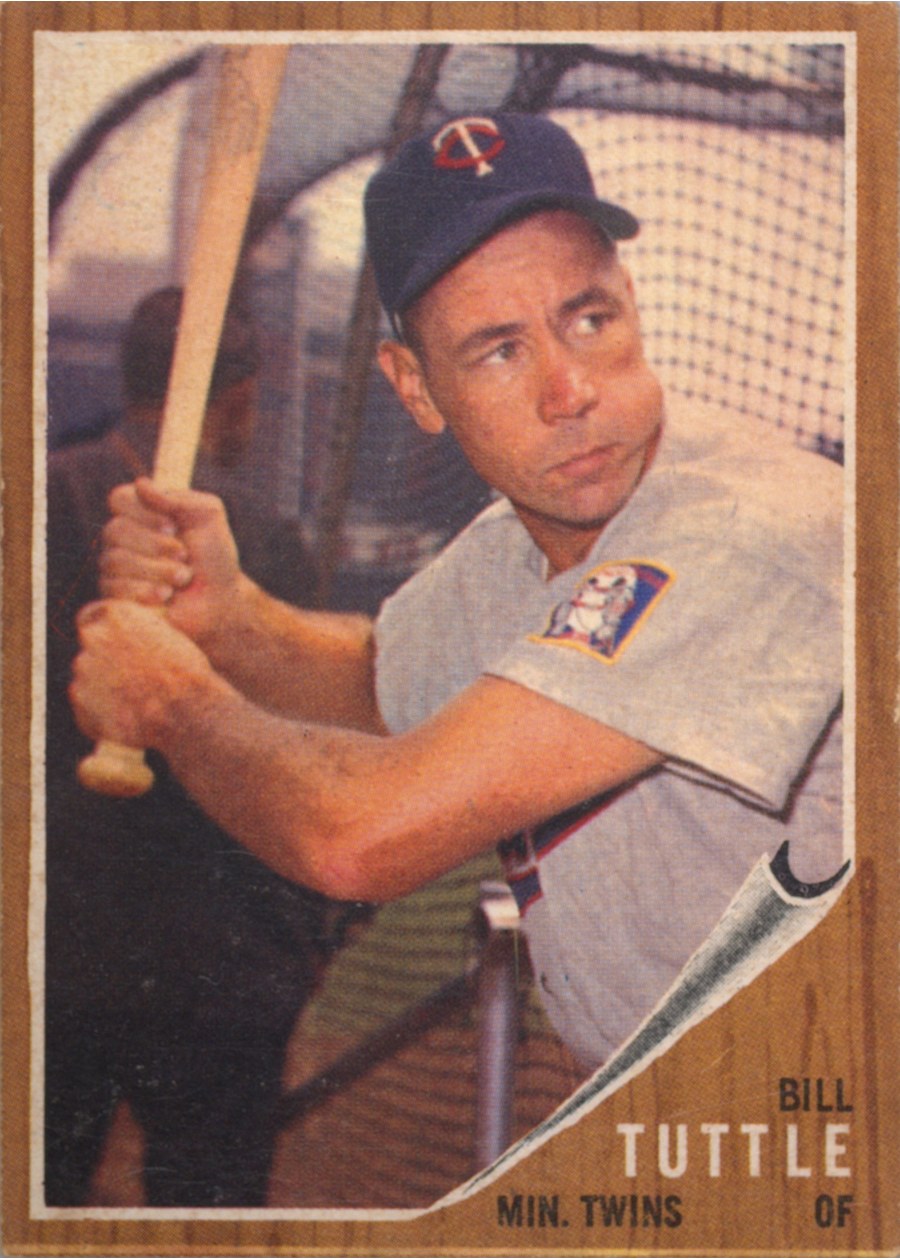
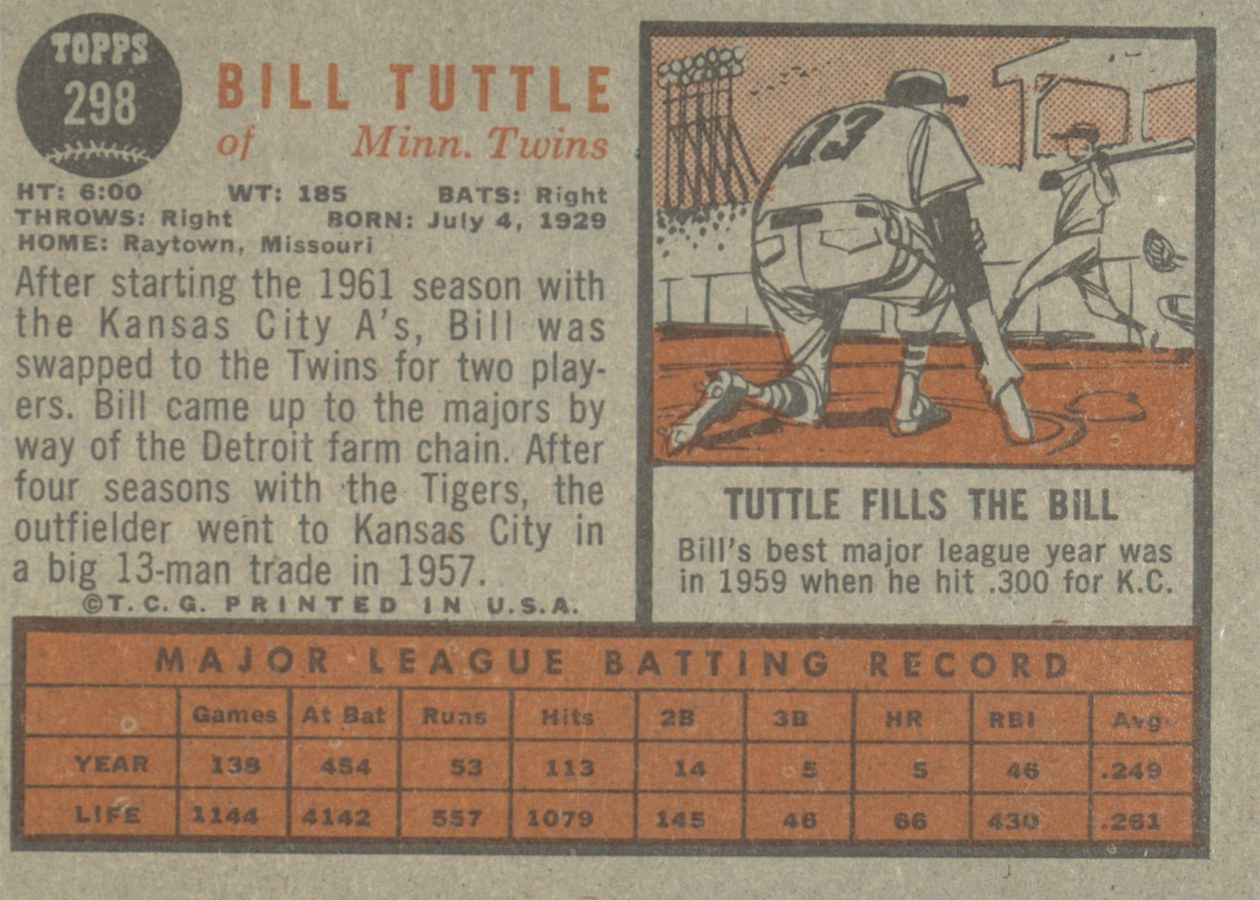
About Bill Tuttle
A full season in Minnesota turned Tuttle into a bench man: 110 games but only 27 starts, spelling Lenny Green in center and Bob Allison in right, with 123 at-bats, 26 hits and a .211 average for a Twins club that won 91 games and finished second to the Yankees. He turns up in the record books as a baserunner - he was one of three runners Harmon Killebrew drove in on July 18, when Killebrew and Allison hit grand slams in the same inning, a major league first. Afterward Tuttle asked to be traded rather than spend another season as a late-inning substitute. His Topps card, number 298, comes from the fourth series.
Bill Tuttle was a durable, defense-minded outfielder who played 11 major league seasons for the Detroit Tigers, Kansas City Athletics and Minnesota Twins, debuting in September 1952, spending 1953 back in the minors at Buffalo, and finishing in May 1963. A right-handed hitter and thrower out of Bradley University in Peoria, Illinois, he was rated one of the American League's most reliable center fielders: he led AL outfielders in putouts in 1955 and 1960 and in assists in 1959 and 1960, and led AL center fielders in assists in 1955, 1956 and 1958. Bradley put him in its athletics hall of fame in January 1954. Tuttle was a contact hitter rather than a power threat, batting .259 with 1,105 hits, 67 home runs and 443 RBIs in 1,270 games; his best years were 1955, when he set career highs of 102 runs, 14 homers and 78 RBIs, and 1959, when he hit .300. Diagnosed with oral cancer in 1993, decades after a Detroit teammate handed him his first chew in 1955, he spent his last years touring clubhouses and schools with Joe Garagiola to warn players and children against spit tobacco, and died in 1998 at 69.
Sources: Wikipedia · SABR BioProject · Baseball-Reference
Graded population (PSA & SGC)
| Grader | Total | 10 | 9 | 8 | 7 | 6 | 5 | 1-4 | Auth |
|---|---|---|---|---|---|---|---|---|---|
| PSA | 174 | 0 | 4 | 37 | 72 | 33 | 13 | 15 | 0 |
| SGC | 11 | 0 | 0 | 3 | 3 | 2 | 3 | 0 | 0 |
Graded population — a scarcity guide, not a price. Snapshot 2026-09-24. Half-grades fold down (8.5→8), and PSA's qualified grades are counted separately from the straight-grade rows shown here. Slabs of the three cards printed #139 are joined by description, never by number alone. PSA registers the green tints as a separate set; a tint's population is listed under that state of the card it belongs to.
Find this card
Search T206 Cards Live auctions Buy It Now on eBay Sold prices
As an eBay Partner Network affiliate, T206Cards.com may earn from qualifying purchases.
Related cards
Team card: #584 Minnesota Twins Team
More Minnesota Twins cards:
- #21 Jim Kaat
- #70 Harmon Killebrew
- #84 Lenny Green
- #102 Al Schroll
- #124 Bill Pleis
- #164 Hal Naragon
- #166 Don Lee
- #180 Bob Allison
- #208 Billy Martin
- #222 Jerry Zimmerman
- #230 Camilo Pascual
- #316 Harmon Killebrew
- #321 Lee Stange
- #339 Jose Valdivielso
Frequently asked questions
What is the 1962 Topps #298 card?
It is card #298 of the 600-card 1962 Topps Baseball set, picturing Bill Tuttle of the Minnesota Twins.
How many cards are in the 1962 Topps Baseball set?
600 cards, tracked as 708 collectible states. The numbers run from 1 to 598 with no gaps, but three different cards were printed #139 - two Hal Reniff poses, catalogued 139a and 139b, and the Babe Hits 60 Babe Ruth Special, 139c - so 598 numbers make 600 cards; 93 cards carry catalogued print variations, the series-2 green tints among them, that the master set counts separately.
Sources: Baseball Almanac, Trading Card Database, PSA CardFacts, Cardboard Connection, BaseballCardPedia, The Topps Archives, Baseball-Reference, the SABR BioProject and the National Baseball Hall of Fame, PSA & SGC population reports. Card data compiled and maintained by T206Cards.com. Page last updated 2026-10-03.