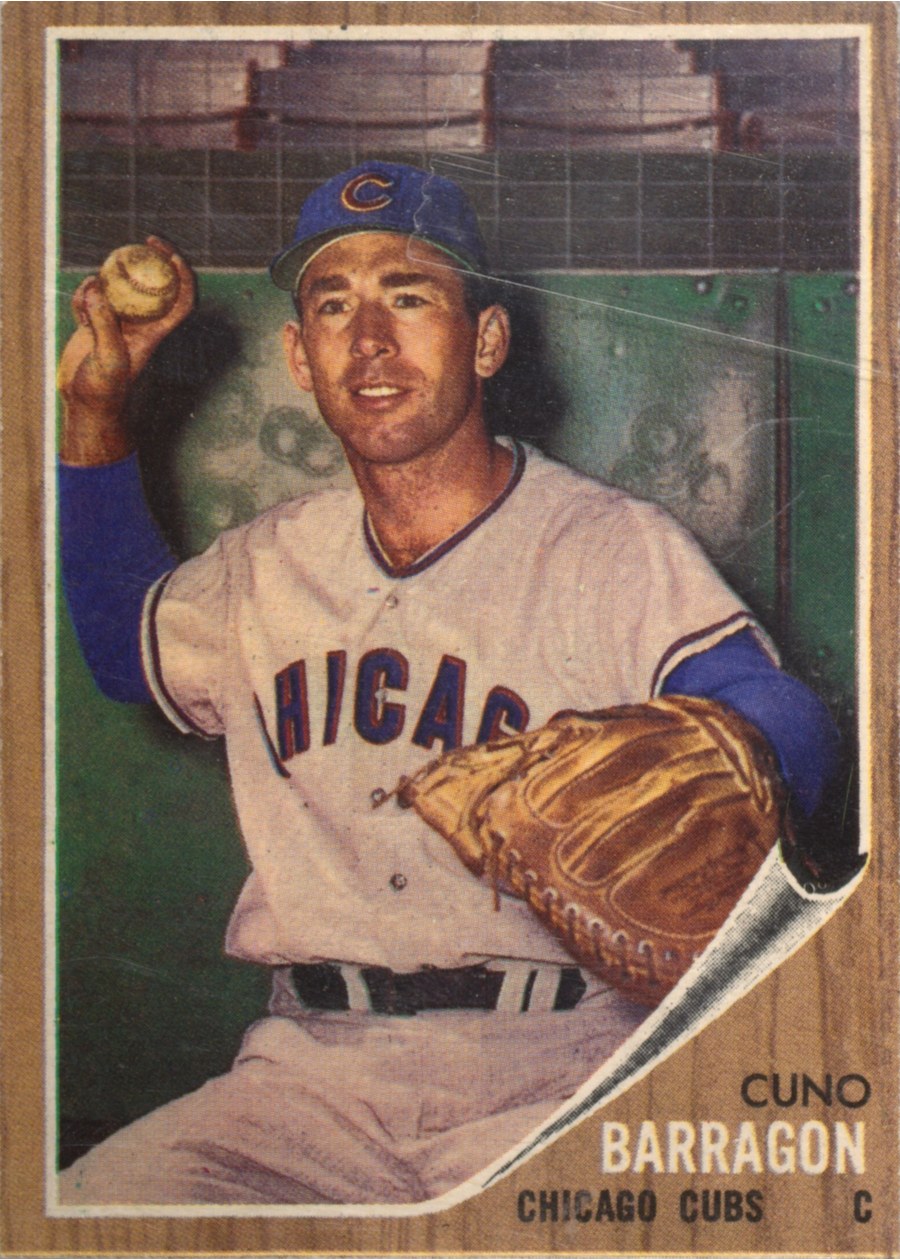
1962 Topps #66 Cuno Barragan
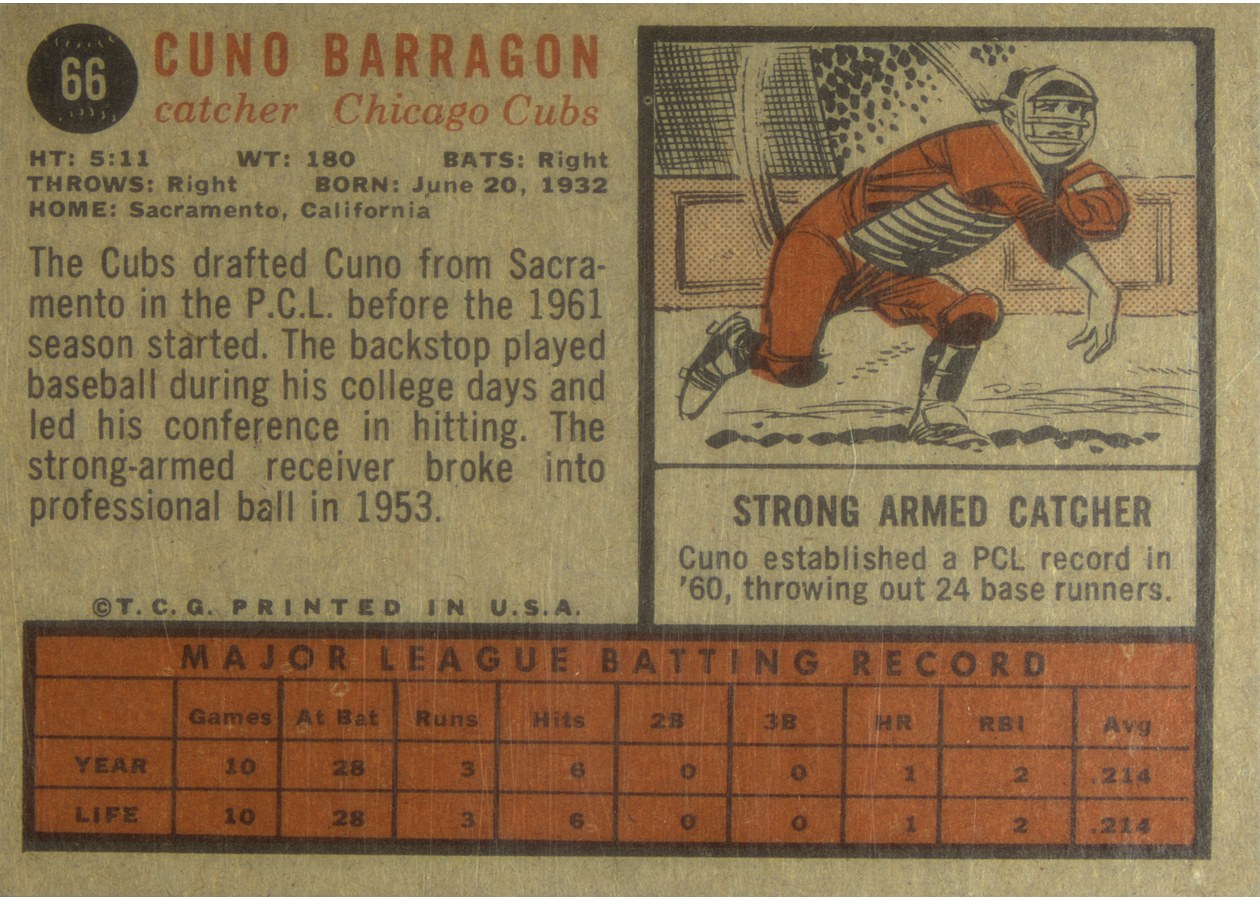
Barragan's last name is misspelled "Barragon" on both the front and the back of this card.
Uncorrected error: Last name misspelled "Barragon" on the front and back
About Cuno Barragan
Card #66 is a first-series 1962 card, and it is Barragan's recognized rookie card, showing him as a Chicago Cubs catcher. Topps misspelled him "Barragon" on both the front and the back. He was one of five catchers the Cubs carried that year, behind Dick Bertell's .302 bat, and the College of Coaches put three different men in charge on the way to 59-103 and ninth place. Barragan started Opening Day at Colt Stadium in Houston's first major-league game, then sank to .063 before a 10-for-23 tear against the Phillies and Mets lifted his average to .282. He settled at .201 in 58 games and caught the finale, a 5-1 win that handed the Mets a record 120th loss.
Facundo "Cuno" Barragan was a catcher from Sacramento, California, born June 20, 1932, the youngest of seven children of Mexican immigrant parents. His father died when Cuno was two and his mother when he was fifteen, so older siblings largely raised him. He took up catching as a boy only because nobody else on the neighborhood team he had organized would take the job, and the position stuck for the rest of his playing days. After Sacramento Junior College and a two-year Navy hitch, he spent the rest of the 1950s in the Sacramento Solons' orbit - Idaho Falls, Amarillo, and dollar sales to Portland and Spokane - until a .318 year for the Solons in 1960 got him drafted by the Chicago Cubs. A broken ankle in his first Cubs spring training pushed his debut to September 1, 1961, when he homered in his first big-league at-bat, the third Cub ever to do it. He caught parts of three seasons in Chicago, 1961-1963, batting .202 with 33 hits and 14 RBIs in 69 games; that debut homer was his only one. He sold insurance around Sacramento until 2011, entered the Mexican American Hall of Fame in 1973 and the Sacramento City College Hall of Fame in 2002, and died in 2024 at 91.
Sources: Wikipedia · SABR BioProject · Baseball-Reference
Graded population (PSA & SGC)
| Grader | Total | 10 | 9 | 8 | 7 | 6 | 5 | 1-4 | Auth |
|---|---|---|---|---|---|---|---|---|---|
| PSA | 226 | 0 | 10 | 86 | 85 | 22 | 15 | 6 | 2 |
| SGC | 9 | 0 | 2 | 3 | 1 | 1 | 1 | 0 | 1 |
Graded population — a scarcity guide, not a price. Snapshot 2026-09-24. Half-grades fold down (8.5→8), and PSA's qualified grades are counted separately from the straight-grade rows shown here. Slabs of the three cards printed #139 are joined by description, never by number alone. PSA registers the green tints as a separate set; a tint's population is listed under that state of the card it belongs to.
Find this card
Search T206 Cards Live auctions Buy It Now on eBay Sold prices
As an eBay Partner Network affiliate, T206Cards.com may earn from qualifying purchases.
Related cards
Team card: #552 Chicago Cubs Team
More Chicago Cubs cards:
- #25 Ernie Banks
- #47 Bob Will
- #89 Barney Schultz
- #119 Danny Murphy
- #170 Ron Santo
- #191 Jim Brewer
- #240 George Altman
- #264 Dick Ellsworth
- #274 Sammy Taylor
- #288 Billy Williams
- #309 Moe Morhardt
- #359 Bobby Locke
- #372 Jack Curtis
- #387 Lou Brock
Frequently asked questions
What is the 1962 Topps #66 card?
It is card #66 of the 600-card 1962 Topps Baseball set, picturing Cuno Barragan of the Chicago Cubs.
Is 1962 Topps #66 a rookie card?
Yes - #66 is the 1962 Topps rookie card of Cuno Barragan.
Does 1962 Topps #66 have an error?
Last name misspelled "Barragon" on the front and back. It was never corrected, so there is no variation to chase - every copy of #66 reads the same way.
How many cards are in the 1962 Topps Baseball set?
600 cards, tracked as 708 collectible states. The numbers run from 1 to 598 with no gaps, but three different cards were printed #139 - two Hal Reniff poses, catalogued 139a and 139b, and the Babe Hits 60 Babe Ruth Special, 139c - so 598 numbers make 600 cards; 93 cards carry catalogued print variations, the series-2 green tints among them, that the master set counts separately.
Sources: Baseball Almanac, Trading Card Database, PSA CardFacts, Cardboard Connection, BaseballCardPedia, The Topps Archives, Baseball-Reference, the SABR BioProject and the National Baseball Hall of Fame, PSA & SGC population reports. Card data compiled and maintained by T206Cards.com. Page last updated 2026-10-03.