
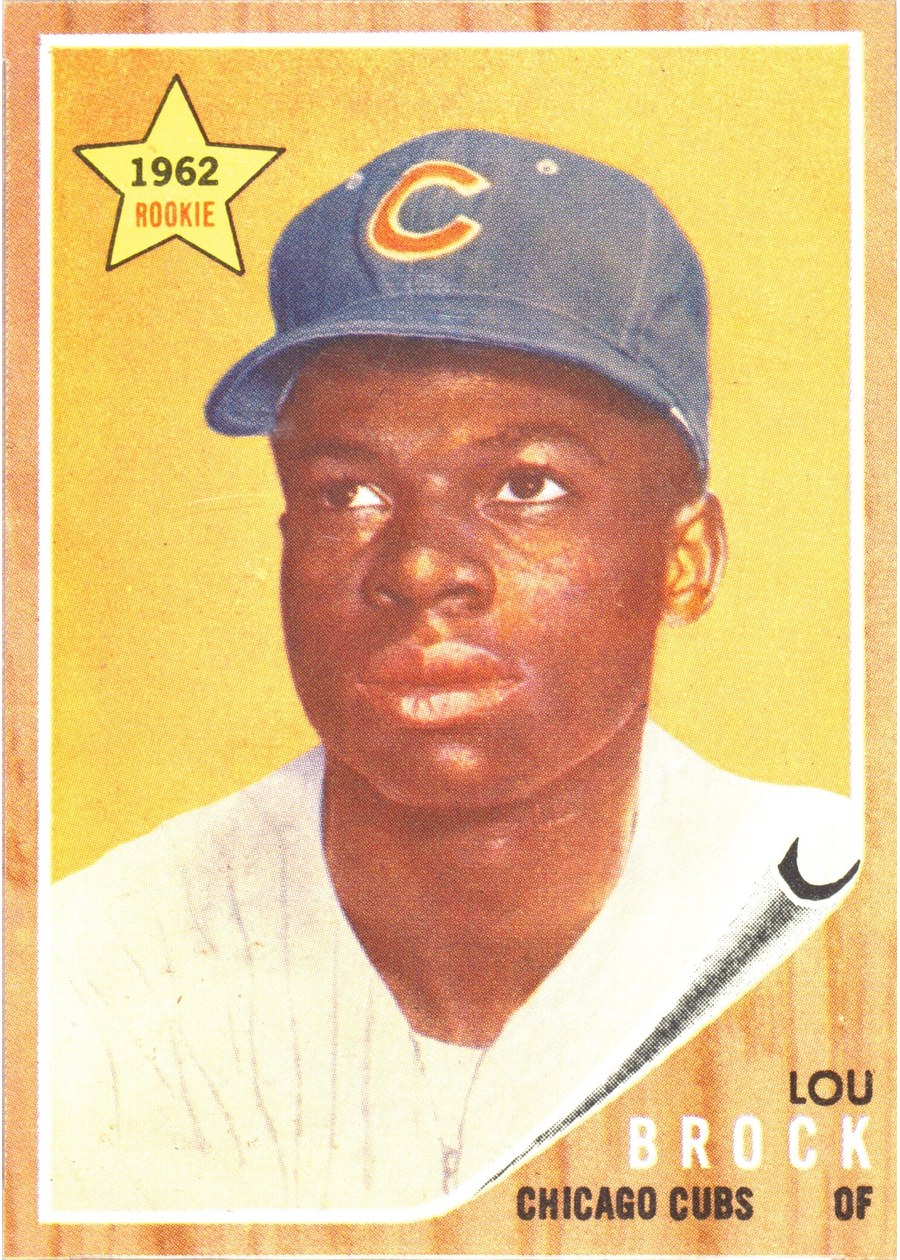
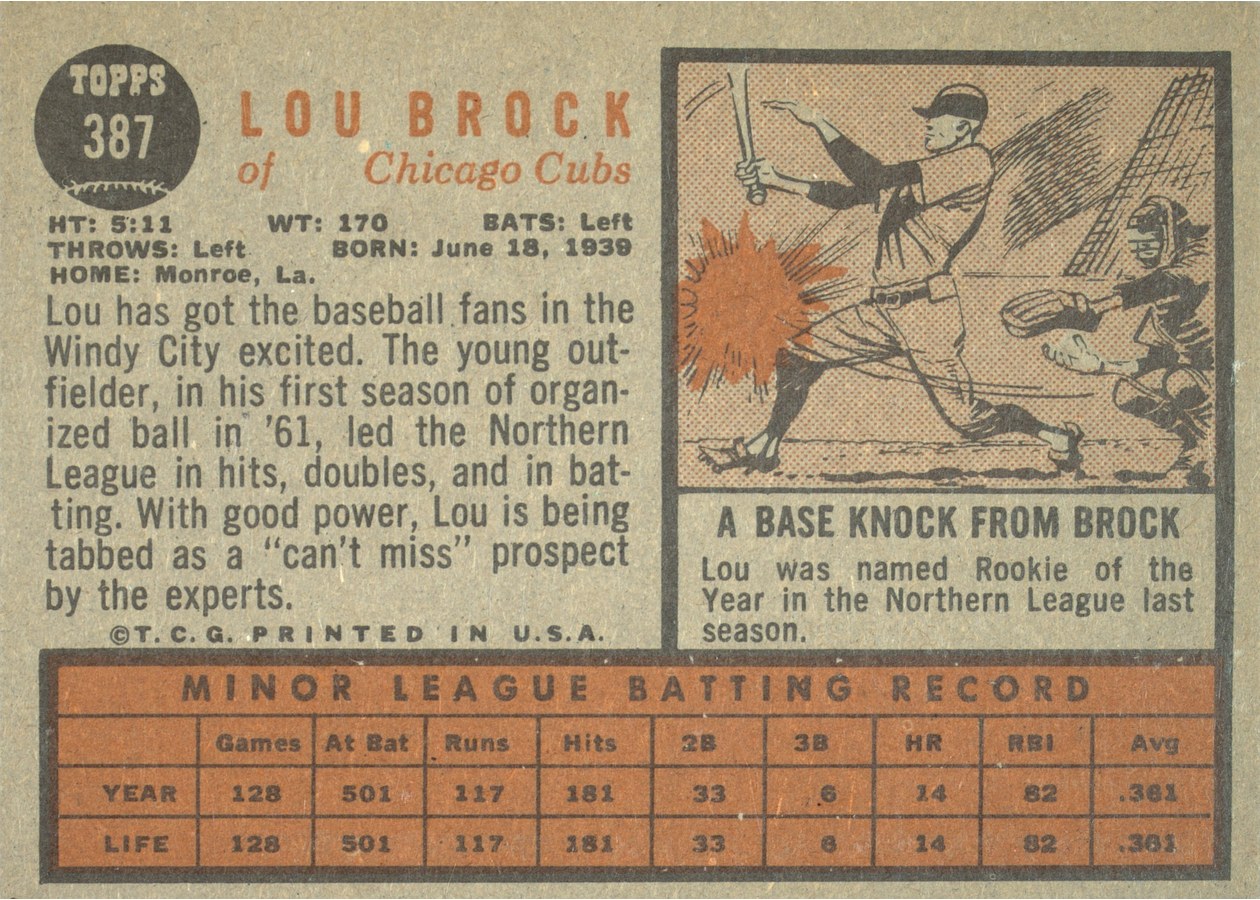
1962 Topps #387 Lou Brock
About Lou Brock
Topps #387 is Brock's first card, a fifth-series issue from the middle of the 1962 run. It followed a .361 batting title at St. Cloud and a four-game September callup that brought one hit in eleven at-bats. As the Cubs' 23-year-old center fielder he batted .263 with nine homers and 16 steals, and on June 17 at the Polo Grounds he cleared the center-field bleachers, something almost nobody had done there. It is the key rookie card of the set.
Lou Brock played 19 major league seasons, breaking in with a September callup by the Chicago Cubs in 1961 and spending parts of four seasons there before the June 15, 1964 trade that sent him to St. Louis for pitcher Ernie Broglio, a deal still remembered as one of the most lopsided in baseball history. Moved to left field and turned loose on the bases, Brock led the National League in stolen bases eight times between 1966 and 1974, broke Maury Wills' single-season record with 118 steals in 1974, and passed Ty Cobb's career mark in 1977 on the way to a total of 938 that stood until 1991. A six-time All-Star and a career .293 hitter, he helped the Cardinals to pennants in 1964, 1967 and 1968 and to World Series titles in 1964 and 1967, batting .391 with 14 steals across three Fall Classics. He collected his 3,000th hit on August 13, 1979 off Dennis Lamp of the Cubs, the club that had traded him, then retired at 40 with a .304 average. St. Louis retired his number 20 that September, and he was elected to the National Baseball Hall of Fame in 1985, his first year on the ballot.
Sources: Wikipedia · SABR BioProject · Baseball-Reference · National Baseball Hall of Fame
Graded population (PSA & SGC)
| Grader | Total | 10 | 9 | 8 | 7 | 6 | 5 | 1-4 | Auth |
|---|---|---|---|---|---|---|---|---|---|
| PSA | 4,914 | 2 | 31 | 271 | 692 | 1,003 | 903 | 1,999 | 13 |
| SGC | 2,139 | 1 | 6 | 28 | 128 | 229 | 470 | 1,200 | 77 |
Graded population — a scarcity guide, not a price. Snapshot 2026-09-24. Half-grades fold down (8.5→8), and PSA's qualified grades are counted separately from the straight-grade rows shown here. Slabs of the three cards printed #139 are joined by description, never by number alone. PSA registers the green tints as a separate set; a tint's population is listed under that state of the card it belongs to.
Find this card
Search T206 Cards Live auctions Buy It Now on eBay Sold prices
As an eBay Partner Network affiliate, T206Cards.com may earn from qualifying purchases.
Related cards
Team card: #552 Chicago Cubs Team
More Chicago Cubs cards:
- #25 Ernie Banks
- #47 Bob Will
- #66 Cuno Barragan
- #89 Barney Schultz
- #119 Danny Murphy
- #170 Ron Santo
- #191 Jim Brewer
- #240 George Altman
- #264 Dick Ellsworth
- #274 Sammy Taylor
- #288 Billy Williams
- #309 Moe Morhardt
- #359 Bobby Locke
- #372 Jack Curtis
Frequently asked questions
What is the 1962 Topps #387 card?
It is card #387 of the 600-card 1962 Topps Baseball set, picturing Lou Brock of the Chicago Cubs.
Is 1962 Topps #387 a rookie card?
Yes - #387 is the 1962 Topps rookie card of Lou Brock.
What are the key cards in the 1962 Topps set?
The #200 Mickey Mantle anchors the set, with #1 Roger Maris opening it, #300 Willie Mays, #320 Hank Aaron, #5 Sandy Koufax and #10 Bob Clemente (printed under the shortened name Topps used for him) among the stars, #18 Managers' Dream pairing Mantle and Mays, and Mantle again on the #471 AL All-Star card. The #387 Lou Brock and #199 Gaylord Perry rookies head the first-year cards, and #530 Bob Gibson sits in the short-printed high series (#523-598), the hardest cards to find. Behind them come the #218 Joe Torre rookie, Mantle's #318 In Action card and the ten-card Babe Ruth Special.
How many cards are in the 1962 Topps Baseball set?
600 cards, tracked as 708 collectible states. The numbers run from 1 to 598 with no gaps, but three different cards were printed #139 - two Hal Reniff poses, catalogued 139a and 139b, and the Babe Hits 60 Babe Ruth Special, 139c - so 598 numbers make 600 cards; 93 cards carry catalogued print variations, the series-2 green tints among them, that the master set counts separately.
Sources: Baseball Almanac, Trading Card Database, PSA CardFacts, Cardboard Connection, BaseballCardPedia, The Topps Archives, Baseball-Reference, the SABR BioProject and the National Baseball Hall of Fame, PSA & SGC population reports. Card data compiled and maintained by T206Cards.com. Page last updated 2026-10-03.