
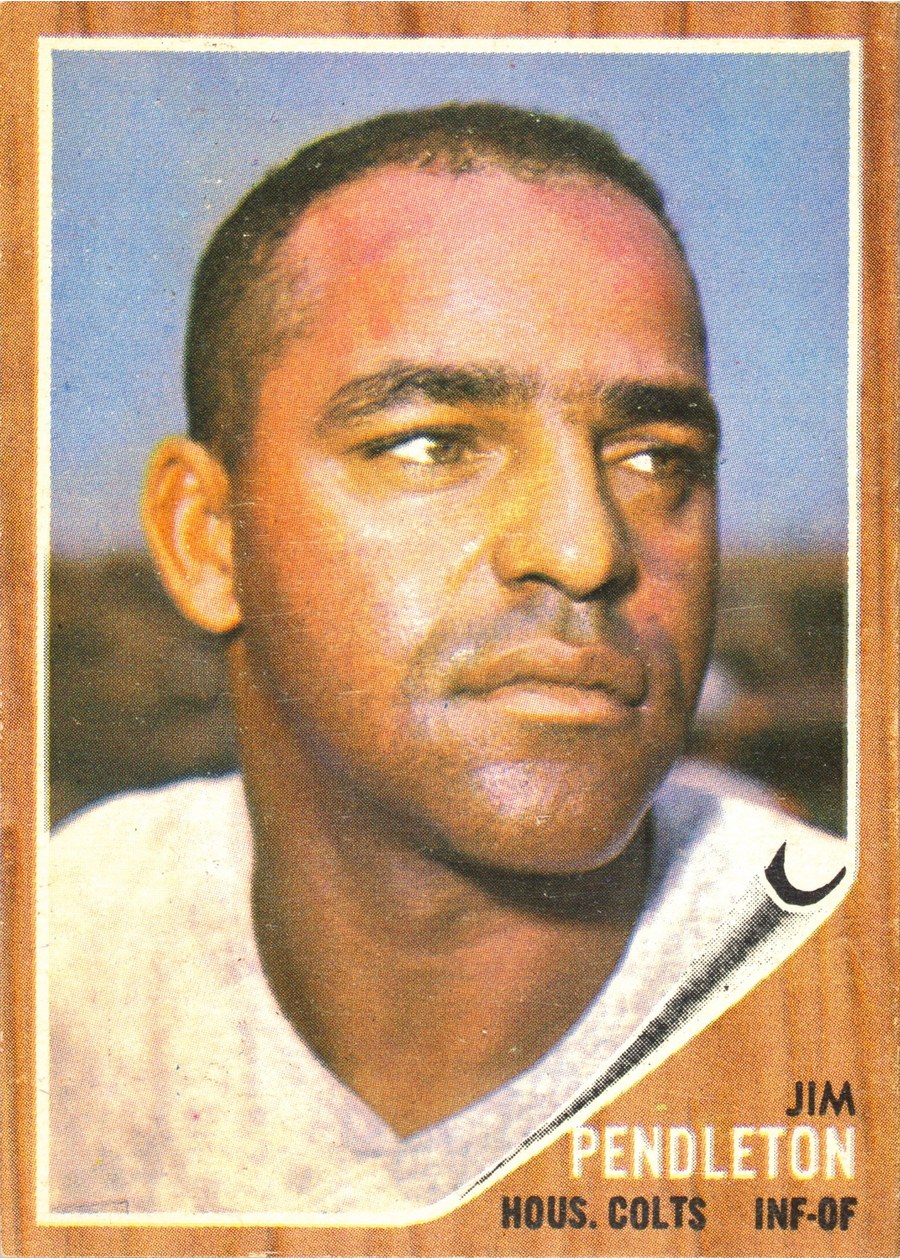
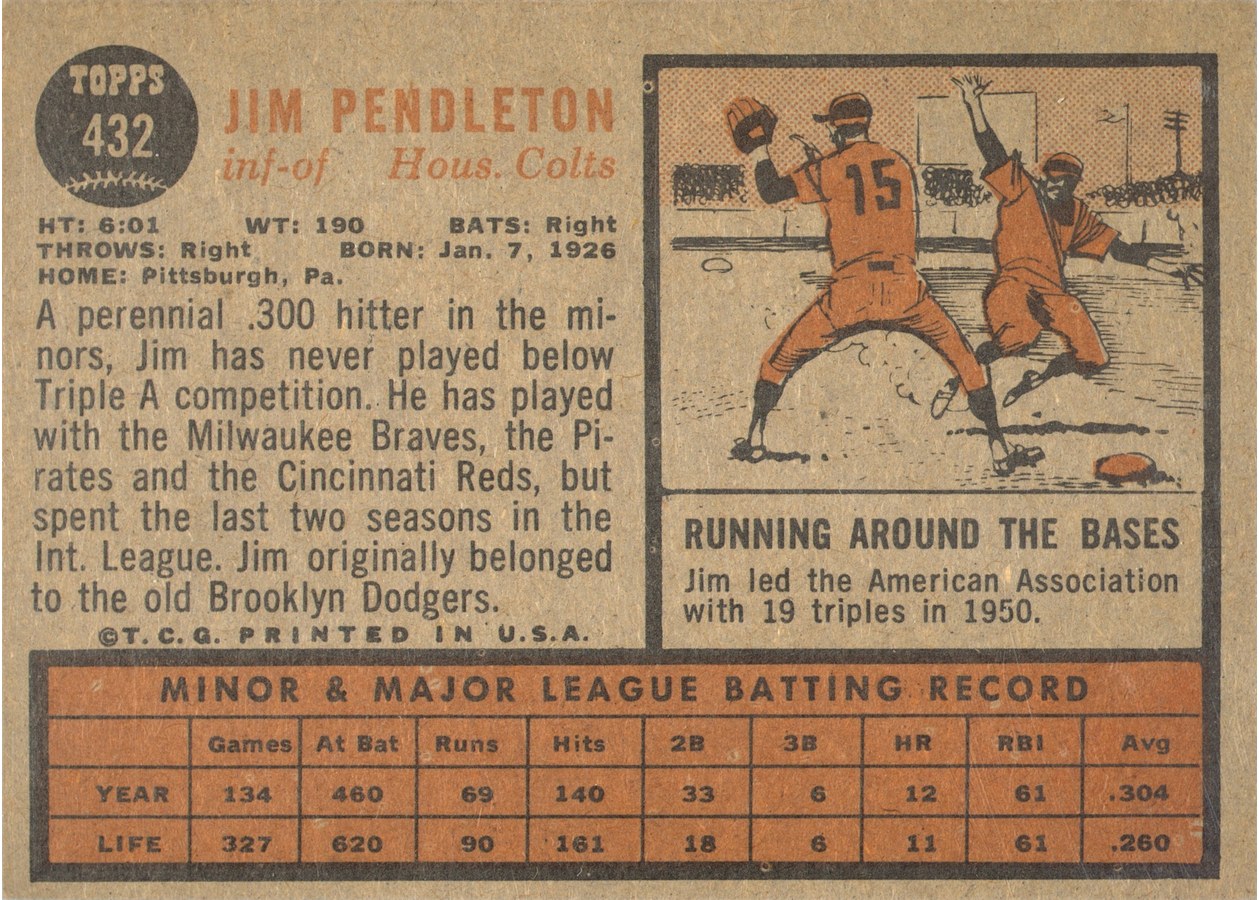
1962 Topps #432 Jim Pendleton
The back of this card lists the wrong birth year. Pendleton was born January 7, 1924, but he had taken two years off his age when he signed with the Dodgers, and the shaved figure followed him onto his baseball cards.
Uncorrected error: The back gives the wrong birth year - Pendleton was born in 1924
About Jim Pendleton
Pendleton was 38 when the expansion Houston Colt .45s put him in left field and fifth in the order for the franchise's very first game, an 11-2 win over the Cubs at Colt Stadium on April 10, 1962. He wore number 23, played 117 games and hit .246 with 8 home runs and 36 RBI, and made his last big league appearance on September 30. Card #432 shows him with Houston in the set's fifth print series, arriving nine years after his 1953 debut with the Milwaukee Braves. The back gets his birth year wrong, an echo of the two years he shaved off his age when he signed with Brooklyn.
James Edward Pendleton (born January 7, 1924 in St. Charles, Missouri; died March 20, 1996 in Houston, Texas) was a right-handed-batting, right-handed-throwing outfielder and infielder who reached the National League only after a long apprenticeship in the Negro leagues and high minors. He played shortstop for the Negro American League's Chicago American Giants in 1948, batting .301, then signed with the Brooklyn Dodgers organization, shaving two years off his listed age, and became the only Black player in the American Association when he joined St. Paul. From 1950 through 1952, at St. Paul and then Montreal, he hit between .291 and .301 every year while averaging 14 home runs and more than 15 triples. With Pee Wee Reese entrenched at shortstop in Brooklyn, the Dodgers sent him to the Milwaukee Braves in a four-team February 1953 trade that also involved Cincinnati and the Phillies. He debuted at 29 on April 17, 1953, and on August 30 hit three home runs in one game at Pittsburgh, only the second rookie ever to do it, after teammate Eddie Mathews. He batted .299 in 120 games as a Milwaukee part-timer that season and later played for the Pirates, Reds and Houston Colt .45s, finishing with 19 home runs in 444 big league games over eight seasons.
Sources: Wikipedia · SABR BioProject · Baseball-Reference
Graded population (PSA & SGC)
| Grader | Total | 10 | 9 | 8 | 7 | 6 | 5 | 1-4 | Auth |
|---|---|---|---|---|---|---|---|---|---|
| PSA | 247 | 0 | 4 | 127 | 83 | 21 | 10 | 2 | 0 |
| SGC | 20 | 0 | 0 | 7 | 11 | 1 | 1 | 0 | 0 |
Graded population — a scarcity guide, not a price. Snapshot 2026-09-24. Half-grades fold down (8.5→8), and PSA's qualified grades are counted separately from the straight-grade rows shown here. Slabs of the three cards printed #139 are joined by description, never by number alone. PSA registers the green tints as a separate set; a tint's population is listed under that state of the card it belongs to.
Find this card
Search T206 Cards Live auctions Buy It Now on eBay Sold prices
As an eBay Partner Network affiliate, T206Cards.com may earn from qualifying purchases.
Related cards
More Houston Colt .45's cards:
- #12 Harry Craft
- #23 Norm Larker
- #44 Don Taussig
- #74 Bob Lillis
- #126 Al Cicotte
- #156 Merritt Ranew
- #177 Bobby Shantz
- #204 Johnny Weekly
- #227 Bobby Tiefenauer
- #248 Bob Aspromonte
- #278 Ken Johnson
- #304 Dick Farrell
- #332 Don Buddin
- #354 Roman Mejias
Frequently asked questions
What is the 1962 Topps #432 card?
It is card #432 of the 600-card 1962 Topps Baseball set, picturing Jim Pendleton of the Houston Colt .45's.
Does 1962 Topps #432 have an error?
The back gives the wrong birth year - Pendleton was born in 1924. It was never corrected, so there is no variation to chase - every copy of #432 reads the same way.
How many cards are in the 1962 Topps Baseball set?
600 cards, tracked as 708 collectible states. The numbers run from 1 to 598 with no gaps, but three different cards were printed #139 - two Hal Reniff poses, catalogued 139a and 139b, and the Babe Hits 60 Babe Ruth Special, 139c - so 598 numbers make 600 cards; 93 cards carry catalogued print variations, the series-2 green tints among them, that the master set counts separately.
Sources: Baseball Almanac, Trading Card Database, PSA CardFacts, Cardboard Connection, BaseballCardPedia, The Topps Archives, Baseball-Reference, the SABR BioProject and the National Baseball Hall of Fame, PSA & SGC population reports. Card data compiled and maintained by T206Cards.com. Page last updated 2026-10-03.