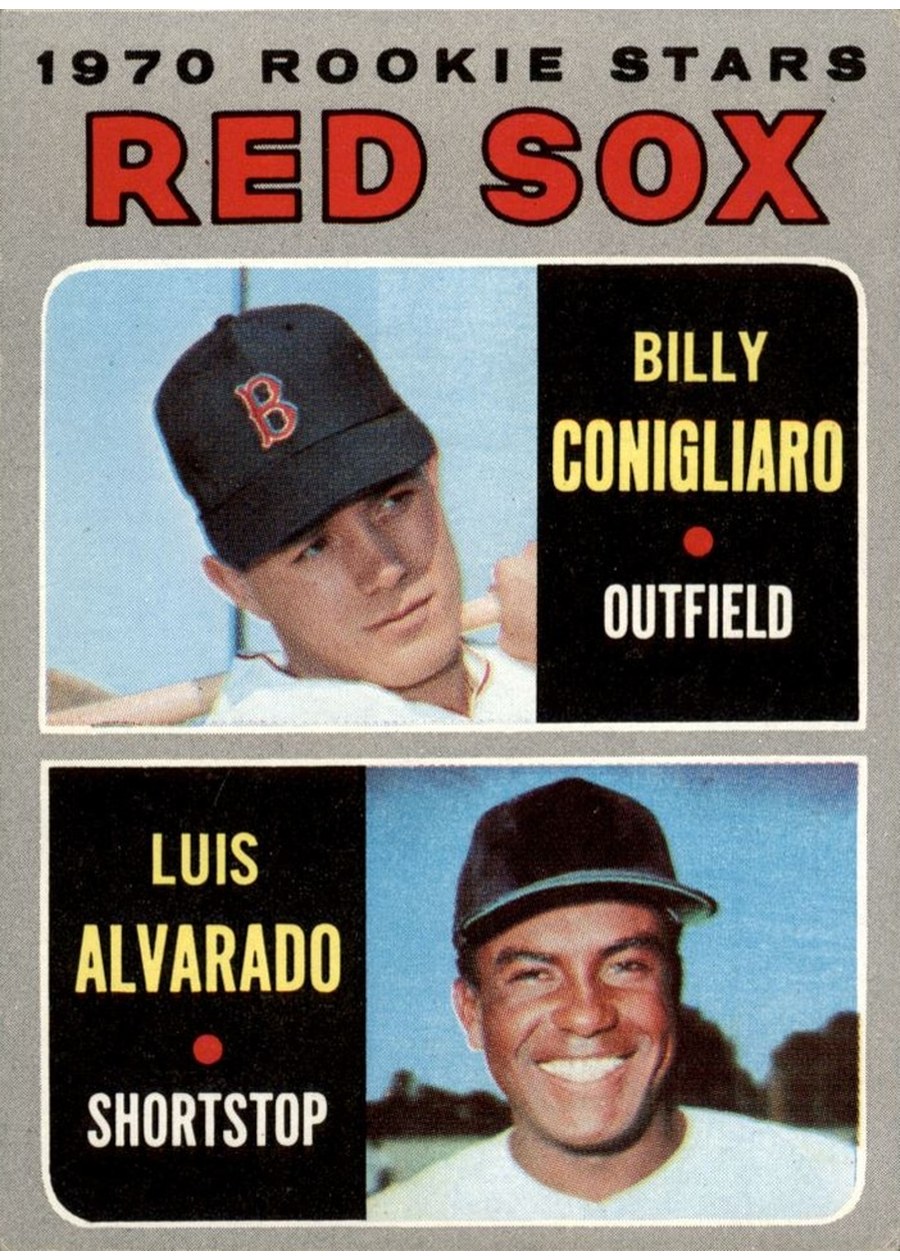
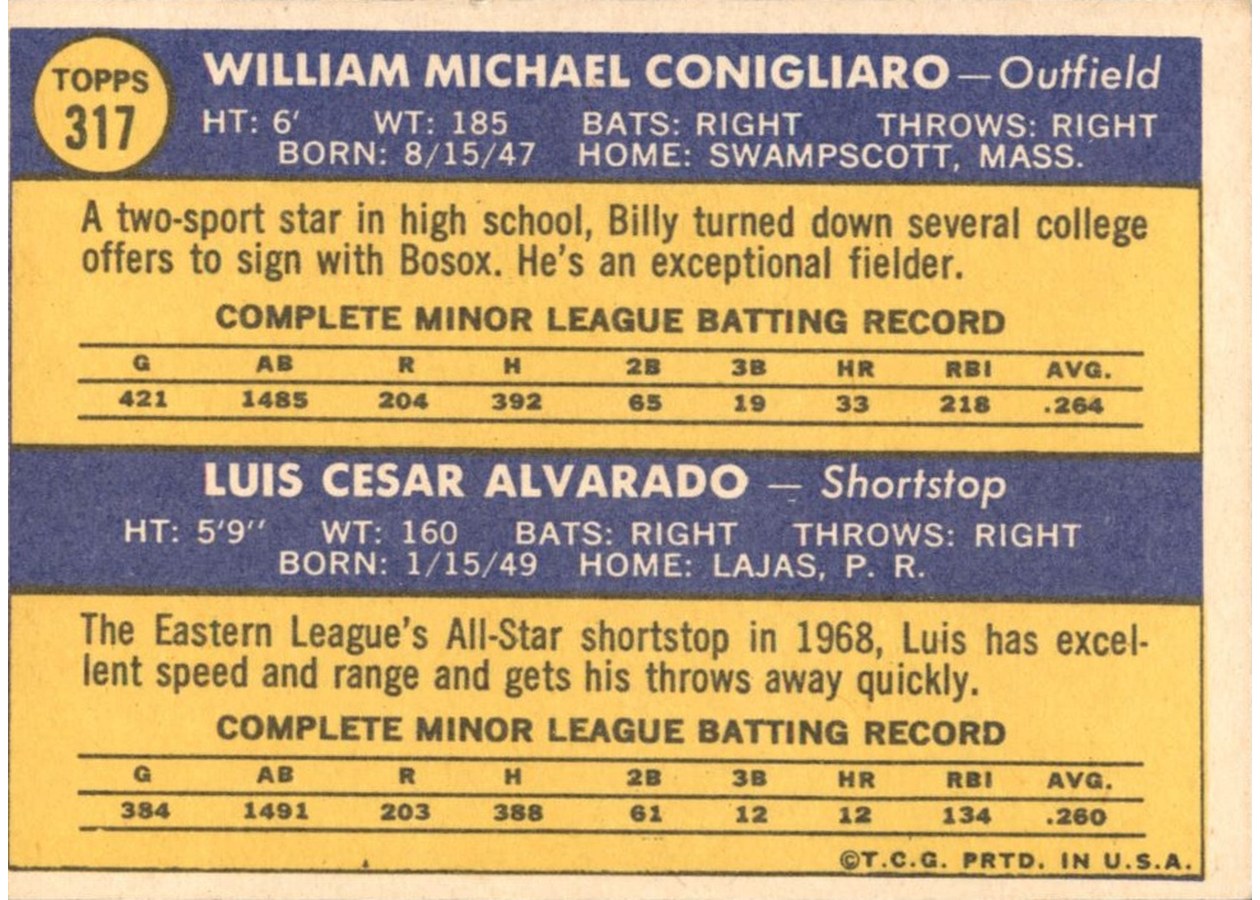
1970 Topps #317 Red Sox Rookie Stars - Billy Conigliaro / Luis Alvarado
On this card: Billy Conigliaro, Luis Alvarado
About this card
This is one of the forty Rookie Stars cards, each showing two or three rookies from one club; #654 (National League) and #702 (American League) each mix three clubs. A Rookie Stars card is a rookie card for the players on it who had no earlier Topps flagship card - on #36, #74, #109, #154, #267, #317, #429, #573, #669 and #683 one of them had already appeared on one, and the rookie-card answer on each card names the players it counts for.
The story on this card
Billy Conigliaro's #317 is a third-series Rookie Stars card that pairs him with fellow Red Sox Luis Alvarado. It follows a 1969 season split in two: he went back to the minors in May and returned in the September roster expansion. He had pinch-run and stolen a base in his first appearance, a 2-1 extra-innings win over Cleveland, after manager Dick Williams said in spring training that Billy "has put himself in the picture." Younger brother of Tony Conigliaro and a Red Sox outfielder; the two combined for a then-record 54 home runs by brothers on one team in 1970, and Billy finished his career with Milwaukee and Oakland.
Alvarado made the Red Sox out of spring training at age 21 and began at third base, a position he said he had not played in about eight years. He played 29 games there and 27 at shortstop before a June 10 benching and a June 22 assignment to Louisville. Recalled in September, he hit his first big-league home run on September 30, a two-run shot off Fritz Peterson. His rookie card is #317, a Rookie Stars card shared with Billy Conigliaro, issued in the third series. Luis Alvarado was a Puerto Rican shortstop and second baseman from Lajas who played for six big-league clubs. He was a glove-first infielder known for quick hands and a fast release.
Sources: Wikipedia (Billy Conigliaro) · Wikipedia (Luis Alvarado) · SABR BioProject (Billy Conigliaro) · SABR BioProject (Luis Alvarado) · BaseballCardPedia
Graded population (PSA & SGC)
| Grader | Total | 10 | 9 | 8 | 7 | 6 | 5 | 1-4 | Auth |
|---|---|---|---|---|---|---|---|---|---|
| PSA | 290 | 2 | 49 | 162 | 41 | 19 | 7 | 7 | 3 |
| SGC | 16 | 0 | 1 | 5 | 5 | 0 | 3 | 2 | 0 |
Graded population — a scarcity guide, not a price. Data as of 2026-10-19. Half grades fold down for both graders (8.5→8); PSA qualified slabs (OC, ST, PD, MC and the like) are not counted.
Find this card
Search T206 Cards Shop 1970 Topps cards Live auctions Buy It Now on eBay Sold prices
As an eBay Partner Network affiliate, T206Cards.com may earn from qualifying purchases.
Related cards
Team card: #563 Boston Red Sox
More Boston Red Sox cards:
- #10 Carl Yastrzemski
- #39 Mike Nagy
- #62 1969 American League Batting Leaders
- #78 Joe Lahoud
- #104 Gerry Moses
- #116 Sparky Lyle
- #144 Ray Culp
- #163 Syd O'Brien
- #191 Vicente Romo
- #215 Reggie Smith
- #237 Russ Gibson
- #251 Dick Schofield
- #279 Bill Lee
- #340 Tony Conigliaro
Frequently asked questions
What is the 1970 Topps #317 card?
It is card #317 of the 720-card 1970 Topps Baseball set, picturing Billy Conigliaro and Luis Alvarado. This is one of the forty Rookie Stars cards, each showing two or three rookies from one club; #654 (National League) and #702 (American League) each mix three clubs. A Rookie Stars card is a rookie card for the players on it who had no earlier Topps flagship card - on #36, #74, #109, #154, #267, #317, #429, #573, #669 and #683 one of them had already appeared on one, and the rookie-card answer on each card names the players it counts for.
Is 1970 Topps #317 a rookie card?
Yes - #317 is the rookie card of Luis Alvarado. Billy Conigliaro had already appeared on an earlier Topps card, so it is not his rookie card.
How many cards are in the 1970 Topps Baseball set?
720 cards, tracked as 726 collectible states. Numbers run from 1 to 720 with none skipped, issued in seven series - #1-132, #133-263, #264-372, #373-459, #460-546, #547-633 and the high numbers, #634-720; 6 cards, all of them checklists, carry catalogued print variations that the master set counts separately.
Sources: Trading Card Database, PSA CardFacts, BaseballCardPedia, Cardboard Connection, Baseball Almanac, Baseball-Reference, the SABR BioProject and the National Baseball Hall of Fame, PSA & SGC population reports. Card data compiled and maintained by T206Cards.com. Page last updated 2026-10-25.