
1935 Goudey 4-in-1 #31 — Pie Traynor / Red Lucas / Tommy Thevenow / Glenn Wright
Glenn Wright is printed “White Sox” on this otherwise all-Pirates blue card — correct, not an error: he closed his career with 9 games for the 1935 White Sox.
The backs of 1935 Goudey cards are puzzle pieces, not player bios: each is marked "PICTURE N — CARD X" and builds one of the set's nine puzzles. This front was printed with 3 different backs (2B, 4B, 7B), so it counts 3 entries toward the 114-combination master set.
One of the set's six blue-border cards — press Panel III, the only panel printed with blue frames and with just three puzzles (Klein, Cochrane, Simmons). Blue combos are not short prints, but each blue front exists with only three backs.
A multi-team card — Chicago White Sox, Pittsburgh Pirates share this front, one of six cards in the set mixing clubs.
The card & its puzzle backs

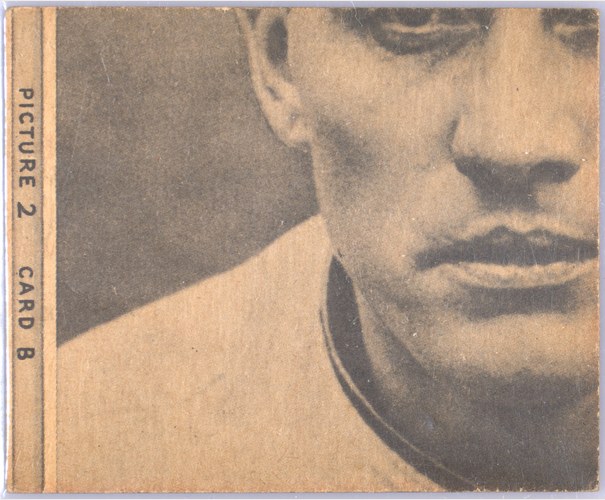
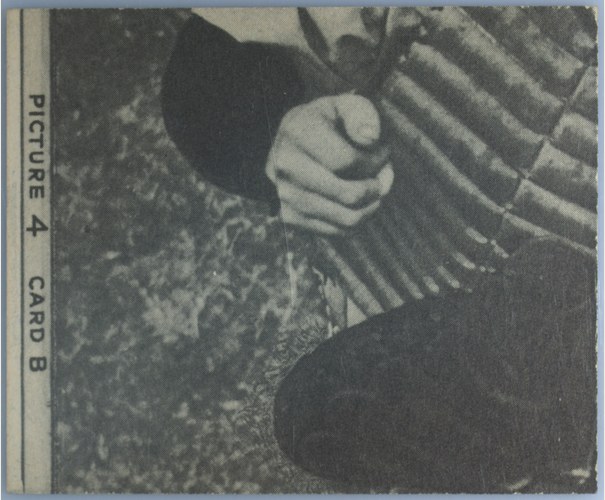

About Pie Traynor
The finest third baseman of his era, Harold “Pie” Traynor earned his nickname as a boy in Somerville, Massachusetts, where the neighborhood kids gathered at Ben Nangle’s corner store and Harold always asked for a slice of pie — “Pie Face” stuck, soon shortened to Pie. Purchased from Portsmouth (Virginia League) for a league-record $10,000 in September 1920, he spent his entire career (1920–37) with Pittsburgh, batting .320 with 2,416 hits, 164 triples, and 1,273 RBI, topping .300 ten times and leading NL third basemen in putouts seven times. He hit .346 in the 1925 World Series, homering off Walter Johnson and tying Game 7 with a triple into the Forbes Field fog as the Pirates rallied past Washington, then batted .342 for the 1927 pennant winners. Named player-manager in June 1934, Traynor was winding down his playing days — 1935 was his last season, save a five-game 1937 cameo — when this all-Pirates blue panel paired him with Red Lucas, Tommy Thevenow, and Glenn Wright, whose “White Sox” tag is no error: Wright closed his career there in 1935. Cooperstown called in 1948, the first third baseman elected by the baseball writers, and the Pirates retired his No. 20.
Sources: Wikipedia · Baseball-Reference · SABR
About Red Lucas
Tennessee-born Charles Fred “Red” Lucas broke into pro ball in 1920 and debuted with John McGraw’s New York Giants in 1923; after a year with the Boston Braves, he became Cincinnati’s workhorse (1926–33), then finished with Pittsburgh (1934–38), closing at 157-135 with a 3.72 ERA and 204 complete games. A supreme control artist, he walked just 18 batters in 219⅔ innings in 1933 and led the NL in complete games three times; Cincinnati Tribune writer Colonel Bob Newhall coined his florid nickname, “The Nashville Narcissus.” A .281 lifetime hitter, Lucas led the NL in pinch hits four times and retired holding baseball’s career pinch-hit record — 114, by far the most ever for a pitcher — a mark that stood until Smoky Burgess passed it in 1965, the year the Reds Hall of Fame welcomed him. In May 1935, this card’s season, he served up Babe Ruth’s 712th homer the day the Babe hit his final three; Goudey’s blue 4-in-1 panel lines him up beside his skipper, Pie Traynor.
Sources: Wikipedia · Baseball-Reference · SABR
About Tommy Thevenow
"Silent Tommy" Thevenow — so quiet his entire World Series homecoming speech was "I want to thank you very much" — signed at Joplin in 1923 and became the Cardinals' shortstop under Rogers Hornsby's wing. In 1926 he played every game, placed fourth in MVP voting, and hit .417 against the Yankees in the Series — circling the bases when Babe Ruth lost his Game 2 fly ball, then blooping home Game 7's winning runs. Grover Cleveland Alexander called him "the kid who won the series." He never cleared a fence in 15 seasons — all three homers came inside the park in 17 days in 1926, then a record 3,347 at-bats without another. Injuries made him a utilityman — Phillies, Pirates (1931–35, 1938), Reds, Bees — .247, 1,030 hits. This blue all-Pirates panel doubles as a reunion: his 597 assists in 1926 missed panel-mate Glenn Wright's record by four, and he spelled Pie Traynor at third. Dealt to Cincinnati after 1935, he later ran his hometown Madison, Indiana grocery: "Stop & Shop with the Shortstop."
Sources: Wikipedia · Baseball-Reference · SABR
About Glenn Wright
"Buckshot" Glenn Wright owed his nickname to a cannon arm that scattered throws all over Kansas City — "I could throw hard but no one could tell where," he admitted of his Blues days. Sold to Pittsburgh, the Missouri shortstop set a major-league record with 601 assists as a 1924 rookie, a mark that stood until Ozzie Smith broke it in 1980. On May 7, 1925, he turned an unassisted triple play against the Cardinals — spearing Jim Bottomley's liner, doubling Jimmy Cooney, and tagging Rogers Hornsby — then drove in 121 runs and homered off Stan Coveleski as the Pirates won the World Series. Compared by contemporaries to Honus Wagner, he added a 1927 pennant before an offseason handball crash wrecked his shoulder, yet he rebounded for Brooklyn in 1930 with a .321 average, 126 RBIs, and 22 home runs, a National League shortstop record until 1953. He retired at .294 with 723 RBIs. Card #31 sets him beside Pirates Traynor, Lucas, and Thevenow yet prints him a White Sox — no error: Wright closed his career with nine games for Chicago in 1935, making this 4-in-1 panel a true final-season card.
Sources: Wikipedia · Baseball-Reference · SABR
Graded population (PSA & SGC)
| Grader | Total | 10 | 9 | 8 | 7 | 6 | 5 | 1-4 | Auth |
|---|---|---|---|---|---|---|---|---|---|
| PSA | 138 | 0 | 0 | 4 | 3 | 15 | 20 | 94 | 2 |
| SGC | 55 | 0 | 0 | 0 | 0 | 1 | 7 | 45 | 2 |
Graded population — a scarcity guide, not a price. Snapshot 2026-08-06. Half-grades fold down (8.5→8). Totals are summed across this front's graded back combinations.
PSA by back: 2B 39 · 4B 52 · 7B 47
SGC by back: 2B 12 · 4B 20 · 7B 23
Find this card
Search T206 Cards Buy It Now on eBay eBay auctions ending soon
As an eBay Partner Network affiliate, T206Cards.com may earn from qualifying purchases.
Related cards
More Chicago White Sox cards:
- #8 George Earnshaw / Jimmy Dykes / Luke Sewell / Luke Appling
- #12 Jackie Hayes / Ted Lyons / Mule Haas / Zeke Bonura
- #25 Muddy Ruel / Al Simmons / Willie Kamm / Mickey Cochrane
More Pittsburgh Pirates cards:
- #13 Babe Herman / Gus Suhr / Tom Padden / Cy Blanton
- #33 Paul Waner / Guy Bush / Waite Hoyt / Lloyd Waner
Other fronts in the same puzzle pictures:
- #1 Charlie Berry / Bobby Burke / Red Kress / Dazzy Vance
- #4 Mickey Cochrane / Charlie Gehringer / Tommy Bridges / Billy Rogell
- #5 Hughie Critz / Dick Bartell / Mel Ott / Gus Mancuso
- #8 George Earnshaw / Jimmy Dykes / Luke Sewell / Luke Appling
- #10 Frankie Frisch / Dizzy Dean / Ernie Orsatti / Tex Carleton
- #11 Burleigh Grimes / Chuck Klein / Kiki Cuyler / Woody English
- #16 Willie Kamm / Oral Hildebrand / Earl Averill / Hal Trosky
- #19 Sam Leslie / Lonny Frey / Joe Stripp / Watty Clark
Frequently asked questions
What is the 1935 Goudey 4-in-1 Traynor/Lucas/Thevenow/Wright card?
It is one of the 36 unnumbered fronts of the 1935 Goudey 4-in-1 set (R321), picturing Pie Traynor / Red Lucas / Tommy Thevenow / Glenn Wright. The 2-3/8 by 2-7/8 inch card carries four color portraits on the front and a puzzle piece on the back. Checklists that number the set (Old Cardboard / the Burdick Collection convention, alphabetical by the upper-left player) list it as #31 of 36.
How many backs does this card have?
3: 2B, 4B, 7B. Every 1935 Goudey front was printed with two to four different puzzle-piece backs, and collectors chasing the 114-combination master set track each front/back pairing separately.
Why does this card have a blue border?
It belongs to press Panel III, the only six-card panel Goudey printed with blue frames instead of red. The blue six are Berry/Burke/Kress/Vance, Critz/Bartell/Ott/Mancuso, Martin/O'Farrell/Byrd/MacFayden, Moore/Hogan/Frankhouse/Brandt, Ruffing/Malone/Lazzeri/Dickey and Traynor/Lucas/Thevenow/Wright.
How many cards are in the 1935 Goudey 4-in-1 set?
36 fronts, each with four players (144 panels picturing 138 different men). Counting the two-to-four puzzle backs each front was printed with, the master set runs to 114 front/back combinations, 42 of them short prints. A complete set of all nine puzzles requires 72 different backs.
Sources: Trading Card Database, Old Cardboard, the Burdick Collection catalog (Metropolitan Museum of Art), SABR Baseball Cards research, Baseball-Reference, PSA & SGC population reports, and the Dec 1995 VCBC press-panel analysis. Card data compiled and maintained by T206Cards.com. Page last updated 2026-08-14.