
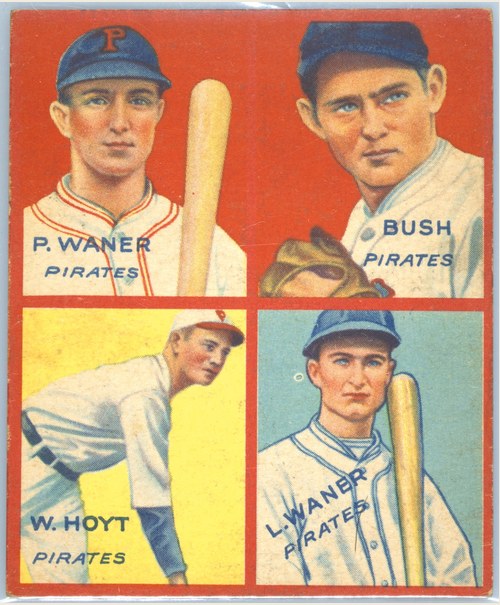
1935 Goudey 4-in-1 #33 — Paul Waner / Guy Bush / Waite Hoyt / Lloyd Waner
Both Waner brothers and Waite Hoyt — three Hall of Famers on one Pirates card.
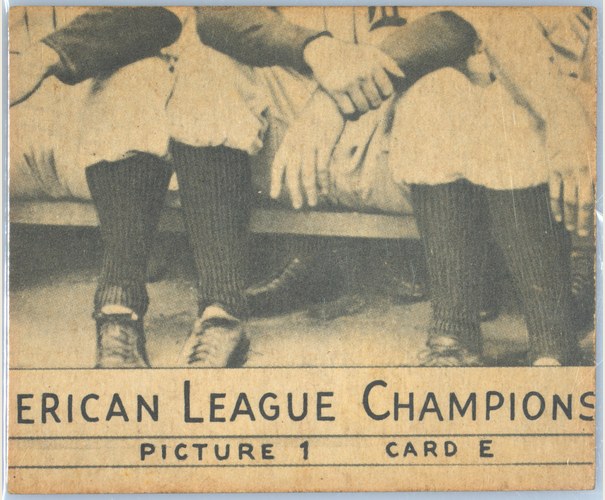
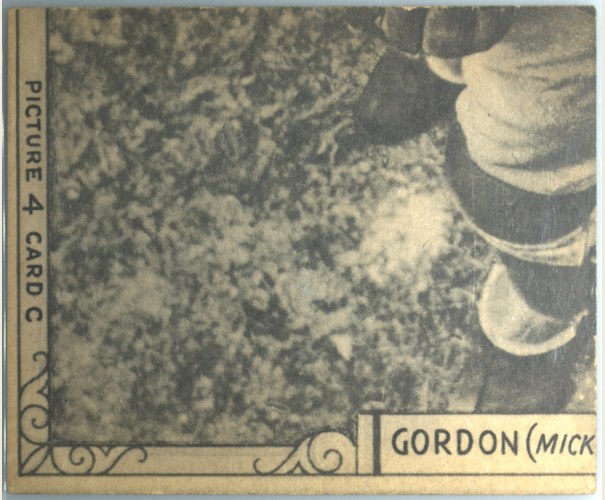
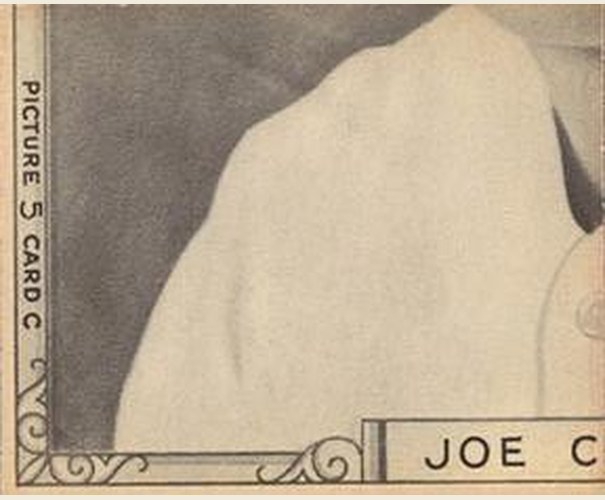
The backs of 1935 Goudey cards are puzzle pieces, not player bios: each is marked "PICTURE N — CARD X" and builds one of the set's nine puzzles. This front was printed with 4 different backs (1E, 3C, 4C, 5C), so it counts 4 entries toward the 114-combination master set.
Puzzles 1-7 were each printed twice with different front panels, and one side of each pairing is much scarcer: for this front, 4C is the short-printed combo (per Beckett's tags and the Dec 1995 VCBC press-panel analysis).
The card & its puzzle backs

About Paul Waner
Paul "Big Poison" Waner was the bigger half of Pittsburgh's brother act — a New York fan's cry of "big person" came out "poison," and the name stuck, with kid brother Lloyd, "Little Poison," beside him in center field. An Oklahoma farm boy who honed his timing swatting corncobs, Waner went from sore-armed college pitcher to San Francisco Seals outfielder, hit .401 in 1925, and joined the Pirates in a $100,000 deal. Pittsburgh's right fielder for fifteen seasons (1926–40), he hit .340, won the 1927 NL MVP (.380, 237 hits, 131 RBIs) while driving the Pirates to the pennant, and batted .333 as Murderers' Row swept the World Series. He added three batting titles, eight 200-hit seasons, and a then-NL-record 62 doubles in 1932. On June 19, 1942, a single off old Pirate teammate Rip Sewell made him the seventh member of the 3,000-hit club — two days after he waved off a questionable single, insisting No. 3,000 be clean. A .333 lifetime hitter with 3,152 hits, he reached Cooperstown in 1952. Goudey's new-for-1935 4-in-1 prints him as "P. Waner" on a loaded panel with Lloyd, Guy Bush, and Waite Hoyt — three Hall of Famers on one Pirates card.
Sources: Wikipedia · Baseball-Reference · SABR
About Guy Bush
Guy Terrell Bush (1901–1985), the right-hander they called “The Mississippi Mudcat,” came off a Mississippi cotton farm into the Class D Cotton States League in 1923 — and was so wary of big-city Chicago that when the Cubs wired him to report, he hid out under an alias in another Class D league for six weeks before braving the trip north. He became a North Side mainstay, going 152–101 over twelve seasons, winning Game 3 of the 1929 World Series for Chicago’s lone victory over the A’s, starting Game 1 of the infamous 1932 “called shot” Series, and peaking at 20–12 with a 2.75 ERA in 1933. Traded to Pittsburgh in November 1934, he entered history on May 25, 1935, serving Babe Ruth’s final two home runs — No. 714 the first ball ever to clear Forbes Field’s right-field grandstand; Bush called it “the longest cockeyed ball I ever saw.” Waite Hoyt relieved him and won that game — and shares this very panel, which pictures Bush in his new Pirates flannels beside Hoyt and both Waners: three Hall of Famers flanking the Mudcat, who finished 176–136 after a 1945 farewell with Cincinnati.
Sources: Wikipedia · Baseball-Reference · SABR
About Waite Hoyt
Brooklyn schoolboy Waite Charles Hoyt (1899–1984) was signed by John McGraw’s Giants at just 15 in 1915, straight off the Erasmus Hall High School nine — and “Schoolboy” followed him onto his Hall of Fame plaque. Debuting in July 1918 and dealt from the Red Sox to the Yankees in December 1920, the right-hander became the pitching mainstay of the Yankees’ 1920s dynasty: six pennants, world titles in 1923, 1927, and 1928, three complete games without an earned run in the 1921 World Series, and an AL-best 22 wins for the 110-win Murderers’ Row club of 1927. He retired in 1938 at 237–182 with a 6–4, 1.83 ERA line across seven World Series. Here he appears during his Pittsburgh revival (1933–37), fresh off 15 wins in 1934 — printed “W. Hoyt” in the lower-left of panel #33 beside Guy Bush and the Waner brothers, he joins Paul and Lloyd as one of three Hall of Famers on a single Pirates card, wearing the uniform of the very team his 1927 Yankees swept. Later the Reds’ beloved radio voice for 24 years (1942–65), famed for his two-hour on-air Babe Ruth eulogy in 1948, Hoyt reached Cooperstown via the Veterans Committee in 1969.
Sources: Wikipedia · Baseball-Reference · SABR
About Lloyd Waner
The smaller half of baseball’s greatest brother act, Lloyd “Little Poison” Waner went from a cup of coffee with the 1925 San Francisco Seals and an MVP year in the Sally League to the Pittsburgh Pirates’ center-field job in 1927 — and simply never stopped hitting. His rookie season: a .355 average, a league-best 133 runs, and 223 hits, still the National League rookie record, capped by a .400 World Series as the Murderers’ Row Yankees swept Pittsburgh. His 678 hits through his first three seasons set a record even Ichiro Suzuki couldn’t catch. The nickname arrived that same summer: by Lloyd’s own telling, a leather-lunged Polo Grounds fan bellowing “little person” and “big person” in thick New Yorkese came out “poison,” and the sportswriters ran with it. One of the keenest eyes in history — just 173 strikeouts in 7,772 at-bats — he wandered to the Braves, Reds, Phillies, and Dodgers before retiring a Pirate in 1945 at .316 with 2,459 hits; he and Paul still hold the brothers’ record of 5,611 combined. This 4-in-1 panel, printed “L. Waner,” squeezes both Waners and Waite Hoyt — three Hall of Famers — onto one Pirates card. Cooperstown called in 1967, via the Veterans Committee.
Sources: Wikipedia · Baseball-Reference · SABR
Graded population (PSA & SGC)
| Grader | Total | 10 | 9 | 8 | 7 | 6 | 5 | 1-4 | Auth |
|---|---|---|---|---|---|---|---|---|---|
| PSA | 181 | 0 | 0 | 2 | 14 | 12 | 33 | 119 | 1 |
| SGC | 51 | 0 | 0 | 0 | 1 | 1 | 3 | 42 | 4 |
Graded population — a scarcity guide, not a price. Snapshot 2026-08-06. Half-grades fold down (8.5→8). Totals are summed across this front's graded back combinations.
PSA by back: 1E 70 · 3C 74 · 4C (SP) 14 · 5C 23
SGC by back: 1E 21 · 3C 25 · 4C (SP) 3 · 5C 2
Find this card
Search T206 Cards Buy It Now on eBay eBay auctions ending soon
As an eBay Partner Network affiliate, T206Cards.com may earn from qualifying purchases.
Related cards
More Pittsburgh Pirates cards:
- #13 Babe Herman / Gus Suhr / Tom Padden / Cy Blanton
- #31 Pie Traynor / Red Lucas / Tommy Thevenow / Glenn Wright
Other fronts in the same puzzle pictures:
- #1 Charlie Berry / Bobby Burke / Red Kress / Dazzy Vance
- #4 Mickey Cochrane / Charlie Gehringer / Tommy Bridges / Billy Rogell
- #5 Hughie Critz / Dick Bartell / Mel Ott / Gus Mancuso
- #6 Joe Cronin / Carl Reynolds / Max Bishop / Bill Cissell
- #8 George Earnshaw / Jimmy Dykes / Luke Sewell / Luke Appling
- #10 Frankie Frisch / Dizzy Dean / Ernie Orsatti / Tex Carleton
- #11 Burleigh Grimes / Chuck Klein / Kiki Cuyler / Woody English
- #14 Willis Hudlin / Glenn Myatt / Adam Comorosky / Jim Bottomley
Frequently asked questions
What is the 1935 Goudey 4-in-1 Waner/Bush/Hoyt/Waner card?
It is one of the 36 unnumbered fronts of the 1935 Goudey 4-in-1 set (R321), picturing Paul Waner / Guy Bush / Waite Hoyt / Lloyd Waner. The 2-3/8 by 2-7/8 inch card carries four color portraits on the front and a puzzle piece on the back. Checklists that number the set (Old Cardboard / the Burdick Collection convention, alphabetical by the upper-left player) list it as #33 of 36.
How many backs does this card have?
4: 1E, 3C, 4C, 5C. Every 1935 Goudey front was printed with two to four different puzzle-piece backs, and collectors chasing the 114-combination master set track each front/back pairing separately. The 4C printing is short prints per Beckett and the VCBC press-panel analysis.
How many cards are in the 1935 Goudey 4-in-1 set?
36 fronts, each with four players (144 panels picturing 138 different men). Counting the two-to-four puzzle backs each front was printed with, the master set runs to 114 front/back combinations, 42 of them short prints. A complete set of all nine puzzles requires 72 different backs.
Sources: Trading Card Database, Old Cardboard, the Burdick Collection catalog (Metropolitan Museum of Art), SABR Baseball Cards research, Baseball-Reference, PSA & SGC population reports, and the Dec 1995 VCBC press-panel analysis. Card data compiled and maintained by T206Cards.com. Page last updated 2026-08-14.