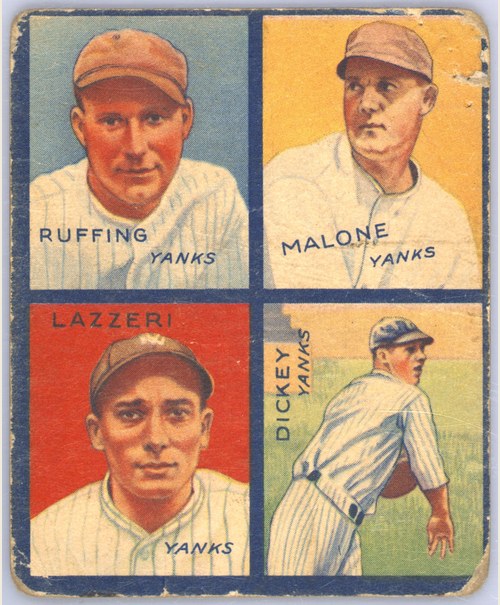
1935 Goudey 4-in-1 #26 — Red Ruffing / Pat Malone / Tony Lazzeri / Bill Dickey
The blue-border Yankees card: Dickey, Lazzeri and Ruffing — three Hall of Famers. Pat Malone is printed as a Yankee (sold to New York March 26, 1935), which dates the blue panel.
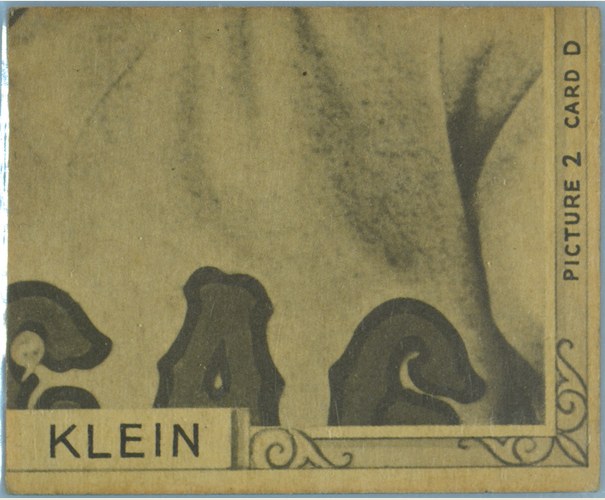
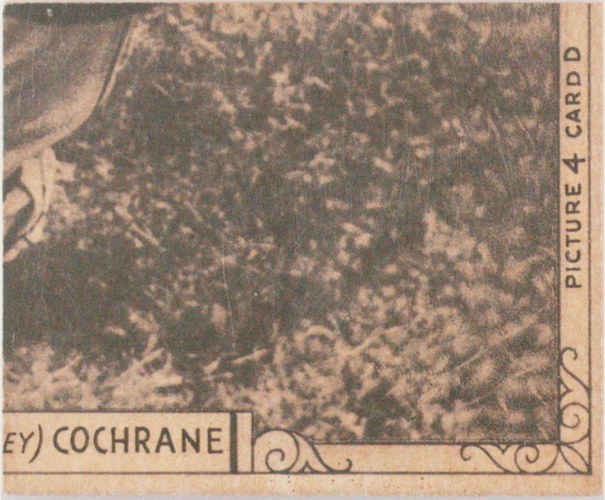
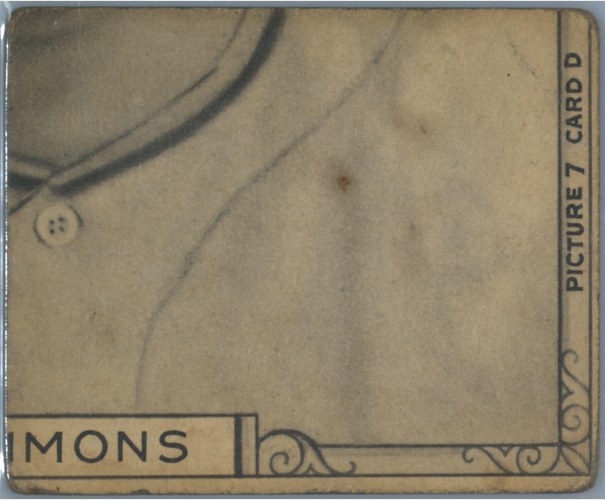
The backs of 1935 Goudey cards are puzzle pieces, not player bios: each is marked "PICTURE N — CARD X" and builds one of the set's nine puzzles. This front was printed with 3 different backs (2D, 4D, 7D), so it counts 3 entries toward the 114-combination master set.
One of the set's six blue-border cards — press Panel III, the only panel printed with blue frames and with just three puzzles (Klein, Cochrane, Simmons). Blue combos are not short prints, but each blue front exists with only three backs.
The card & its puzzle backs
About Red Ruffing
Red — the nickname came from his hair — Charles Herbert Ruffing quit school at 13 for the Illinois coal mines and lost four toes at 15 when his left foot was crushed between coal cars. Unable to run in the outfield, he turned to pitching, signed with Danville of the Three-I League in 1923, and debuted with Boston on May 31, 1924. He went 39-96 for the last-place Red Sox before a May 1930 trade to the Yankees for Cedric Durst and $50,000 — one of the most lopsided deals in baseball history. In New York he led the AL in strikeouts in 1932, won 20-plus games four straight years from 1936-39, started a record six World Series openers, and claimed six championships (1932, 1936-39, 1941), all while batting .269 with 36 career home runs. He finished 273-225 with 1,987 strikeouts; his 231 Yankee victories still lead all franchise right-handers. Coming off 19 wins in 1934, Ruffing shares this blue-border panel with his roommate Tony Lazzeri and close friend Bill Dickey — three Hall of Famers on one card front, with newly acquired Pat Malone dating the artwork to spring 1935. Cooperstown called in 1967.
Sources: Wikipedia · Baseball-Reference · SABR
About Pat Malone
Born Perce Leigh Malone in the railroad town of Altoona, Pennsylvania, he decided “Perce” sounded too sissy and enforced “Pat” with his fists. A onetime locomotive fireman and amateur boxer, the hard-throwing right-hander logged seven years in the minors before the Cubs bought him from Minneapolis for 1928. He won 18 games as a rookie, then led the National League in victories two years running — 22–10 in 1929 with league bests in shutouts and strikeouts (166, ending Dazzy Vance’s seven-year strikeout reign) for the pennant-winning Cubs, then 20 wins in 1930. Alongside Charlie Root and Guy Bush he anchored one of the era’s great staffs, and in the 1932 World Series he was the man who relieved Root moments after Babe Ruth’s called shot, firing 2⅔ scoreless innings. Sold to the Yankees on March 26, 1935 — the transaction that dates this blue-border panel, which he shares with Hall of Famers Red Ruffing, Tony Lazzeri, and Bill Dickey — “Blubber,” as writers dubbed the 230-pounder, reinvented himself as New York’s bullpen fireman, leading the American League with nine saves for the 1936 world champions. He finished 134–92 with 1,024 strikeouts and died at just 40 in 1943.
Sources: Wikipedia · Baseball-Reference · SABR
About Tony Lazzeri
A San Francisco boilermaker’s son, Tony Lazzeri turned pro with Salt Lake City in 1922 and erupted in 1925: .355 with 222 RBI and 60 home runs, then the most ever hit in professional baseball. Epilepsy scared off the Cubs and Reds; the Yankees paid $50,000, and Miller Huggins converted the shortstop into his second baseman. New York’s first great Italian star, he was crowned “Poosh ’Em Up Tony,” a nickname he traced to a Salt Lake fan’s broken-English plea for a hit. Brains of the Murderers’ Row infield, he topped 100 RBI seven times in twelve Yankee seasons (1926–37), winning six pennants and five World Series, though the bases-loaded strikeout against Grover Cleveland Alexander in the 1926 Series shadowed him for life. On May 24, 1936, he drove in an American League–record 11 runs and hit two grand slams in one game, a big-league first. He finished with the Cubs (1938), Dodgers and Giants (1939): .292, 178 homers, nearly 1,200 RBI. Goudey’s blue-border Yankees panel stacks Lazzeri beside Bill Dickey and Red Ruffing, three Hall of Famers on one card, and Pat Malone’s Yankee tag (sold to New York March 26, 1935) dates the printing. Cooperstown finally called in 1991.
Sources: Wikipedia · Baseball-Reference · SABR
About Bill Dickey
Bill Dickey was a teenage fill-in catcher on a Hot Springs semipro club when the Little Rock Travelers signed him in 1925 — on the back of an Elks membership card. Yankees scout Johnny Nee soon wired New York, “I will quit scouting if this boy does not make good,” and Dickey made good for 17 seasons, all in pinstripes (1928–43 and 1946): a .313 lifetime average, 202 home runs, 1,209 RBI, eleven All-Star selections, a record thirteen straight years catching 100-plus games, and seven World Series titles — the last clinched by his own two-run homer in Game 5 of the 1943 Series. His .362 average in 1936 stood as the single-season record for catchers until 2009. So quiet and reserved he was dubbed “The Man Nobody Knows,” Dickey came back as a coach in 1949 to school young Yogi Berra — “Bill was learning me all his experience,” Yogi explained — and reached the Hall of Fame in 1954. Here he holds down the blue-bordered Yankees quadrant beside fellow Hall of Famers Lazzeri and Ruffing, while Pat Malone in pinstripes — sold to New York March 26, 1935 — dates the panel.
Sources: Wikipedia · Baseball-Reference · SABR
Graded population (PSA & SGC)
| Grader | Total | 10 | 9 | 8 | 7 | 6 | 5 | 1-4 | Auth |
|---|---|---|---|---|---|---|---|---|---|
| PSA | 164 | 0 | 0 | 1 | 4 | 15 | 22 | 119 | 3 |
| SGC | 91 | 0 | 0 | 0 | 0 | 1 | 7 | 78 | 5 |
Graded population — a scarcity guide, not a price. Snapshot 2026-08-06. PSA counts are straight grades only; PSA half-grade and qualified slabs are not included. SGC half grades fold down (8.5→8). Totals are summed across this front's graded back combinations.
PSA by back: 2D 47 · 4D 49 · 7D 68
SGC by back: 2D 19 · 4D 29 · 7D 43
Find this card
Search T206 Cards Buy It Now on eBay eBay auctions ending soon Sold prices
As an eBay Partner Network affiliate, T206Cards.com may earn from qualifying purchases.
Related cards
More New York Yankees cards:
Other fronts in the same puzzle pictures:
- #1 Charlie Berry / Bobby Burke / Red Kress / Dazzy Vance
- #4 Mickey Cochrane / Charlie Gehringer / Tommy Bridges / Billy Rogell
- #5 Hughie Critz / Dick Bartell / Mel Ott / Gus Mancuso
- #8 George Earnshaw / Jimmy Dykes / Luke Sewell / Luke Appling
- #10 Frankie Frisch / Dizzy Dean / Ernie Orsatti / Tex Carleton
- #11 Burleigh Grimes / Chuck Klein / Kiki Cuyler / Woody English
- #16 Willie Kamm / Oral Hildebrand / Earl Averill / Hal Trosky
- #19 Sam Leslie / Lonny Frey / Joe Stripp / Watty Clark
Frequently asked questions
What is the 1935 Goudey 4-in-1 Ruffing/Malone/Lazzeri/Dickey card?
It is one of the 36 unnumbered fronts of the 1935 Goudey 4-in-1 set (R321), picturing Red Ruffing / Pat Malone / Tony Lazzeri / Bill Dickey. The 2-3/8 by 2-7/8 inch card carries four color portraits on the front and a puzzle piece on the back. Checklists that number the set (Old Cardboard / the Burdick Collection convention, alphabetical by the upper-left player) list it as #26 of 36.
How many backs does this card have?
3: 2D, 4D, 7D. Every 1935 Goudey front was printed with two to four different puzzle-piece backs, and collectors chasing the 114-combination master set track each front/back pairing separately.
Why does this card have a blue border?
It belongs to press Panel III, the only six-card panel Goudey printed with blue frames instead of red. The blue six are Berry/Burke/Kress/Vance, Critz/Bartell/Ott/Mancuso, Martin/O'Farrell/Byrd/MacFayden, Moore/Hogan/Frankhouse/Brandt, Ruffing/Malone/Lazzeri/Dickey and Traynor/Lucas/Thevenow/Wright.
How many cards are in the 1935 Goudey 4-in-1 set?
36 fronts, each with four players (144 panels picturing 138 different men). Counting the two-to-four puzzle backs each front was printed with, the master set runs to 114 front/back combinations, 42 of them short prints. A complete set of all nine puzzles requires 72 different backs.
Sources: Trading Card Database, Old Cardboard, the Burdick Collection catalog (Metropolitan Museum of Art), SABR Baseball Cards research, Baseball-Reference, PSA & SGC population reports, and the Dec 1995 VCBC press-panel analysis. Card data compiled and maintained by T206Cards.com. Page last updated 2026-10-05.