1951 Topps Connie Mack's All-Star Honus Wagner
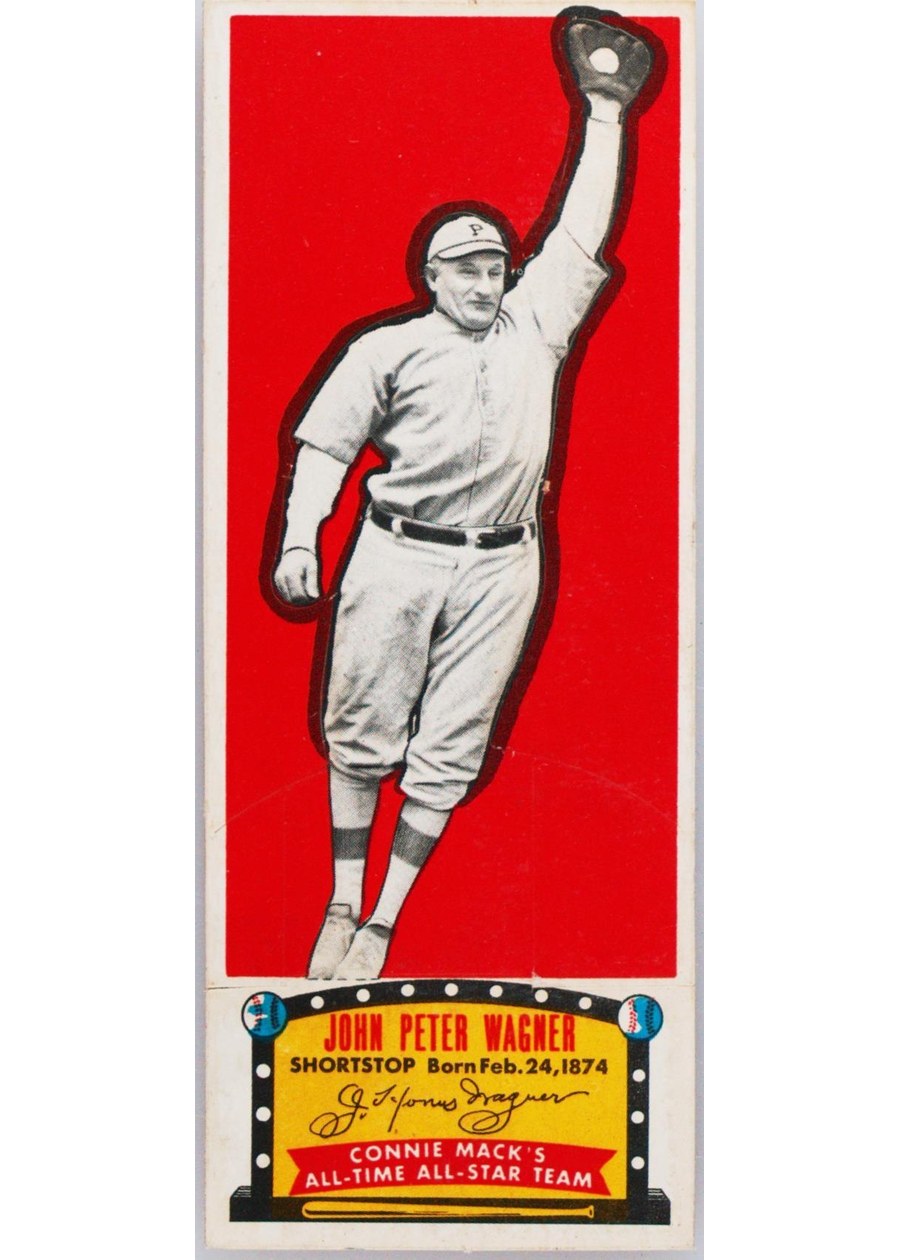
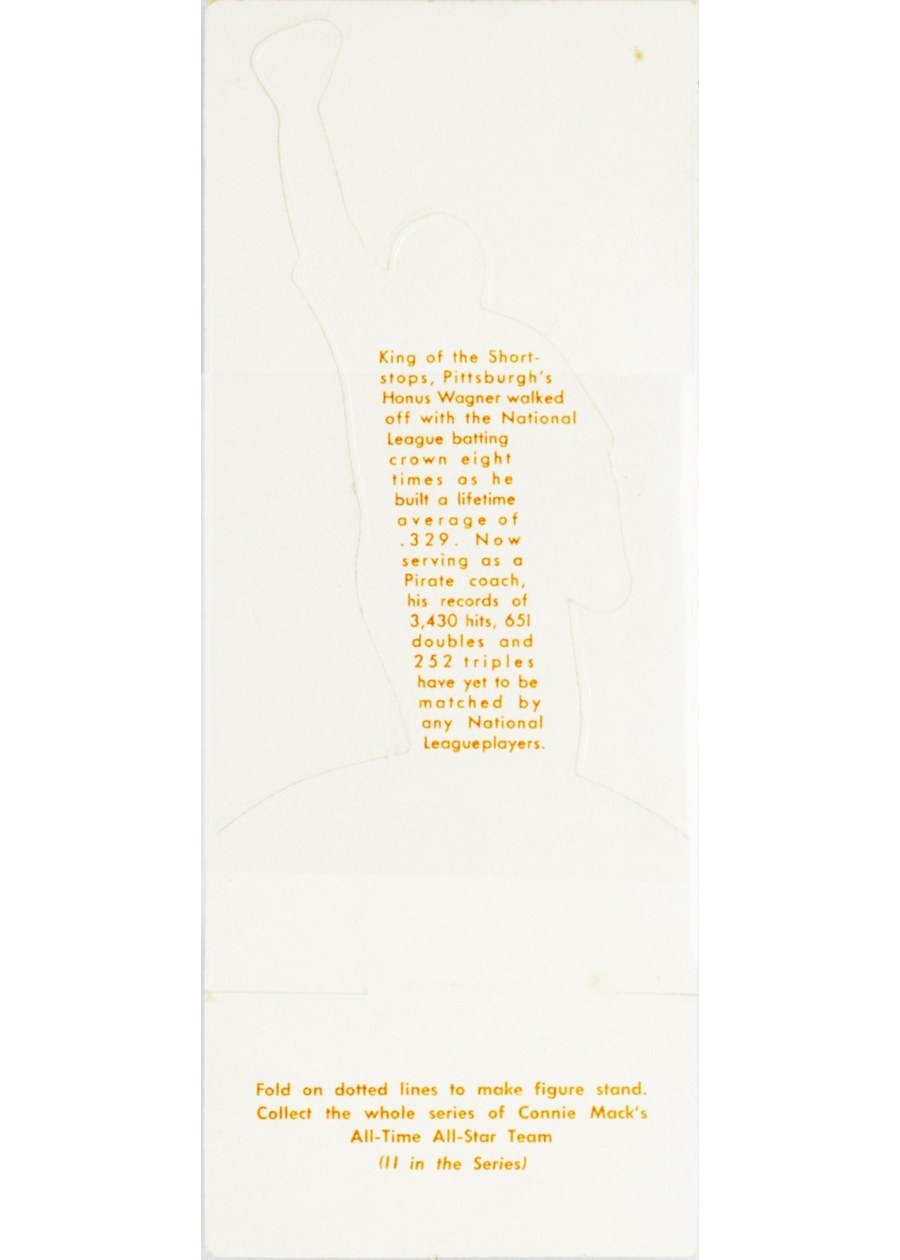
About this card
Connie Mack's All-Stars are eleven die-cut stand-ups of the all-time greats Connie Mack picked; every one of the eleven is in the Hall of Fame. They were made to be folded and stood up, so complete, unbent examples are hard to find.
About Honus Wagner
Wagner's place on an all-time team rests on the decade from 1900 to 1909, when he led the National League in every major batting category except triples and home runs, and Pittsburgh went 938-538. He hit .300 or better every season from 1899 through 1913. His .354 in 1908 came in a year both leagues hit .239, and his offensive winning percentage of .878 that season stood as the National League best until Barry Bonds in 2001. He entered the Hall of Fame in 1936.
Honus Wagner played 21 major league seasons and settled at shortstop after playing across the infield and outfield. Louisville gave him his major league debut on July 19, 1897, and when the Colonels folded after 1899, club president Barney Dreyfuss brought him along to the Pirates, where he spent the rest of his career. Wagner won a joint-record eight National League batting titles, the first at .381 in 1900, and in 1908 led the league in hitting, hits, doubles, triples, RBI and stolen bases. He played every position except catcher and gave up no earned runs in two turns on the mound. His speed and German heritage earned him the nickname the Flying Dutchman. In 1905 he signed a contract for the first bat bearing a player's signature, the Louisville Slugger. In 1914, at 40, he collected his 3,000th hit, the second player to reach it after Cap Anson. He retired after 1917 with 3,415 hits, a .327 average and 722 stolen bases, and in 1936 was one of the first five men inducted into the Hall of Fame.
Sources: Wikipedia · SABR BioProject · Baseball-Reference · SABR Games Project · BaseballCardPedia
Graded population (PSA & SGC)
| Grader | Total | 10 | 9 | 8 | 7 | 6 | 5 | 1-4 | Auth |
|---|---|---|---|---|---|---|---|---|---|
| PSA | 122 | 0 | 0 | 1 | 3 | 17 | 25 | 59 | 17 |
| SGC | 98 | 0 | 0 | 0 | 4 | 3 | 14 | 40 | 37 |
Graded population — a scarcity guide, not a price. Data as of 2026-10-19. Half grades fold down for both graders (8.5→8); PSA qualified slabs (OC, ST, PD, MC and the like) are not counted.
Find this card
Search T206 Cards Shop 1951 Topps cards Live auctions Buy It Now on eBay Sold prices
As an eBay Partner Network affiliate, T206Cards.com may earn from qualifying purchases.
Related cards
More Pittsburgh Pirates cards:
- Red Back #15 Ralph Kiner
- Red Back #17 Dave Bell
- Red Back #25 Cliff Chambers
- Red Back #27 Wally Westlake
- Red Back #33 William Werle
- Blue Back #16 Murry Dickson
- Major League All-Star Ralph Kiner
Frequently asked questions
What is the 1951 Topps Connie Mack's All-Star card?
It is Connie Mack's All-Star in the 135-card 1951 Topps Baseball checklist, picturing Honus Wagner of the Pittsburgh Pirates. Connie Mack's All-Stars are eleven die-cut stand-ups of the all-time greats Connie Mack picked; every one of the eleven is in the Hall of Fame. They were made to be folded and stood up, so complete, unbent examples are hard to find.
How many cards are in the 1951 Topps Baseball set?
135 cards across five issues - the Red Backs and Blue Backs (52 each), nine Team cards, and eleven each of Connie Mack's All-Stars and the Major League All-Stars. With the Zernial and Holmes variations and both versions of each Team card the master set is 146. All 135 count toward the full set; Jim Konstanty, Robin Roberts and Eddie Stanky, the three rarest Major League All-Stars, are so rarely seen that collectors often count a complete set as 132 without them.
Sources: PSA, BaseballCardPedia, Trading Card Database, Baseball-Reference, PSA & SGC population reports. Card data compiled and maintained by T206Cards.com. Page last updated 2026-10-26.