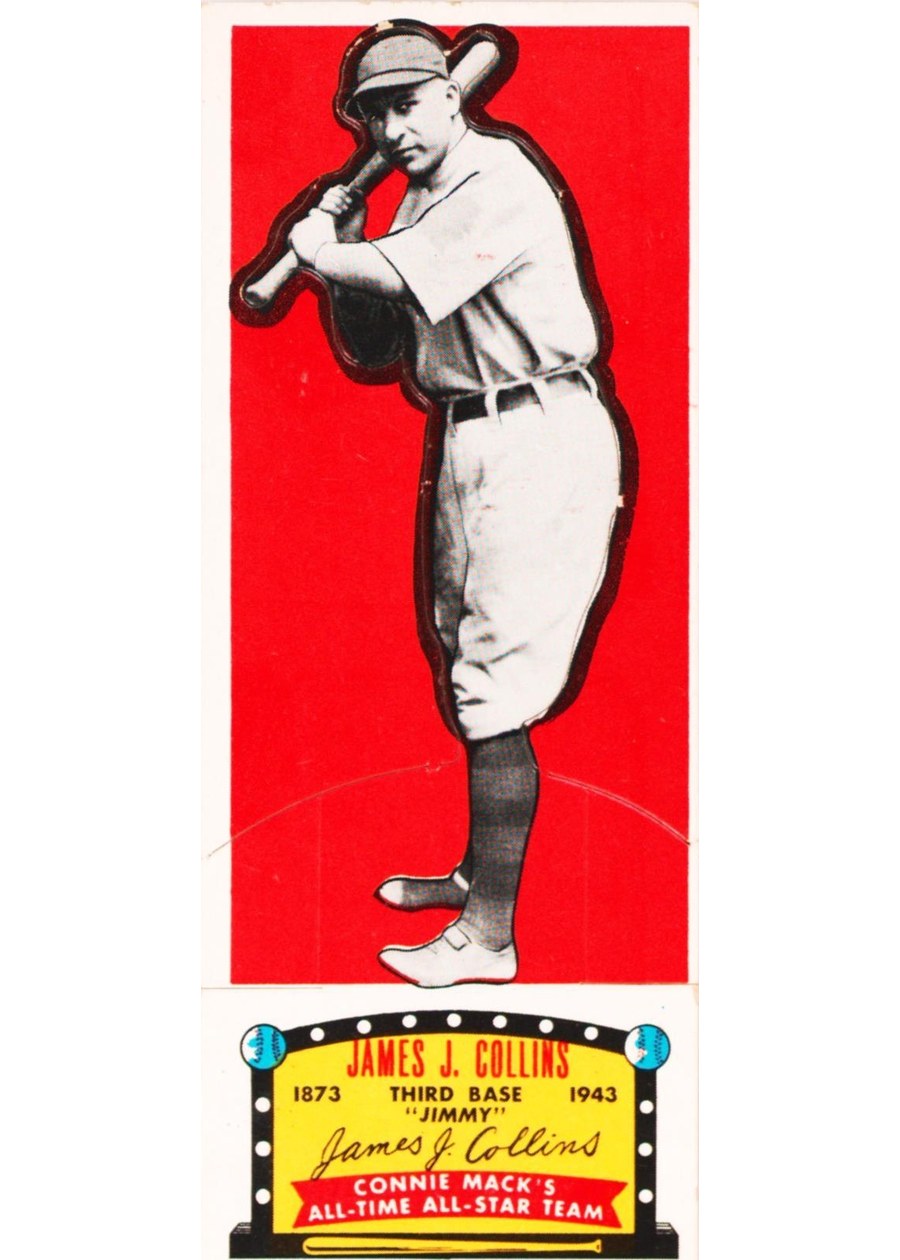
1951 Topps Connie Mack's All-Star Jimmy Collins
About this card
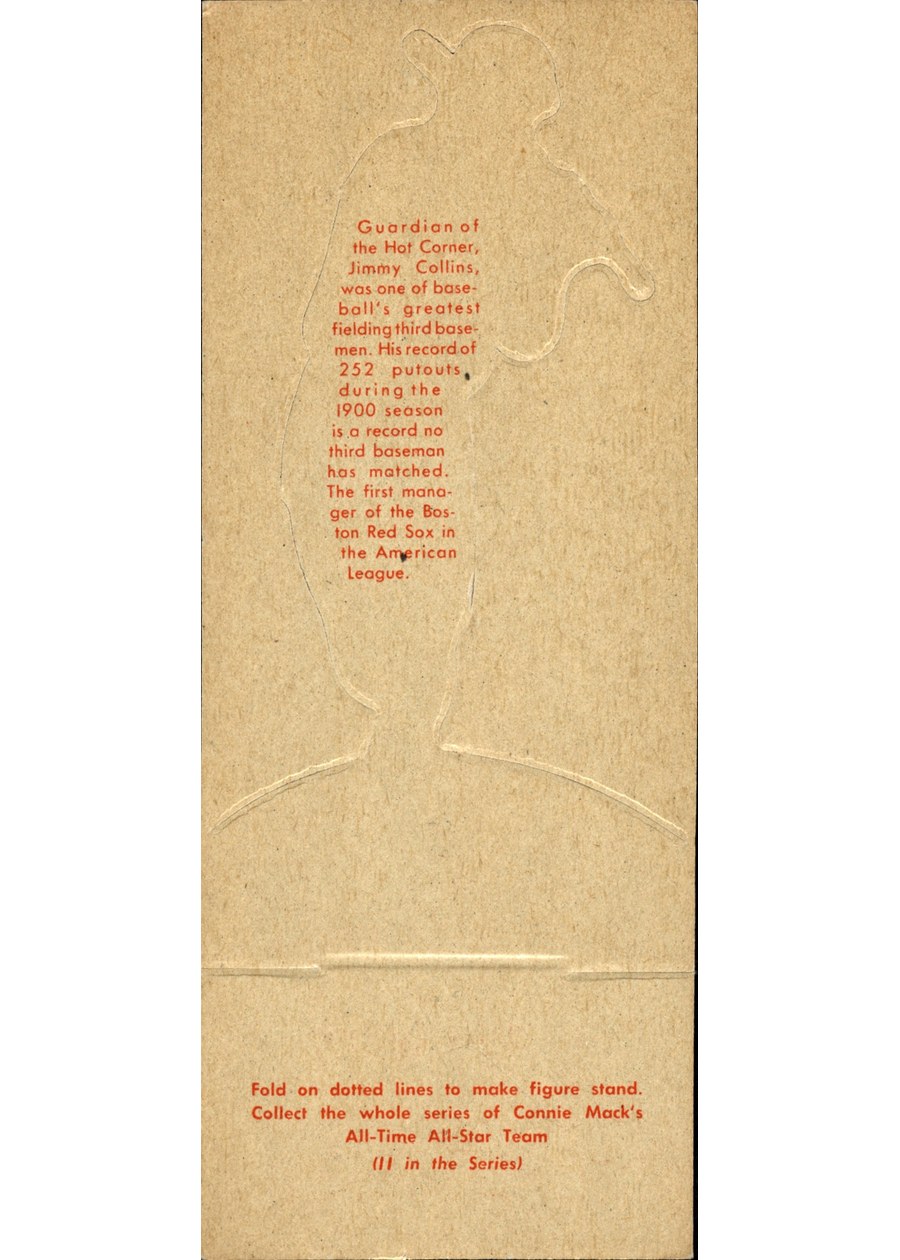
Connie Mack's All-Stars are eleven die-cut stand-ups of the all-time greats Connie Mack picked; every one of the eleven is in the Hall of Fame. They were made to be folded and stood up, so complete, unbent examples are hard to find.
About Jimmy Collins
Collins earned his place at third base on an all-time team in Boston, where the Beaneaters won consecutive pennants with him in 1897 and 1898. He hit .346 with 132 RBI in 1897, then hit .328 and led the National League with 15 home runs in 1898, and he led the league in putouts and assists in 1897 and again in 1900. As player-manager of the Americans he won the 1903 pennant by 14 and a half games and batted .250 with two triples in the World Series win over Pittsburgh. Boston fans presented him a loving cup during the final series of 1904, another pennant year. Traded to Philadelphia in June 1907, he finished his career there in 1908 and was elected to the Hall of Fame in 1945.
Jimmy Collins played third base for the Boston Beaneaters, Louisville Colonels, Boston Americans and Philadelphia Athletics from 1895 to 1908, and he is remembered as the man who changed how the position was played. Before his debut the shortstop generally handled bunts down the third-base line; Collins played in on the grass and fielded them himself. He ranked second all-time in putouts by a third baseman, behind Brooks Robinson. He hit .294 over 1,725 games, with 1,999 hits, 65 home runs, 983 RBI and 1,055 runs. In 1901 he left Boston's National League club for the new American League as player-manager of the Americans, and in 1903 he managed them to the first World Series title, five games to three over Pittsburgh. Boston won the pennant again in 1904. He was elected to the Hall of Fame in 1945, the first player chosen primarily as a third baseman. He died of pneumonia in Buffalo on March 6, 1943, having built a real-estate business there on his baseball earnings.
Sources: Wikipedia · SABR BioProject · Baseball-Reference
Graded population (PSA & SGC)
| Grader | Total | 10 | 9 | 8 | 7 | 6 | 5 | 1-4 | Auth |
|---|---|---|---|---|---|---|---|---|---|
| PSA | 127 | 0 | 0 | 0 | 1 | 7 | 34 | 73 | 12 |
| SGC | 81 | 0 | 0 | 0 | 2 | 1 | 15 | 45 | 18 |
Graded population — a scarcity guide, not a price. Data as of 2026-10-19. Half grades fold down for both graders (8.5→8); PSA qualified slabs (OC, ST, PD, MC and the like) are not counted.
Find this card
Search T206 Cards Shop 1951 Topps cards Live auctions Buy It Now on eBay Sold prices
As an eBay Partner Network affiliate, T206Cards.com may earn from qualifying purchases.
Frequently asked questions
What is the 1951 Topps Connie Mack's All-Star card?
It is Connie Mack's All-Star in the 135-card 1951 Topps Baseball checklist, picturing Jimmy Collins of the Boston Americans. Connie Mack's All-Stars are eleven die-cut stand-ups of the all-time greats Connie Mack picked; every one of the eleven is in the Hall of Fame. They were made to be folded and stood up, so complete, unbent examples are hard to find.
How many cards are in the 1951 Topps Baseball set?
135 cards across five issues - the Red Backs and Blue Backs (52 each), nine Team cards, and eleven each of Connie Mack's All-Stars and the Major League All-Stars. With the Zernial and Holmes variations and both versions of each Team card the master set is 146. All 135 count toward the full set; Jim Konstanty, Robin Roberts and Eddie Stanky, the three rarest Major League All-Stars, are so rarely seen that collectors often count a complete set as 132 without them.
Sources: PSA, BaseballCardPedia, Trading Card Database, Baseball-Reference, PSA & SGC population reports. Card data compiled and maintained by T206Cards.com. Page last updated 2026-10-26.