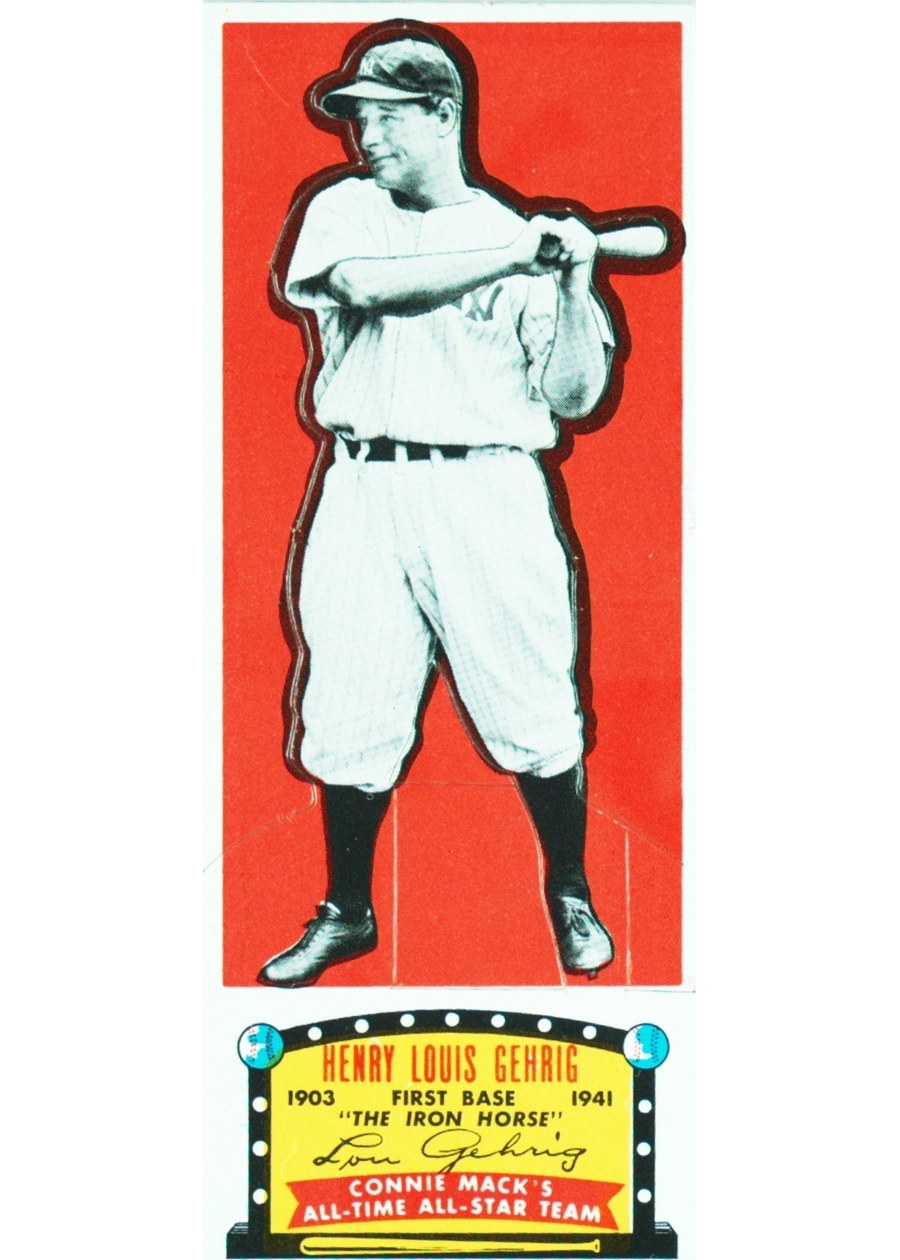
1951 Topps Connie Mack's All-Star Lou Gehrig
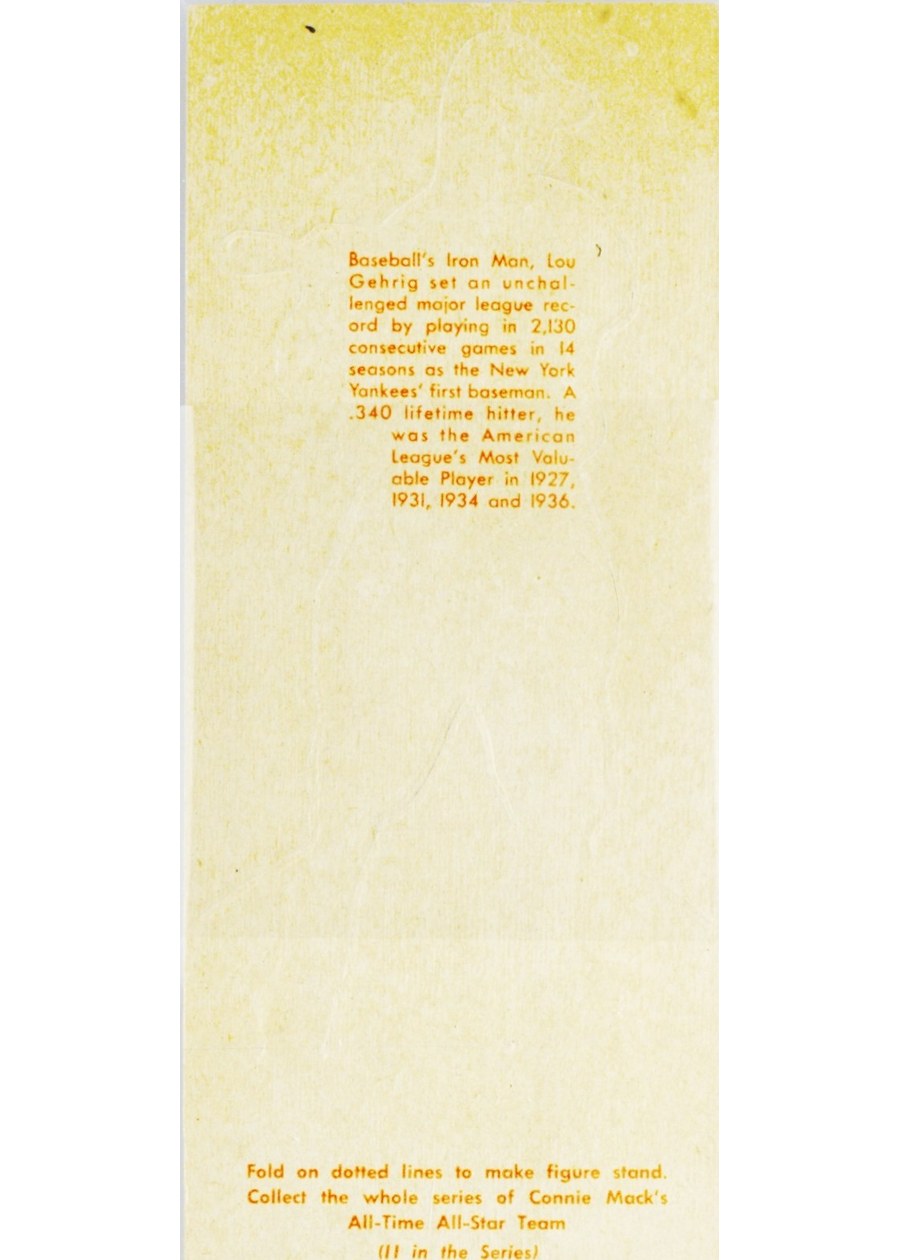
About this card
Connie Mack's All-Stars are eleven die-cut stand-ups of the all-time greats Connie Mack picked; every one of the eleven is in the Hall of Fame. They were made to be folded and stood up, so complete, unbent examples are hard to find.
About Lou Gehrig
In 1969 the Baseball Writers' Association of America voted Gehrig the greatest first baseman of all time. His claim rests on run production: from 1926 through 1938 he drove in at least 112 runs in 13 straight seasons and led the American League five times, topping out at 184 in 1931, when he also scored 163. On June 3, 1932, at Shibe Park, he hit four home runs against the Philadelphia Athletics, the first player of the 20th century to do it. He entered the Hall of Fame in 1939.
Henry Louis Gehrig grew up in New York City, the son of German immigrants, and starred at Columbia University before signing with the New York Yankees in 1923. He spent all 17 of his big-league seasons in pinstripes, nearly every game of them at first base. Sportswriters hung the nickname "the Iron Horse" on him in 1931 for the durability that carried him through 2,130 straight games, a record that stood 56 years until Cal Ripken Jr. passed it in 1995. Gehrig won two American League Most Valuable Player awards and took the 1934 Triple Crown with a .363 average, 49 home runs and 165 runs batted in. He played on six World Series winners and finished at .340 with 493 home runs and 1,995 RBI. An undiagnosed illness, later identified as the disease that now carries his name, pushed him out of the lineup on May 2, 1939; that July 4 he told a packed Yankee Stadium he considered himself "the luckiest man on the face of the earth." Baseball held a special election in 1939, the year he retired, to put him in the National Baseball Hall of Fame. He died on June 2, 1941.
Sources: Wikipedia · SABR BioProject · Baseball-Reference · National Baseball Hall of Fame · Baseball Almanac · BaseballCardPedia
Graded population (PSA & SGC)
| Grader | Total | 10 | 9 | 8 | 7 | 6 | 5 | 1-4 | Auth |
|---|---|---|---|---|---|---|---|---|---|
| PSA | 99 | 0 | 0 | 1 | 1 | 5 | 19 | 43 | 30 |
| SGC | 54 | 0 | 0 | 0 | 1 | 4 | 7 | 14 | 28 |
Graded population — a scarcity guide, not a price. Data as of 2026-10-19. Half grades fold down for both graders (8.5→8); PSA qualified slabs (OC, ST, PD, MC and the like) are not counted.
Find this card
Search T206 Cards Shop 1951 Topps cards Live auctions Buy It Now on eBay Sold prices
As an eBay Partner Network affiliate, T206Cards.com may earn from qualifying purchases.
Related cards
More New York Yankees cards:
- Red Back #1 Yogi Berra
- Red Back #5 Phil Rizzuto
- Red Back #6 Allie Reynolds
- Red Back #18 Gerry Coleman
- Red Back #24 Hank Bauer
- Blue Back #10 Joe Page
- Blue Back #35 Tommy Byrne
- Blue Back #39 Ed Lopat
- Blue Back #50 Johnny Mize
- Connie Mack's All-Star Babe Ruth
- Major League All-Star Yogi Berra
- Major League All-Star Phil Rizzuto
Frequently asked questions
What is the 1951 Topps Connie Mack's All-Star card?
It is Connie Mack's All-Star in the 135-card 1951 Topps Baseball checklist, picturing Lou Gehrig of the New York Yankees. Connie Mack's All-Stars are eleven die-cut stand-ups of the all-time greats Connie Mack picked; every one of the eleven is in the Hall of Fame. They were made to be folded and stood up, so complete, unbent examples are hard to find.
What are the key cards in 1951 Topps?
The three rarest are the Major League All-Stars of Jim Konstanty, Robin Roberts and Eddie Stanky, the three short prints of the issue. Red Back #1 Yogi Berra leads the Red Backs and Blue Back #3 Richie Ashburn the Blue Backs, with Blue Back #50 Johnny Mize and Blue Back #37 Bobby Doerr next; Red Back #49 Al Zarilla and Blue Back #51 Eddie Waitkus are the hardest of the two decks to find in top condition. Of the Team cards, the Boston Red Sox (Ted Williams' first Topps card) and the St. Louis Cardinals are the scarcest, and the Brooklyn Dodgers card pictures Jackie Robinson, Duke Snider, Pee Wee Reese and Roy Campanella. Babe Ruth and Lou Gehrig lead Connie Mack's All-Stars, and Yogi Berra the Major League All-Stars.
How many cards are in the 1951 Topps Baseball set?
135 cards across five issues - the Red Backs and Blue Backs (52 each), nine Team cards, and eleven each of Connie Mack's All-Stars and the Major League All-Stars. With the Zernial and Holmes variations and both versions of each Team card the master set is 146. All 135 count toward the full set; Jim Konstanty, Robin Roberts and Eddie Stanky, the three rarest Major League All-Stars, are so rarely seen that collectors often count a complete set as 132 without them.
Sources: PSA, BaseballCardPedia, Trading Card Database, Baseball-Reference, PSA & SGC population reports. Card data compiled and maintained by T206Cards.com. Page last updated 2026-10-26.