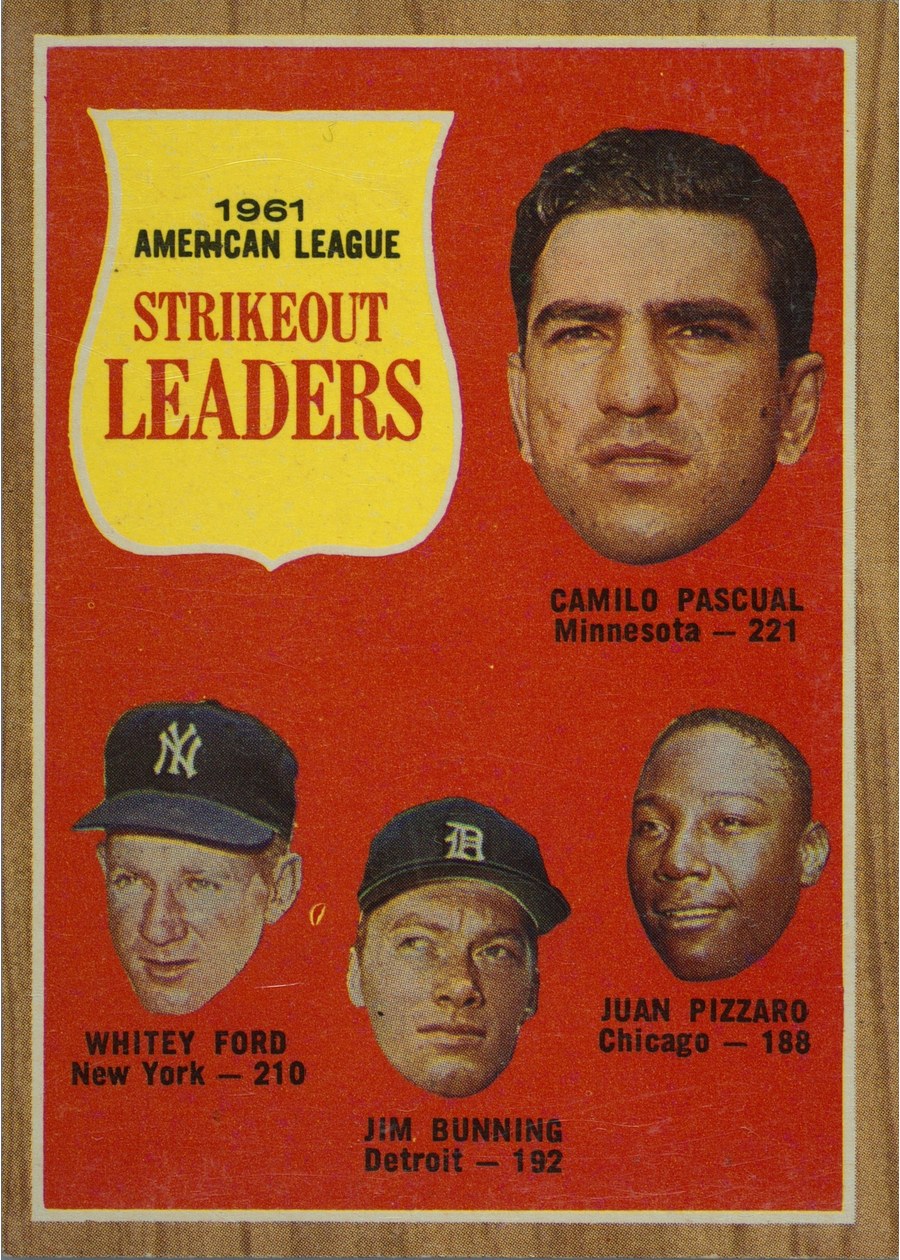
1962 Topps #59 1961 AL Strikeout Leaders
On this card: Camilo Pascual, Whitey Ford, Jim Bunning, Juan Pizarro
Juan Pizarro's last name is misspelled as "Pizzaro" on the card front.
Uncorrected error: Juan Pizarro's last name is spelled "Pizzaro" on the front
About this card
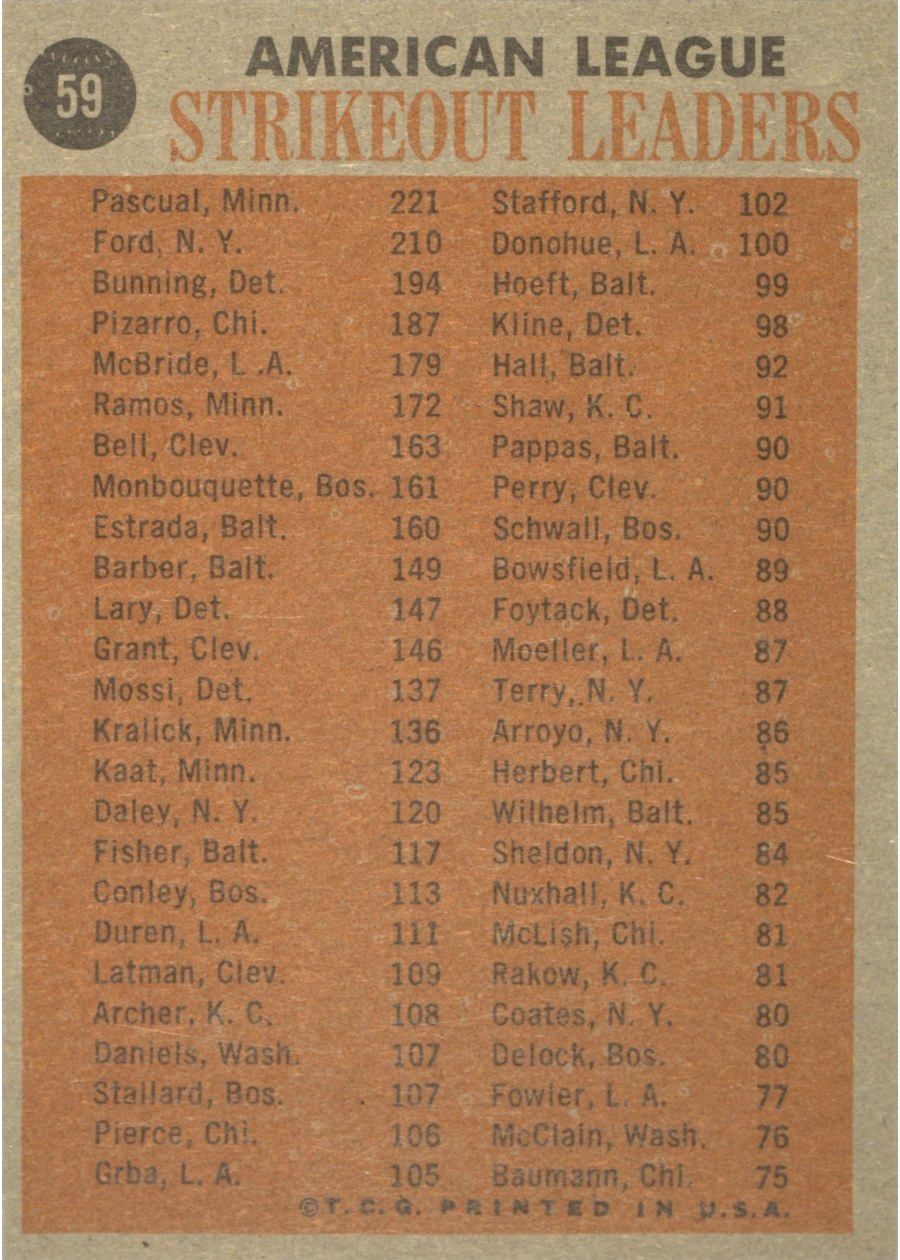
Cards #51-60 are the League Leaders subset, each card listing the 1961 leaders in one statistical category - batting, home runs, ERA, wins and strikeouts - with the American League card first and the National League card second in each pair.
The story on this card
This League Leaders card recaps the 1961 American League strikeout race. Camilo Pascual of the Twins topped the league with 221, a season in which he also tied for the AL lead with eight shutouts and threw 15 complete games over 252.1 innings. Whitey Ford of the pennant-winning Yankees was second at 209, his 25-4 year leading the league in wins and taking the Cy Young Award before he was named World Series MVP that fall. Jim Bunning of the Tigers struck out 194 across 268 innings while going 17-11, and Juan Pizarro of the White Sox closed the foursome with 188 in only 194.2 innings, going 14-7 with the group's lowest ERA at 3.05. The card belongs to Topps' first series for 1962.
Camilo Pascual - Cuban right-hander whose overhand curveball, learned from Adolfo Luque, carried him from the worst Senators teams to three straight American League strikeout crowns and back-to-back 20-win seasons for the Minnesota Twins. Whitey Ford was the New York Yankees' calm, curveball-first ace, the Chairman of the Board who won 236 games, three American League wins titles, the 1961 Cy Young Award and the career World Series pitching records across eleven pennant seasons. Jim Bunning was a hard-throwing right-hander who threw no-hitters in both leagues, including a 1964 perfect game for the Phillies, and later served as a US Senator from Kentucky. Puerto Rican left-hander Juan Pizarro pitched 18 big-league seasons for eight clubs and won 131 games, twice an All-Star in his six years with the Chicago White Sox and a Hall of Famer in his own country.
Sources: Wikipedia (Whitey Ford) · Wikipedia (Camilo Pascual) · Wikipedia (Jim Bunning) · Wikipedia (Juan Pizarro) · SABR BioProject (Camilo Pascual) · SABR BioProject (Whitey Ford) · SABR BioProject (Jim Bunning) · SABR BioProject (Juan Pizarro)
Graded population (PSA & SGC)
| Grader | Total | 10 | 9 | 8 | 7 | 6 | 5 | 1-4 | Auth |
|---|---|---|---|---|---|---|---|---|---|
| PSA | 700 | 0 | 23 | 205 | 230 | 103 | 63 | 73 | 3 |
| SGC | 85 | 0 | 0 | 14 | 24 | 17 | 7 | 22 | 1 |
Graded population — a scarcity guide, not a price. Snapshot 2026-09-24. Half-grades fold down (8.5→8), and PSA's qualified grades are counted separately from the straight-grade rows shown here. Slabs of the three cards printed #139 are joined by description, never by number alone. PSA registers the green tints as a separate set; a tint's population is listed under that state of the card it belongs to.
Find this card
Search T206 Cards Live auctions Buy It Now on eBay Sold prices
As an eBay Partner Network affiliate, T206Cards.com may earn from qualifying purchases.
Frequently asked questions
What is the 1962 Topps #59 card?
It is card #59 of the 600-card 1962 Topps Baseball set, picturing Camilo Pascual, Whitey Ford, Jim Bunning and Juan Pizarro. Cards #51-60 are the League Leaders subset, each card listing the 1961 leaders in one statistical category - batting, home runs, ERA, wins and strikeouts - with the American League card first and the National League card second in each pair.
Does 1962 Topps #59 have an error?
Juan Pizarro's last name is spelled "Pizzaro" on the front. It was never corrected, so there is no variation to chase - every copy of #59 reads the same way.
How many cards are in the 1962 Topps Baseball set?
600 cards, tracked as 708 collectible states. The numbers run from 1 to 598 with no gaps, but three different cards were printed #139 - two Hal Reniff poses, catalogued 139a and 139b, and the Babe Hits 60 Babe Ruth Special, 139c - so 598 numbers make 600 cards; 93 cards carry catalogued print variations, the series-2 green tints among them, that the master set counts separately.
Sources: Baseball Almanac, Trading Card Database, PSA CardFacts, Cardboard Connection, BaseballCardPedia, The Topps Archives, Baseball-Reference, the SABR BioProject and the National Baseball Hall of Fame, PSA & SGC population reports. Card data compiled and maintained by T206Cards.com. Page last updated 2026-10-03.