
1962 Topps #572 Bob Miller
The 1962 Mets carried two pitchers named Bob Miller. This card, #572, is the left-hander, Robert Gerald Miller; the right-hander, Robert Lane Miller, has his own card in the same set at #293.
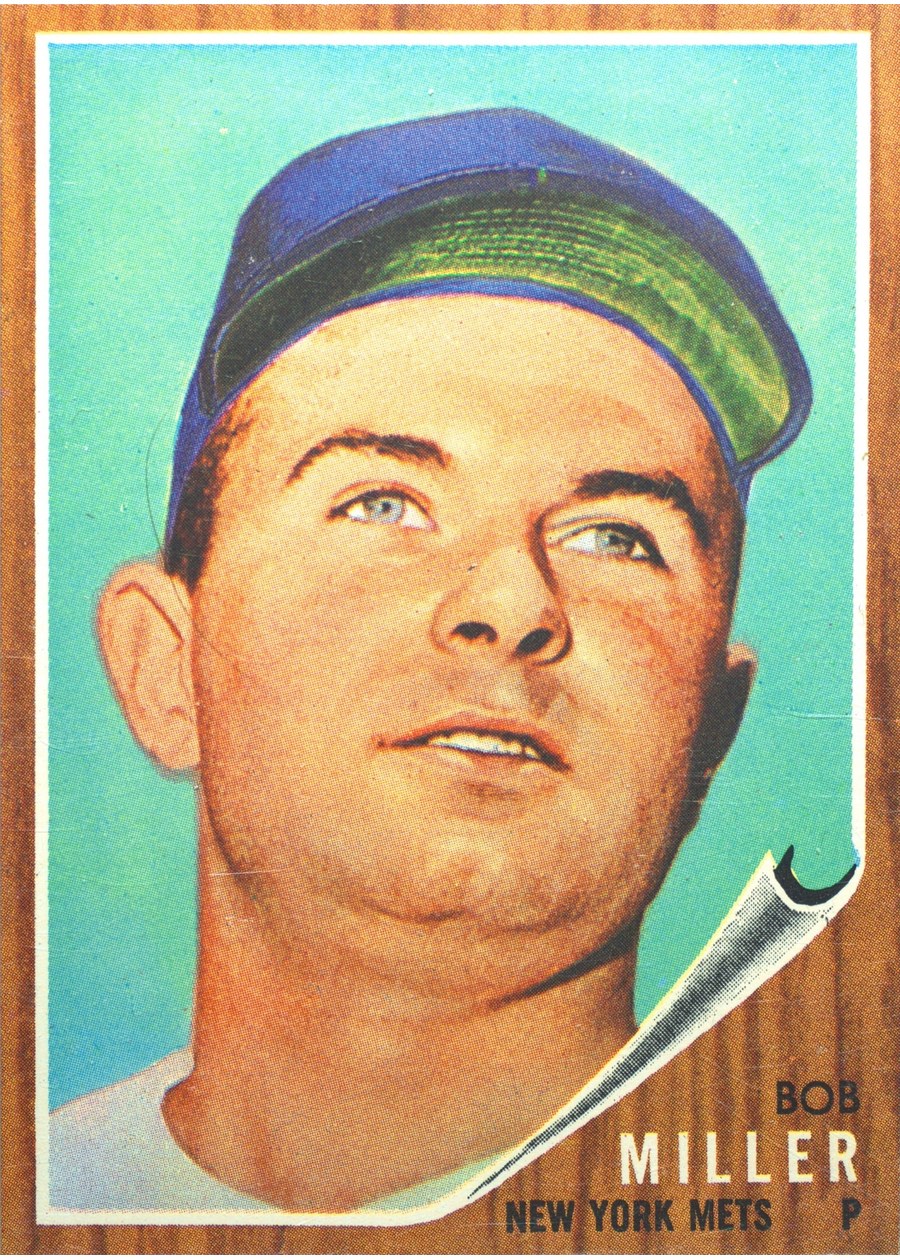
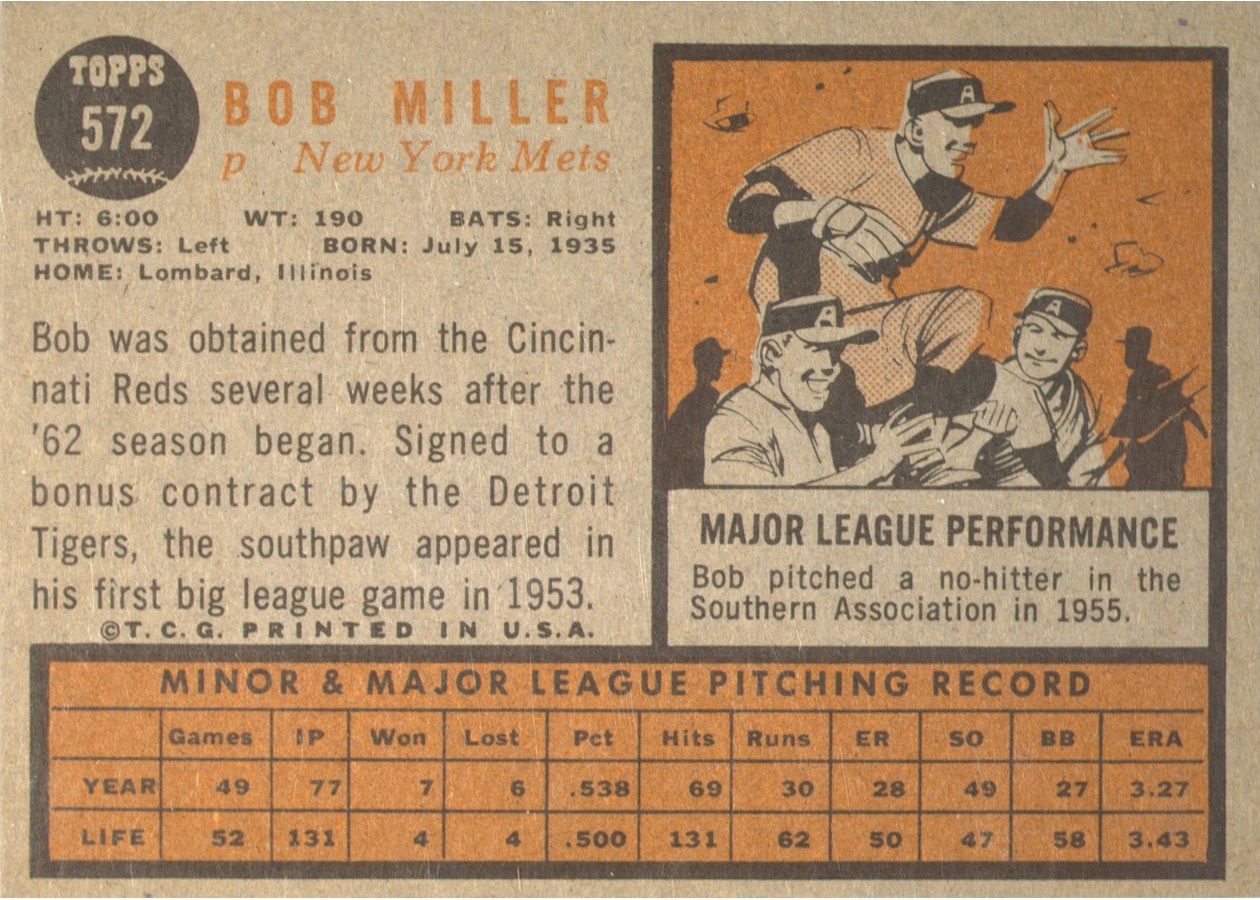
About Bob Miller
This is Miller's only card in Topps' 1961-69 run, and it caught him in his last big-league season. He is pictured as a Met after Cincinnati sent him east on May 7, 1962, with Cliff Cook, in exchange for Don Zimmer. Card #572 sits in the seventh-series high numbers, a short print and a tougher pull than his slim record suggests. Back in 1953, Miller had debuted with Detroit. He closed the year 2-2 with a 7.08 ERA in 17 relief appearances for the 40-120 Mets.
Robert Gerald Miller, a left-hander who batted right-handed, was born in Berwyn, Illinois, on July 15, 1935, and starred at Morton High School in nearby Cicero. Nine days after graduating he signed with the Detroit Tigers for a reported $60,000 bonus, on the same day the club signed fellow bonus baby Al Kaline. The rules of the era forced both onto the big-league roster immediately, so Miller debuted on June 25, 1953 at seventeen, one of only three seventeen-year-olds in the majors that year. He pitched mostly in relief for Detroit through 1956, lost 1957 to military service, and spent 1958 through 1961 in the minors. Cincinnati drafted him away from the Tigers after the 1959 season, and in 1960 he was with the Reds' Havana Sugar Kings when the club was moved to Jersey City amid the upheaval in Cuba. He resurfaced in the majors with Cincinnati in April 1962, only to be traded to the New York Mets a month later. In New York he found a teammate with the same name, right-hander Bob L. Miller, and the two ended up rooming together on the road. Across parts of five big-league seasons Miller went 6-8 with a 4.72 ERA in 86 games.
Sources: Wikipedia · Baseball-Reference
Graded population (PSA & SGC)
| Grader | Total | 10 | 9 | 8 | 7 | 6 | 5 | 1-4 | Auth |
|---|---|---|---|---|---|---|---|---|---|
| PSA | 373 | 1 | 19 | 168 | 116 | 38 | 21 | 10 | 0 |
| SGC | 59 | 0 | 4 | 20 | 12 | 13 | 6 | 2 | 2 |
Graded population — a scarcity guide, not a price. Snapshot 2026-09-24. Half-grades fold down (8.5→8), and PSA's qualified grades are counted separately from the straight-grade rows shown here. Slabs of the three cards printed #139 are joined by description, never by number alone. PSA registers the green tints as a separate set; a tint's population is listed under that state of the card it belongs to.
Find this card
Search T206 Cards Live auctions Buy It Now on eBay Sold prices
As an eBay Partner Network affiliate, T206Cards.com may earn from qualifying purchases.
Related cards
More New York Mets cards:
- #4 John DeMerit
- #7 Frank Thomas
- #26 Chris Cannizzaro
- #29 Casey Stengel
- #85 Gil Hodges
- #94 Jay Hook
- #162 Sammy Drake
- #183 Roger Craig
- #213 Richie Ashburn
- #256 Elio Chacon
- #279 Hobie Landrith
- #293 Bob Miller
- #308 Neil Chrisley
- #337 Jim Marshall
Frequently asked questions
What is the 1962 Topps #572 card?
It is card #572 of the 600-card 1962 Topps Baseball set, picturing Bob Miller of the New York Mets.
Are there two Bob Millers in the 1962 Topps set?
Yes - both pitched for the 1962 New York Mets. #572 is the left-hander, Robert Gerald Miller; the right-hander, Robert Lane Miller, has his own card at #293.
Why is #572 harder to find?
It is a high number card (cards 523-598) from the seventh print series, distributed last and in the smallest quantity - the toughest cards in the set and home to all 42 short prints and the Rookie Parade. It is also a short print card (42 cards, all in 523-598). Printed in smaller quantity than the rest of the seventh series.
How many cards are in the 1962 Topps Baseball set?
600 cards, tracked as 708 collectible states. The numbers run from 1 to 598 with no gaps, but three different cards were printed #139 - two Hal Reniff poses, catalogued 139a and 139b, and the Babe Hits 60 Babe Ruth Special, 139c - so 598 numbers make 600 cards; 93 cards carry catalogued print variations, the series-2 green tints among them, that the master set counts separately.
Sources: Baseball Almanac, Trading Card Database, PSA CardFacts, Cardboard Connection, BaseballCardPedia, The Topps Archives, Baseball-Reference, the SABR BioProject and the National Baseball Hall of Fame, PSA & SGC population reports. Card data compiled and maintained by T206Cards.com. Page last updated 2026-10-03.