
1962 Topps #176 Eddie Yost
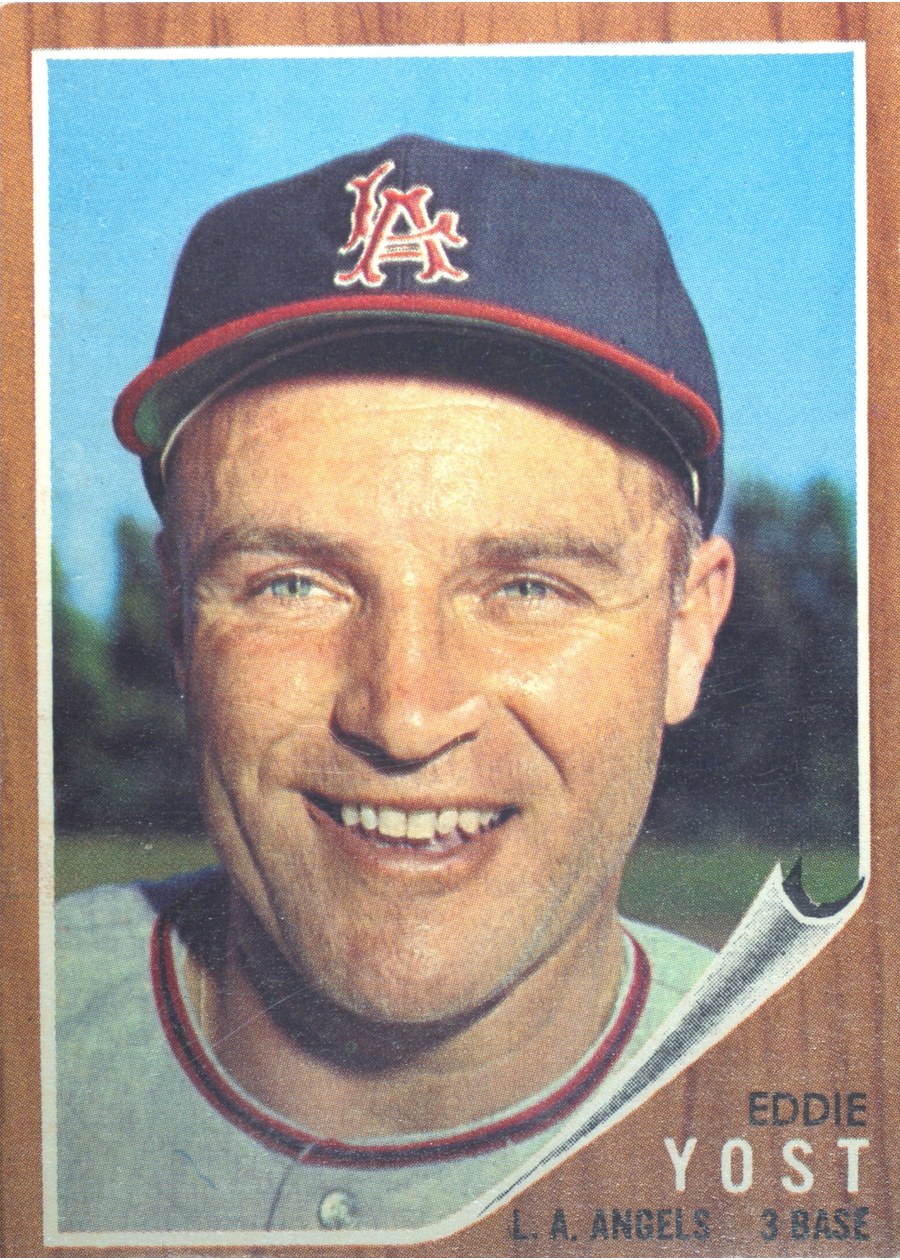
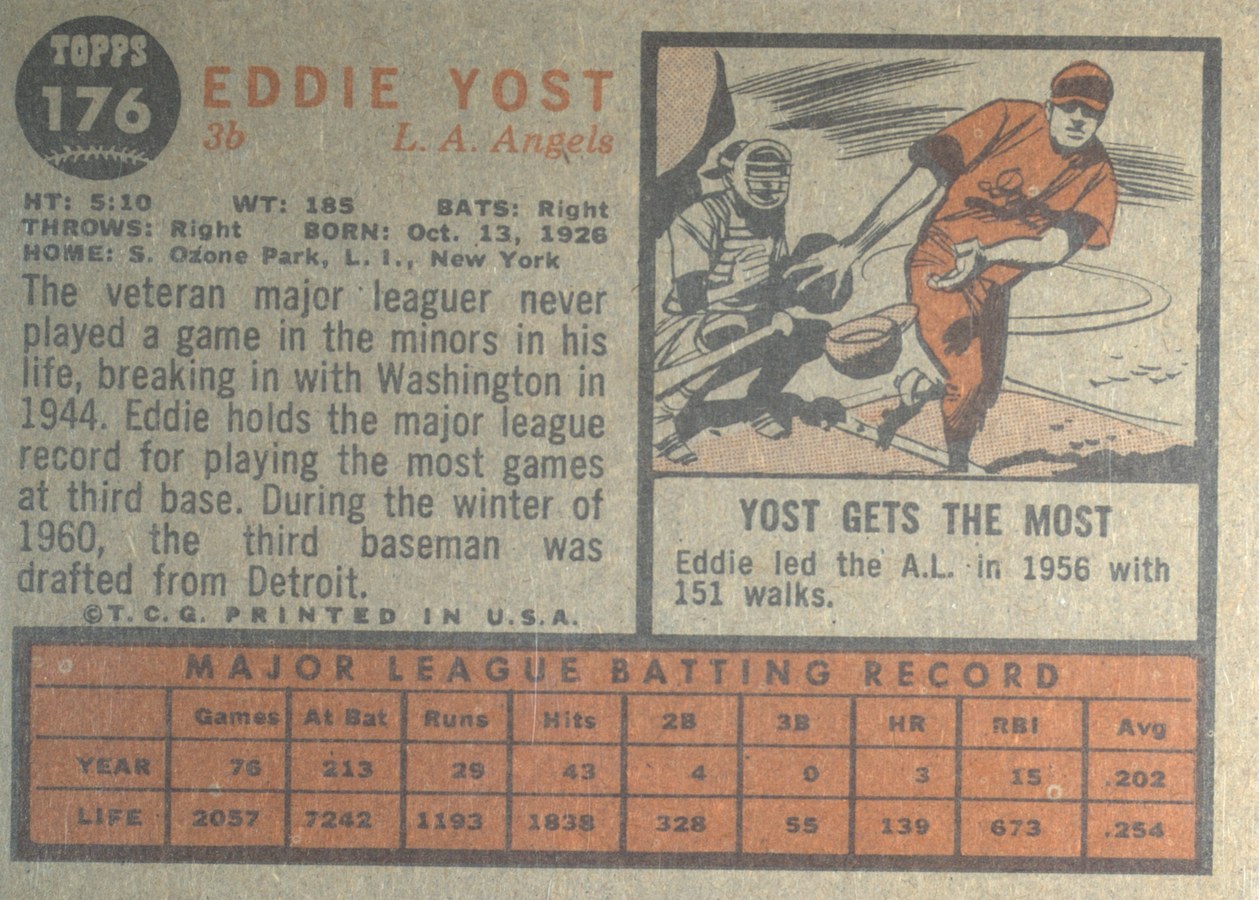
About Eddie Yost
Second-series #176 caught Yost at the end of the line, back with the Los Angeles Angels for what became his last season. Used as a part-timer, he got into 52 games and still hit .240 with a .412 on-base percentage, the best figure of any Angel who appeared in more than ten games that year. He doubled as a playing coach. His final plate appearance, on July 28, 1962, was a walk, which is how The Walking Man ought to have gone out; the club released the 35-year-old soon after to open a roster spot for George Thomas, back from military service. Collectors chase four states of this card: portrait and batting poses, with the portrait counted as the base version, and a green-tint printing of each.
Eddie Yost built an 18-year major league career out of the one skill nobody paid for in his era: he would not swing at a bad pitch. A Brooklyn-born New York University infielder, he signed with the Washington Senators in 1944 and went straight to the big club at age 17, never playing a day in the minors, then lost 1945 to the Navy. From 1947 he held down third base in Washington for a dozen seasons. Fans called him The Walking Man because he drew walks in bunches, leading the American League six times and finishing with 1,614, 11th on the career list, and a .394 on-base percentage against a .254 batting average. He was a fine glove too, setting American League career records at third base with 2,356 putouts, 3,659 assists and 6,285 total chances, and he was the first third baseman to play more than 2,000 games at the position. Washington traded him to Detroit in December 1958 to clear third base for Harmon Killebrew; the expansion Los Angeles Angels took him after the 1960 season, and he retired in 1962. A 23-season coaching career followed, most of it in the third-base box, and it brought him a World Series ring with the 1969 Mets.
Sources: Wikipedia · SABR BioProject · Baseball-Reference
Print variations
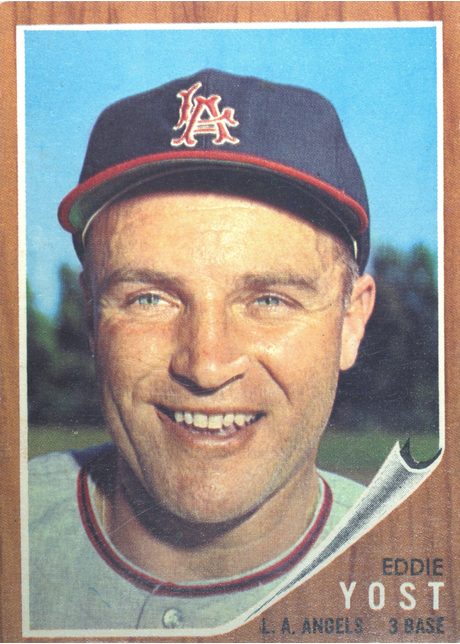
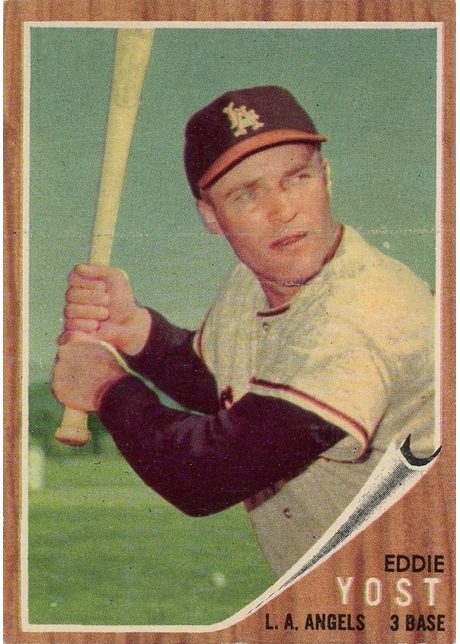
Four states of #176 are tracked individually: 176a - Portrait, 176b - Batting, 176c - Batting-Green Tint and 176d - Portrait-Green Tint. The difference is on the front of the card (photo pose + pose green tint + green tint).
States catalogued by the PSA master set registry; each is tracked here individually.
As an eBay Partner Network affiliate, T206Cards.com may earn from qualifying purchases.
Graded population (PSA & SGC)
| Grader | Total | 10 | 9 | 8 | 7 | 6 | 5 | 1-4 | Auth |
|---|---|---|---|---|---|---|---|---|---|
| 176a - Portrait | |||||||||
| PSA | 214 | 0 | 1 | 60 | 97 | 35 | 14 | 7 | 0 |
| SGC | 22 | 0 | 0 | 4 | 7 | 4 | 3 | 3 | 1 |
| 176b - Batting | |||||||||
| PSA | 107 | 0 | 0 | 28 | 44 | 21 | 6 | 8 | 0 |
| SGC | 12 | 0 | 0 | 0 | 3 | 4 | 1 | 4 | 0 |
| 176c - Batting-Green Tint | |||||||||
| PSA | 108 | 0 | 0 | 16 | 31 | 38 | 11 | 12 | 0 |
| SGC | 1 | 0 | 0 | 0 | 0 | 1 | 0 | 0 | 0 |
| 176d - Portrait-Green Tint | |||||||||
| PSA | 0 | 0 | 0 | 0 | 0 | 0 | 0 | 0 | 0 |
| SGC | 0 | 0 | 0 | 0 | 0 | 0 | 0 | 0 | 0 |
Graded population — a scarcity guide, not a price. Snapshot 2026-09-24. Half-grades fold down (8.5→8), and PSA's qualified grades are counted separately from the straight-grade rows shown here. Where a grader registers a variation separately its population is listed under that variation. Slabs of the three cards printed #139 are joined by description, never by number alone. PSA registers the green tints as a separate set; a tint's population is listed under that state of the card it belongs to.
Find this card
Search T206 Cards Live auctions Buy It Now on eBay Sold prices
As an eBay Partner Network affiliate, T206Cards.com may earn from qualifying purchases.
Related cards
Team card: #132 Los Angeles Angels Team
More Los Angeles Angels cards:
- #11 Tom Morgan
- #39 Joe Koppe
- #68 Ken L. Hunt
- #96 Eli Grba
- #128 Art Fowler
- #154 Lee Thomas
- #194 Dean Chance
- #209 Jim Fregosi
- #257 Jack Spring
- #268 Ken McBride
- #287 George Witt
- #343 Albie Pearson
- #369 Ted Bowsfield
- #388 Ryne Duren
Frequently asked questions
What is the 1962 Topps #176 card?
It is card #176 of the 600-card 1962 Topps Baseball set, picturing Eddie Yost of the Los Angeles Angels.
Does 1962 Topps #176 have variations?
Yes. Four states are catalogued and tracked separately: 176a - Portrait (Eddie Yost portrait - the base pose (the non-tint pose in TCDB and BCP)), 176b - Batting (The batting pose without the tint - TCDB and BCP know it only as a tint; PSA registers it plain as well), 176c - Batting-Green Tint (The batting pose with the green tint) and 176d - Portrait-Green Tint (The portrait with the green tint). Owning any one of them fills the #176 slot; the master set counts each state.
How many cards are in the 1962 Topps Baseball set?
600 cards, tracked as 708 collectible states. The numbers run from 1 to 598 with no gaps, but three different cards were printed #139 - two Hal Reniff poses, catalogued 139a and 139b, and the Babe Hits 60 Babe Ruth Special, 139c - so 598 numbers make 600 cards; 93 cards carry catalogued print variations, the series-2 green tints among them, that the master set counts separately.
Sources: Baseball Almanac, Trading Card Database, PSA CardFacts, Cardboard Connection, BaseballCardPedia, The Topps Archives, Baseball-Reference, the SABR BioProject and the National Baseball Hall of Fame, PSA & SGC population reports. Card data compiled and maintained by T206Cards.com. Page last updated 2026-10-03.