1962 Topps #311 Tony Kubek
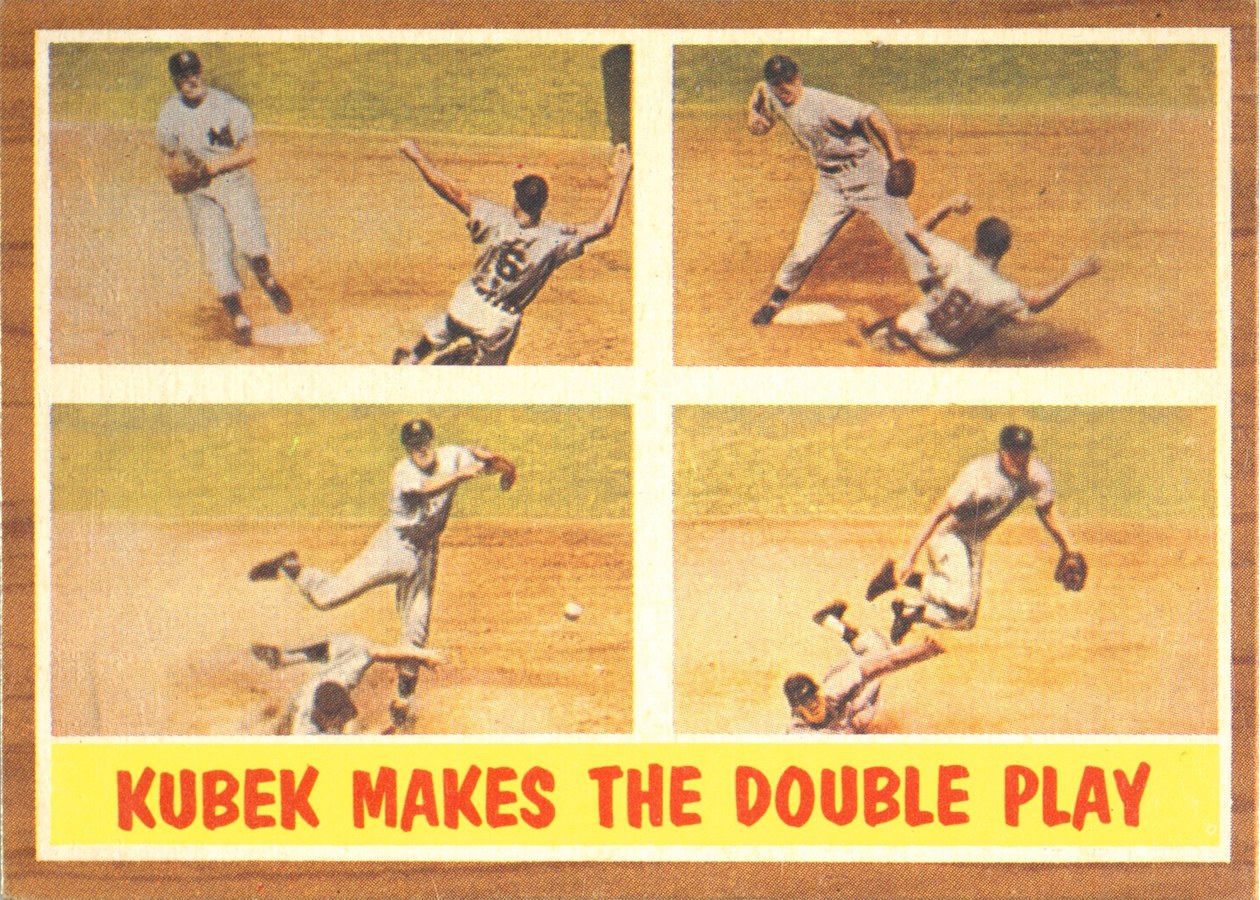
An In Action card: Kubek turning the double play at shortstop.
About this card
Cards #311-319 are the nine In Action cards, each listed under the player and carrying the headline printed on the front - from Kubek Makes The Double Play at #311 to McCormick Shows His Stuff at #319. Every man pictured also has a regular card in the set.
About Tony Kubek
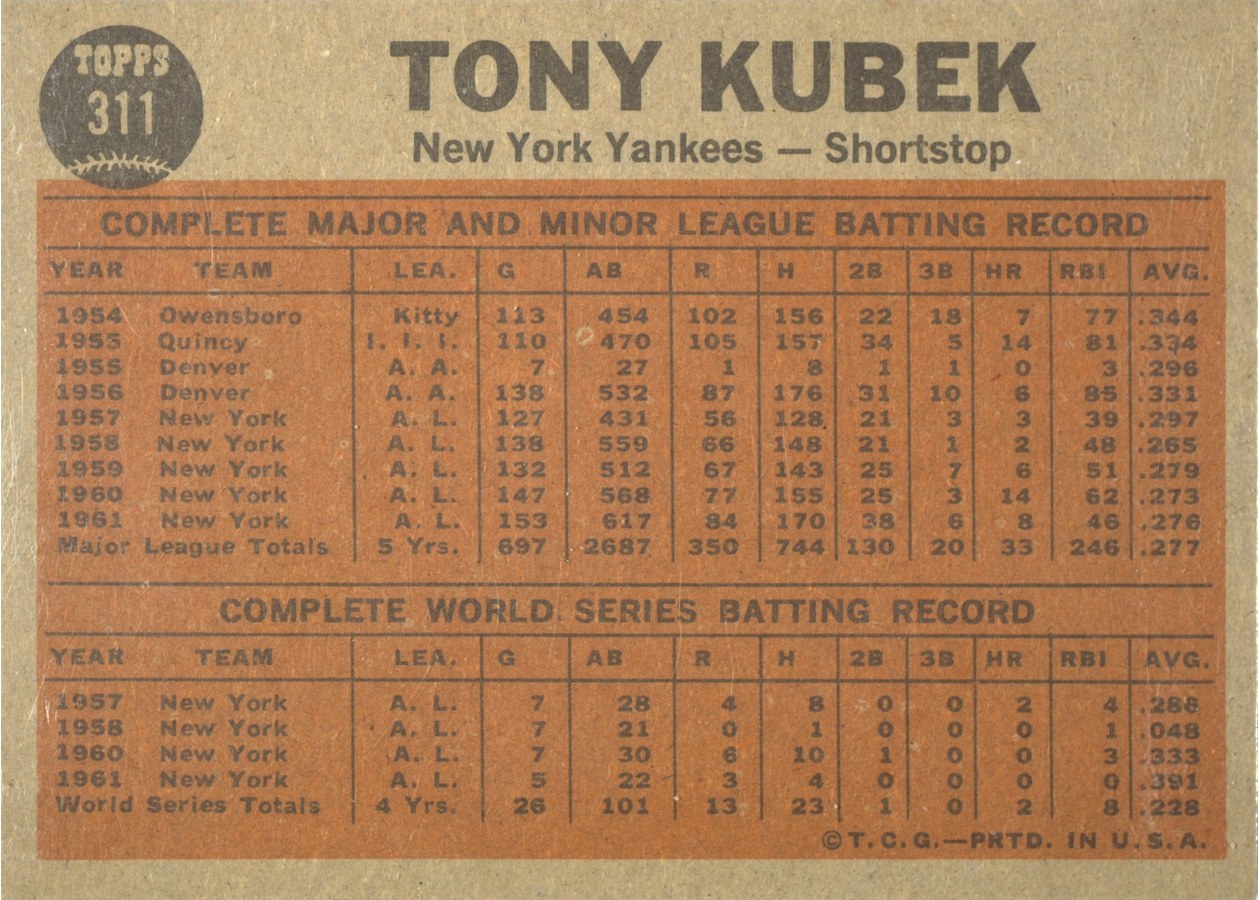
Kubek turns up twice in the 1962 set: #430, his regular issue in the fifth series, and #311 in the fourth series, an In Action card of him turning the double play at shortstop. Both look back on 1961, when he hit 38 doubles -- a Yankees record for shortstops that stood until 2004 -- while batting .276 with 170 hits across 153 games. He started at shortstop for the American League in the All-Star Game, ran off an 18-game hitting streak from May 22 to June 9, and closed the year helping New York put away Cincinnati in five World Series games.
Anthony Christopher Kubek, born October 12, 1935, in Milwaukee, signed with the New York Yankees out of Bay View High School in 1954 for a $1,500 bonus. He hit .344 at Class D Owensboro that first summer and .334 at Class B Quincy in 1955, then reached New York in 1957. Used all over the field as a rookie -- 41 games at shortstop, 38 at third base, 53 in the outfield -- he batted .297 and was voted American League Rookie of the Year. He won the shortstop job in 1958 and held it for good once Ralph Houk took over in 1961, pairing with second baseman Bobby Richardson on one of the era's best double-play combinations. A left-handed hitter whose fielding percentage and range factor both bettered league average, Kubek was a four-time All-Star who played on seven pennant winners between 1957 and 1964 and three world champions. After the 1965 season, Mayo Clinic tests found nerve damage at the top of his spine from an untreated neck injury, and he retired. He broadcast 24 years for NBC, received the Hall of Fame's Ford C. Frick Award for broadcasters in 2009, and entered the Canadian Baseball Hall of Fame in 2016.
Sources: Wikipedia · SABR BioProject · Baseball-Reference
Graded population (PSA & SGC)
| Grader | Total | 10 | 9 | 8 | 7 | 6 | 5 | 1-4 | Auth |
|---|---|---|---|---|---|---|---|---|---|
| PSA | 253 | 0 | 9 | 63 | 79 | 48 | 29 | 22 | 3 |
| SGC | 23 | 0 | 2 | 5 | 5 | 5 | 2 | 4 | 0 |
Graded population — a scarcity guide, not a price. Snapshot 2026-09-24. Half-grades fold down (8.5→8), and PSA's qualified grades are counted separately from the straight-grade rows shown here. Slabs of the three cards printed #139 are joined by description, never by number alone. PSA registers the green tints as a separate set; a tint's population is listed under that state of the card it belongs to.
Find this card
Search T206 Cards Live auctions Buy It Now on eBay Sold prices
As an eBay Partner Network affiliate, T206Cards.com may earn from qualifying purchases.
Related cards
More Tony Kubek in this set: #430
Team card: #251 New York Yankees Team
More New York Yankees cards:
- #1 Roger Maris
- #18 Managers' Dream
- #31 Tom Tresh
- #48 Ralph Terry
- #65 Bobby Richardson
- #88 Ralph Houk
- #93 John Blanchard
- #110 Bill Skowron
- #136 Babe Ruth Special: Babe Joins Yanks
- #137 Babe Ruth Special: Babe and Mgr. Huggins
- #138 Babe Ruth Special: The Famous Slugger
- #139a Hal Reniff
- #139b Hal Reniff
- #139c Babe Ruth Special: Babe Hits 60
Frequently asked questions
What is the 1962 Topps #311 card?
It is card #311 of the 600-card 1962 Topps Baseball set, picturing Tony Kubek of the New York Yankees. Cards #311-319 are the nine In Action cards, each listed under the player and carrying the headline printed on the front - from Kubek Makes The Double Play at #311 to McCormick Shows His Stuff at #319. Every man pictured also has a regular card in the set.
How many cards are in the 1962 Topps Baseball set?
600 cards, tracked as 708 collectible states. The numbers run from 1 to 598 with no gaps, but three different cards were printed #139 - two Hal Reniff poses, catalogued 139a and 139b, and the Babe Hits 60 Babe Ruth Special, 139c - so 598 numbers make 600 cards; 93 cards carry catalogued print variations, the series-2 green tints among them, that the master set counts separately.
Sources: Baseball Almanac, Trading Card Database, PSA CardFacts, Cardboard Connection, BaseballCardPedia, The Topps Archives, Baseball-Reference, the SABR BioProject and the National Baseball Hall of Fame, PSA & SGC population reports. Card data compiled and maintained by T206Cards.com. Page last updated 2026-10-03.