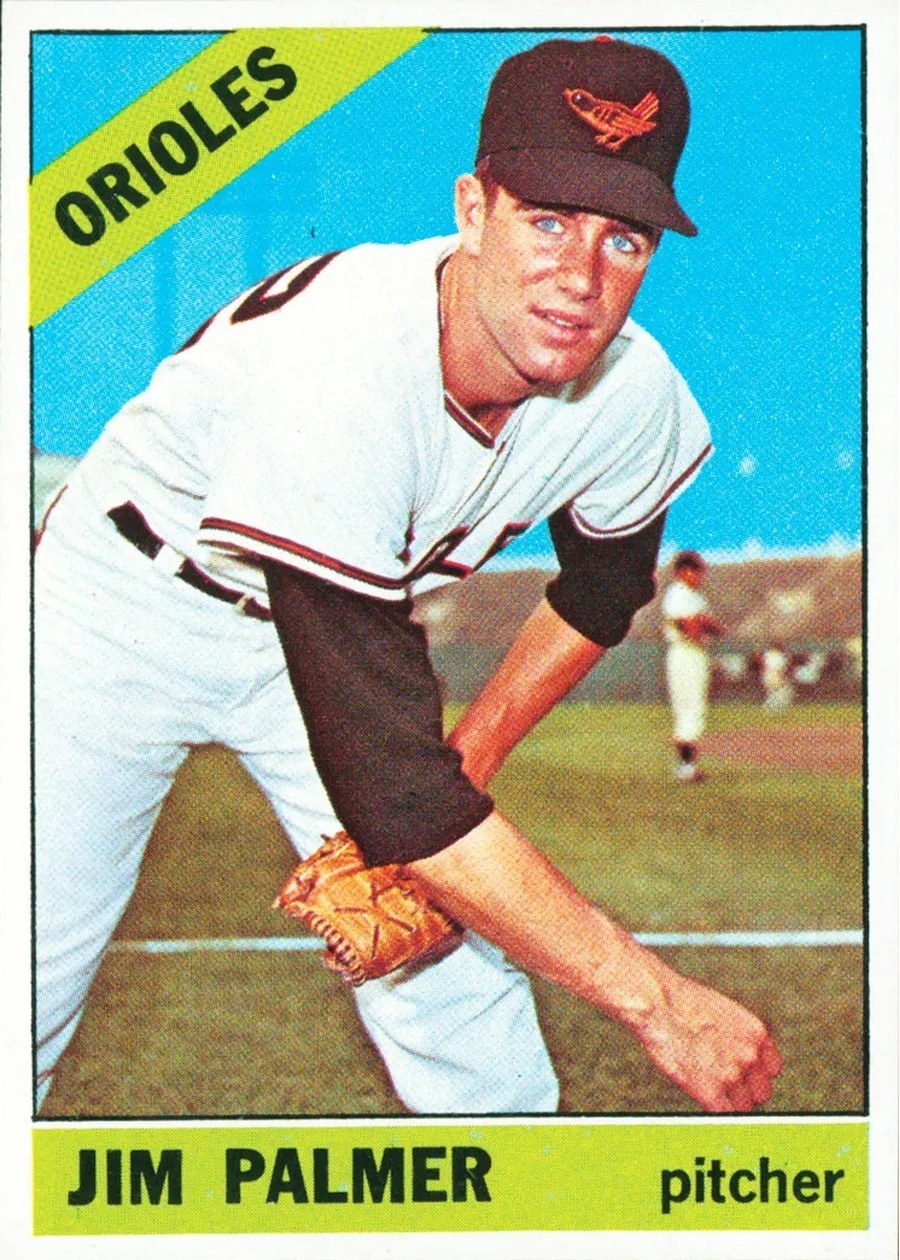
1966 Topps #126 Jim Palmer
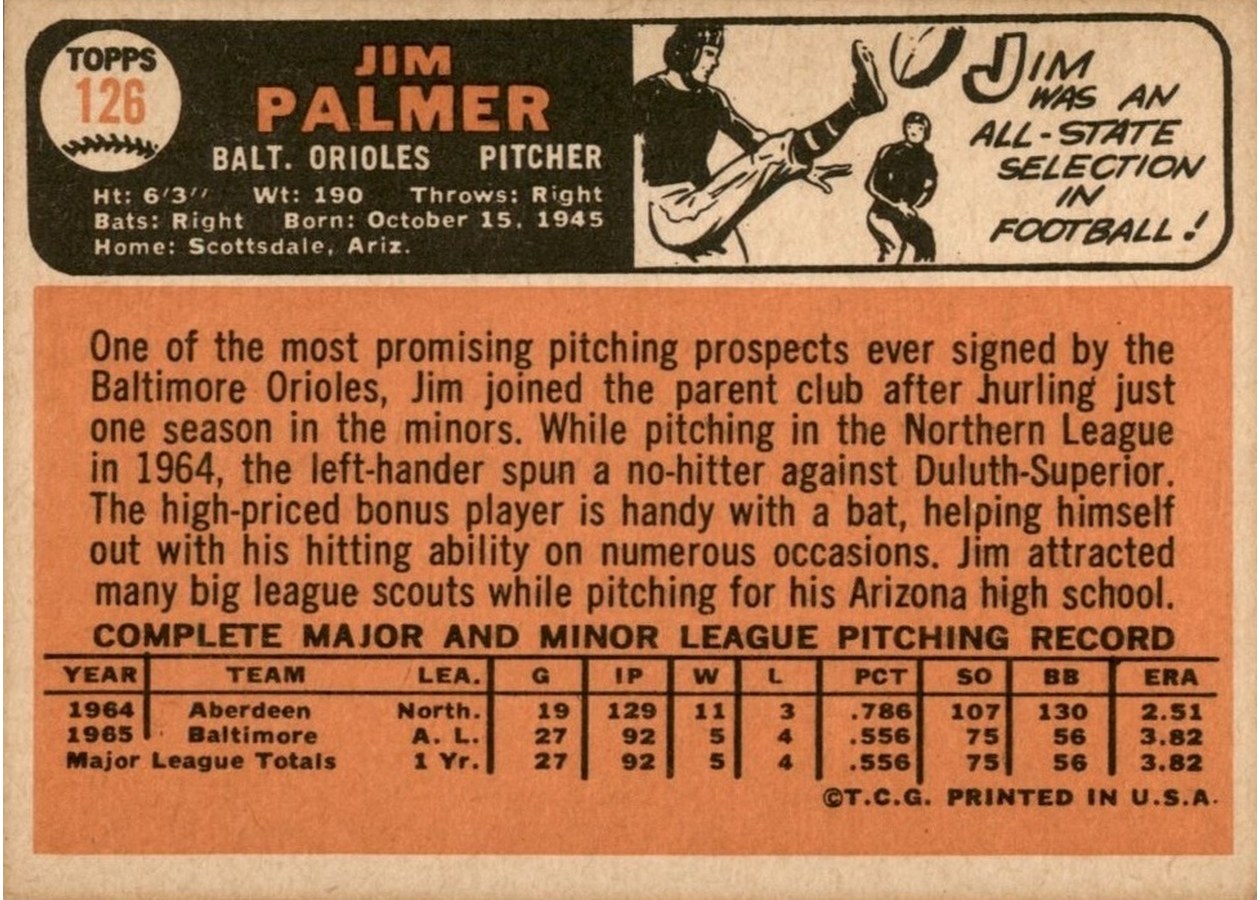
Palmer's rookie card, and the back's biography mistakenly calls him a left-hander.
Uncorrected error: The back bio calls Palmer a left-hander - he threw right
About Jim Palmer
Jim Palmer broke camp with the Orioles in 1965 as a 19-year-old straight out of Single-A Aberdeen, and he went 5-4 with a 3.72 ERA over 92 innings, mostly as a spot starter and long reliever. He won his first big-league game in relief against the Yankees that May and hit a two-run home run off Jim Bouton in the same outing. The biography on the back of his card calls him a left-hander; Palmer threw right.
James Alvin Palmer pitched all 19 of his major league seasons with the Baltimore Orioles (1965-1967, 1969-1984) and finished as the winningest pitcher of the 1970s with 186 wins. A right-hander whose best pitch was a high fastball, he worked on three World Series champions (1966, 1970, 1983) and six American League pennant winners, and he is the only pitcher to win a World Series game in three different decades. His Game Two shutout of Los Angeles in the 1966 Series, thrown nine days before his 21st birthday, made him the youngest man to pitch a complete-game shutout in a Series and sent Sandy Koufax off in his final appearance. Palmer won three Cy Young Awards (1973, 1975, 1976), four straight Gold Gloves (1976-1979), two ERA titles and six All-Star selections. He won 20 or more games eight times and finished 268-152 with a 2.86 ERA, 211 complete games and 53 shutouts. Arm trouble cost him most of 1967 and all of 1968, but he came back in 1969 with the only no-hitter of his career. He was nicknamed Cakes for the pancakes he ate on the mornings he pitched. He was elected to the National Baseball Hall of Fame in 1990, his first year of eligibility.
Sources: Wikipedia · SABR BioProject · Baseball-Reference
Graded population (PSA & SGC)
| Grader | Total | 10 | 9 | 8 | 7 | 6 | 5 | 1-4 | Auth |
|---|---|---|---|---|---|---|---|---|---|
| PSA | 5,779 | 0 | 83 | 561 | 889 | 1,166 | 1,009 | 2,059 | 12 |
| SGC | 1,868 | 0 | 2 | 41 | 183 | 307 | 471 | 816 | 48 |
Graded population — a scarcity guide, not a price. Data as of 2026-09-04. Half grades fold down for both graders (8.5→8); PSA qualified slabs (OC, ST, PD, MC and the like) are not counted. Where SGC registers no separate row for a variation, its slabs of that card are listed under the base version.
Find this card
Search T206 Cards Shop 1966 Topps cards Live auctions Buy It Now on eBay Sold prices
As an eBay Partner Network affiliate, T206Cards.com may earn from qualifying purchases.
Related cards
Team card: #348 Baltimore Orioles
More Baltimore Orioles cards:
- #14 Norm Siebern
- #27 Orioles 1966 Rookie Stars
- #48 Paul Blair
- #90 Luis Aparicio
- #105 Milt Pappas
- #136 Woody Held
- #148 Bob Johnson
- #167 Boog Powell
- #193 Dave McNally
- #229 Hank Bauer
- #247 Carl Warwick
- #265 Stu Miller
- #291 Moe Drabowsky
- #310 Frank Robinson
Frequently asked questions
What is the 1966 Topps #126 card?
It is card #126 of the 598-card 1966 Topps Baseball set, picturing Jim Palmer of the Baltimore Orioles.
Is 1966 Topps #126 a rookie card?
Yes - #126 is the 1966 Topps rookie card of Jim Palmer.
What are the key cards in the 1966 Topps set?
#1 Willie Mays opens the set and #598 Gaylord Perry closes it. The #50 Mickey Mantle anchors it, with #30 Pete Rose, #100 Sandy Koufax (his last solo Topps card), #300 Bob Clemente, #500 Hank Aaron (his first base card as an Atlanta Brave) and #215 National League 1965 Batting Leaders (Clemente, Aaron and Mays on one card) among the headliners, and three Hall of Fame rookies: #126 Jim Palmer, #254 Phillies Rookie Stars (Ferguson Jenkins) and #288 Dodgers Rookie Stars (Don Sutton). The 76-card high series (#523-598) holds 43 short prints by the hobby count.
Does 1966 Topps #126 have an error?
The back bio calls Palmer a left-hander - he threw right. It was never corrected, so there is no corrected version - every copy of #126 reads the same way.
How many cards are in the 1966 Topps Baseball set?
598 cards plus 15 variations (613 in the master set), issued in seven series. The full breakdown is on the 1966 Topps Baseball checklist page.
Sources: Trading Card Database, PSA CardFacts, Cardboard Connection, Baseball Almanac, Baseball-Reference, the SABR BioProject and the National Baseball Hall of Fame, PSA & SGC population reports. Card data compiled and maintained by T206Cards.com. Page last updated 2026-11-02.