
1966 Topps #90 Luis Aparicio
Number 90 is a double print in the 1966 Topps set.
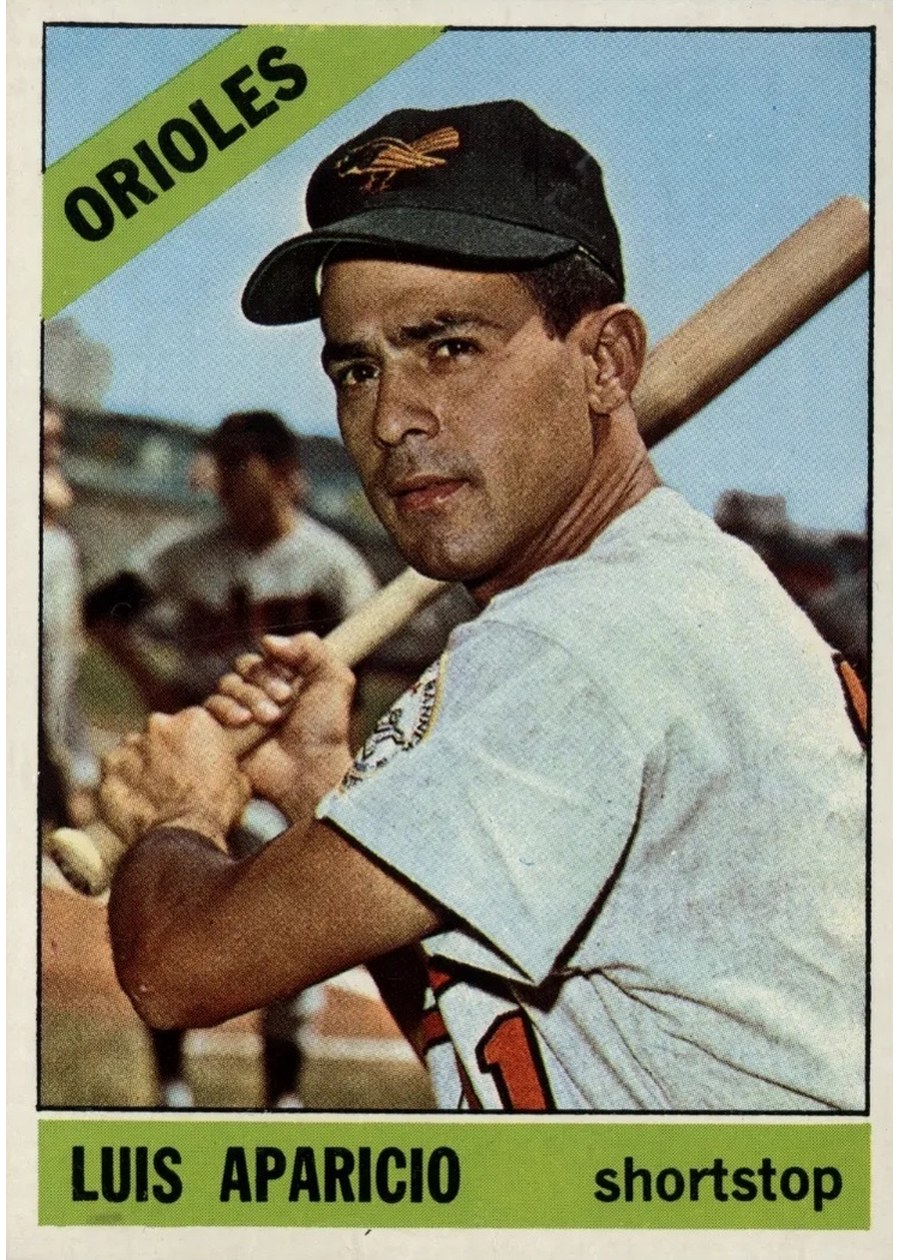
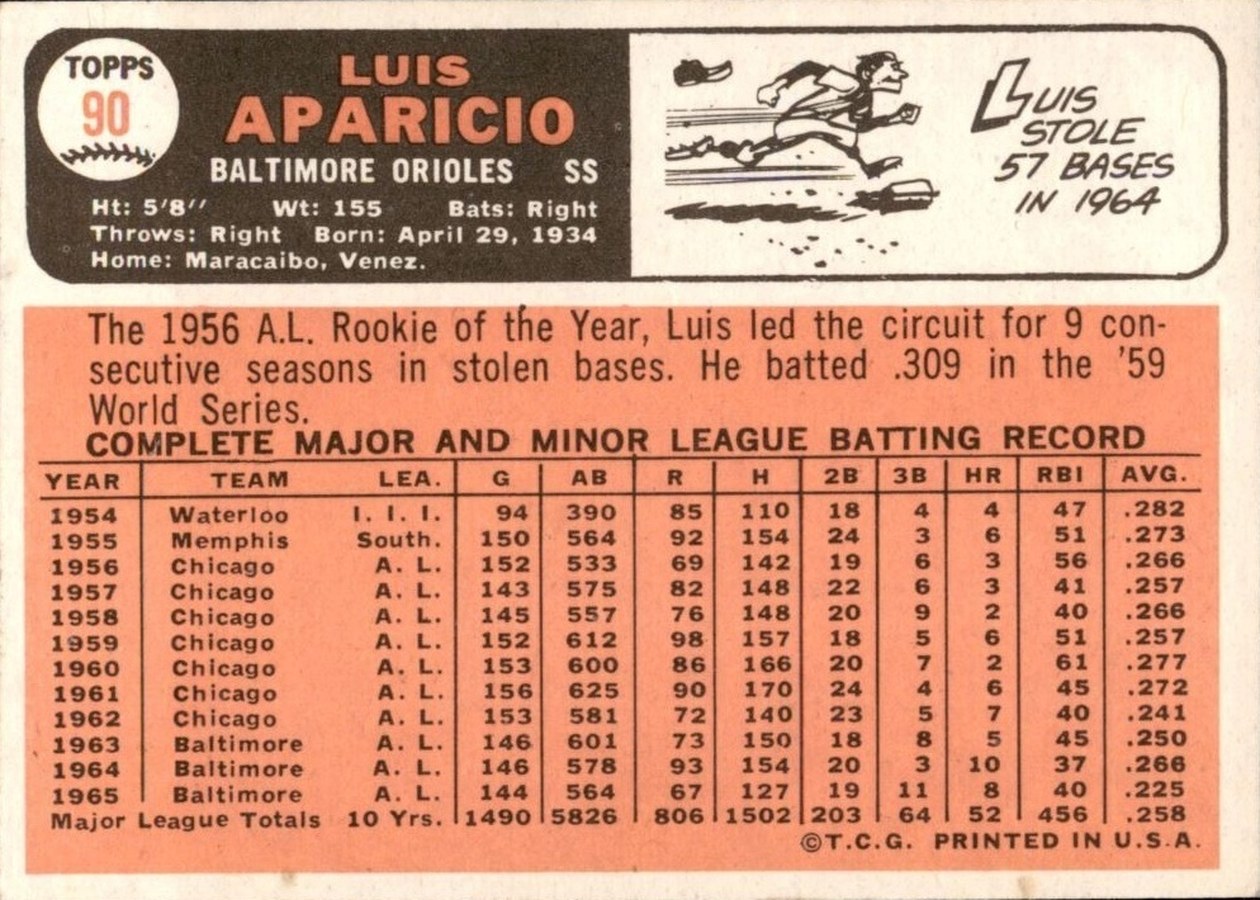
About Luis Aparicio
Luis Aparicio had a down year at the plate for Baltimore in 1965, batting .225, the lowest average of his 18 seasons, with 127 hits, 10 triples, 40 RBI and a .286 on-base percentage. His stolen bases fell from 57 in 1964 to 26. He played 144 games, 141 of them at shortstop, where he made 439 assists and 20 errors and turned 87 double plays.
Luis Ernesto Aparicio Montiel, born in Maracaibo, Venezuela, succeeded Chico Carrasquel as the White Sox shortstop in 1956, led the American League with 21 stolen bases and became the first Latin American player to win Rookie of the Year. Carrasquel had recommended him to general manager Frank Lane, who signed him, and helped persuade him to stay in the minors when he considered returning to Venezuela. Aparicio spent two seasons in the minors, including 1955 at Double-A Memphis. Baseball had been a family occupation in Maracaibo: his father played shortstop and his uncle Ernesto coached him. At his professional debut with Gavilanes in November 1953, his father took the first pitch and then sent his son to the plate in his place. In Chicago, Aparicio partnered with second baseman Nellie Fox on the 1959 Go-Go White Sox pennant winners and finished second to Fox in the MVP vote. He led the American League in stolen bases in nine consecutive seasons, won nine Gold Gloves and was an All-Star in ten seasons. His 18-year major-league career ended with 2,677 hits and 506 steals, with shortstop his only defensive position. Known as Little Louie, he became the first Venezuelan inducted into the Hall of Fame in 1984. The White Sox retired his number 11 that year.
Sources: Wikipedia · SABR BioProject · Baseball-Reference · National Baseball Hall of Fame · Baseball Almanac · BaseballCardPedia
Graded population (PSA & SGC)
| Grader | Total | 10 | 9 | 8 | 7 | 6 | 5 | 1-4 | Auth |
|---|---|---|---|---|---|---|---|---|---|
| PSA | 708 | 2 | 29 | 199 | 188 | 109 | 71 | 109 | 1 |
| SGC | 126 | 0 | 0 | 13 | 31 | 31 | 26 | 23 | 2 |
Graded population — a scarcity guide, not a price. Data as of 2026-09-04. Half grades fold down for both graders (8.5→8); PSA qualified slabs (OC, ST, PD, MC and the like) are not counted. Where SGC registers no separate row for a variation, its slabs of that card are listed under the base version.
Find this card
Search T206 Cards Shop 1966 Topps cards Live auctions Buy It Now on eBay Sold prices
As an eBay Partner Network affiliate, T206Cards.com may earn from qualifying purchases.
Related cards
Team card: #348 Baltimore Orioles
More Baltimore Orioles cards:
- #14 Norm Siebern
- #27 Orioles 1966 Rookie Stars
- #48 Paul Blair
- #105 Milt Pappas
- #126 Jim Palmer
- #136 Woody Held
- #148 Bob Johnson
- #167 Boog Powell
- #193 Dave McNally
- #229 Hank Bauer
- #247 Carl Warwick
- #265 Stu Miller
- #291 Moe Drabowsky
- #310 Frank Robinson
Frequently asked questions
What is the 1966 Topps #90 card?
It is card #90 of the 598-card 1966 Topps Baseball set, picturing Luis Aparicio of the Baltimore Orioles.
Is 1966 Topps #90 a scarce card?
It is a double print card (cards 30, 36, 50, 90, 93, 100). Six first-series cards were printed in double quantity: Pete Rose, Catfish Hunter, Mickey Mantle, Luis Aparicio, Jim Lonborg (#93) and Sandy Koufax. A double print is more plentiful, not scarcer - Mantle stays a set keystone regardless.
How many cards are in the 1966 Topps Baseball set?
598 cards plus 15 variations (613 in the master set), issued in seven series. The full breakdown is on the 1966 Topps Baseball checklist page.
Sources: Trading Card Database, PSA CardFacts, Cardboard Connection, Baseball Almanac, Baseball-Reference, the SABR BioProject and the National Baseball Hall of Fame, PSA & SGC population reports. Card data compiled and maintained by T206Cards.com. Page last updated 2026-11-02.