
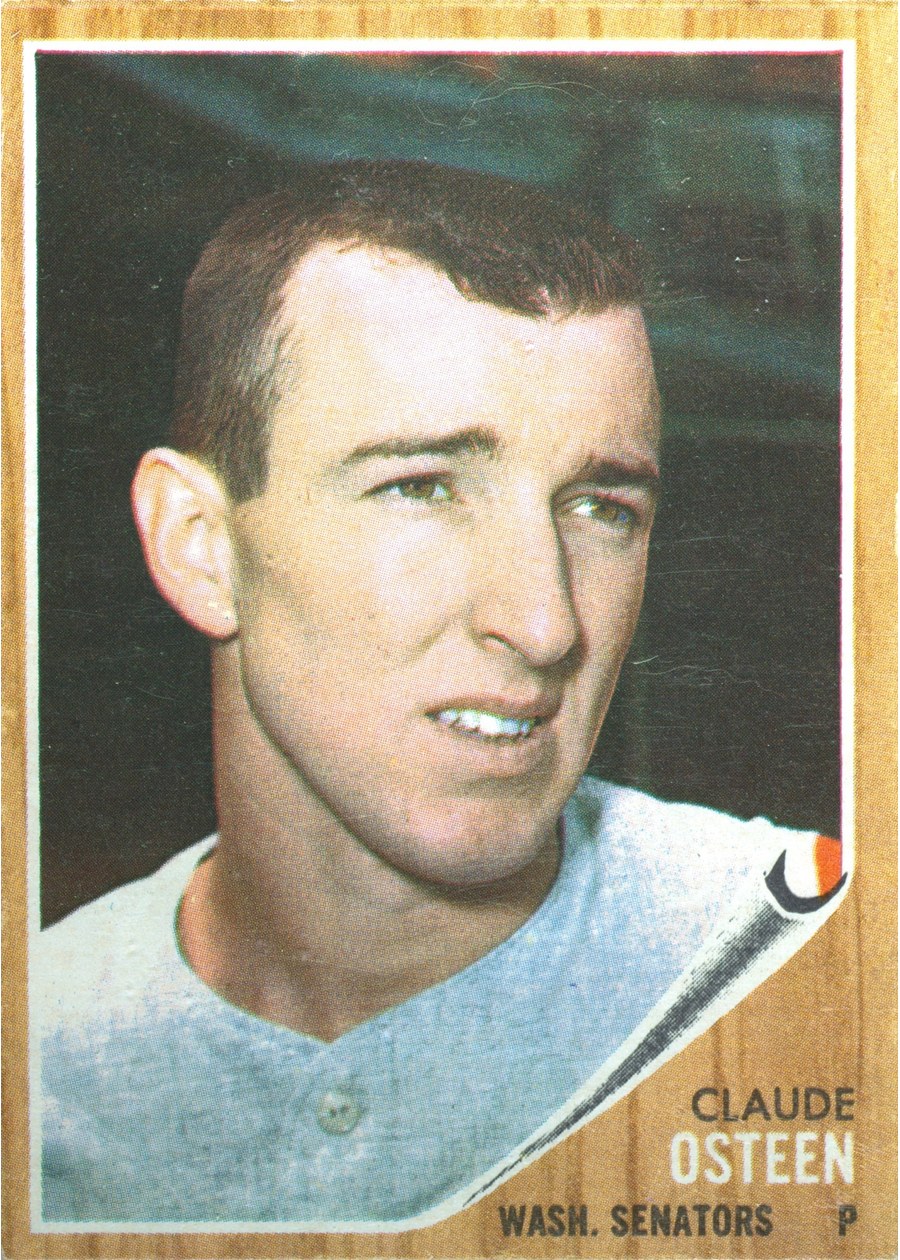
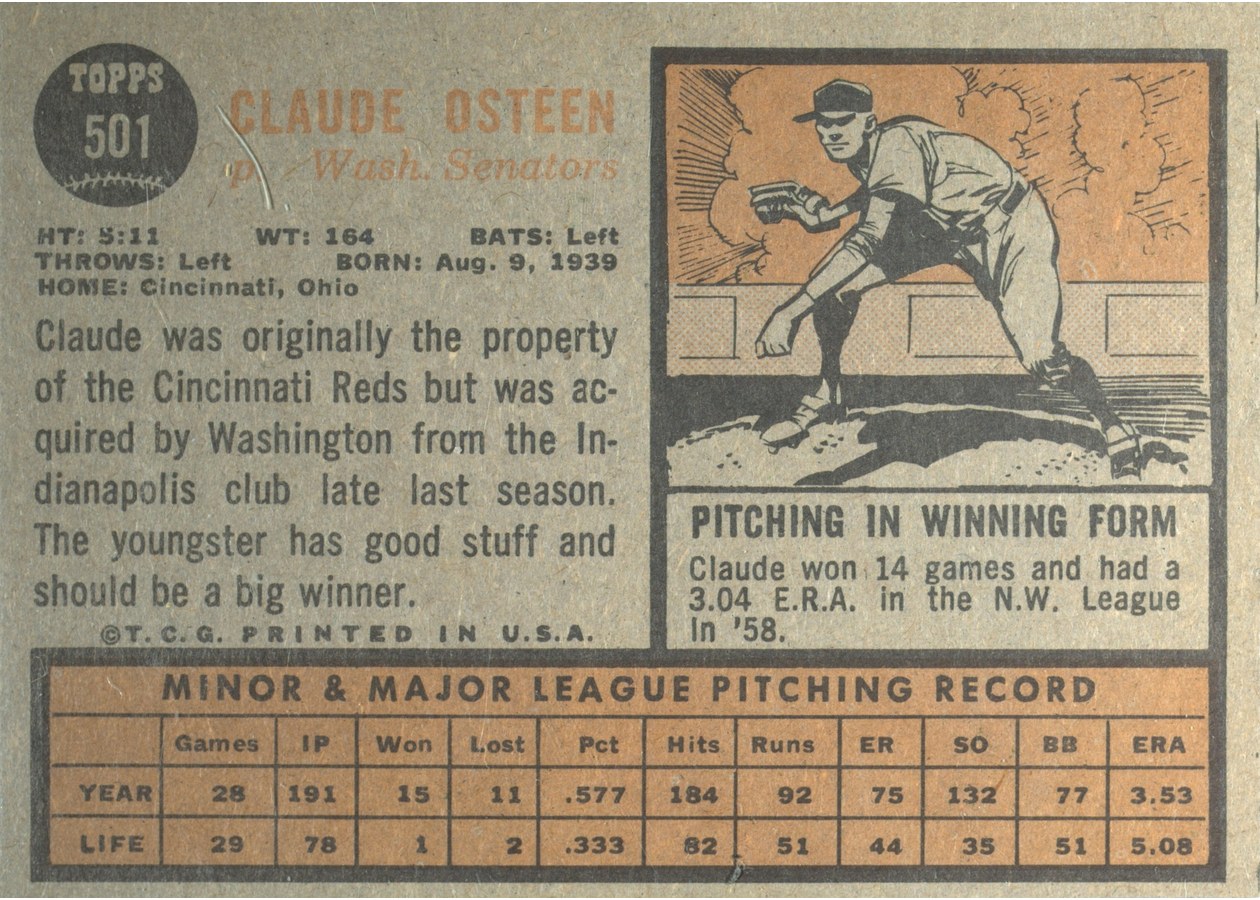
1962 Topps #501 Claude Osteen
About Claude Osteen
Washington's staff was thin enough that Osteen finally got a full run at the rotation in 1962, starting 22 of his 28 games. He lost his first four starts, missed time with an injury, and still came out at 8-13 with a respectable 3.65 ERA over 150 1/3 innings for a club that lost 101 games. The encouraging part was the control: only 47 walks. Topps put him at #501 in the sixth series; the company had already pictured him as a teenaged Redleg back in 1959.
Claude Wilson Osteen was born August 9, 1939, in Caney Spring, Tennessee, the son of a country-store owner who pitched for an amateur team. He starred at Reading High School outside Cincinnati, going 23-1 in his prep career with a 16-0 senior season for the 1957 state champions, and signed with the Cincinnati Redlegs straight out of school, reaching the majors at seventeen without a day in the minors first. The seasoning came afterward, at Wenatchee, Seattle and Indianapolis, because wildness kept him from a regular starting job in Cincinnati. In September 1961 the Reds traded him to the Washington Senators for pitcher Dave Sisler, and Washington gave him the rotation spot he wanted. He grew into a workhorse there, and in December 1964 the Senators cashed him in, sending him to the Los Angeles Dodgers in the deal that brought Frank Howard, Ken McMullen and Pete Richert to Washington. Over nine Dodgers seasons alongside Sandy Koufax and Don Drysdale he became a three-time All-Star, a 20-game winner twice, and the man who turned the 1965 World Series. He finished with Houston, St. Louis and the Chicago White Sox at 196-195 with a 3.30 ERA over 18 seasons, then coached big-league pitchers for decades. He is a member of the Tennessee Sports Hall of Fame.
Sources: Wikipedia · SABR BioProject · Baseball-Reference · National Baseball Hall of Fame
Graded population (PSA & SGC)
| Grader | Total | 10 | 9 | 8 | 7 | 6 | 5 | 1-4 | Auth |
|---|---|---|---|---|---|---|---|---|---|
| PSA | 298 | 0 | 22 | 133 | 92 | 31 | 16 | 4 | 0 |
| SGC | 21 | 0 | 3 | 8 | 5 | 2 | 0 | 3 | 0 |
Graded population — a scarcity guide, not a price. Snapshot 2026-09-24. Half-grades fold down (8.5→8), and PSA's qualified grades are counted separately from the straight-grade rows shown here. Slabs of the three cards printed #139 are joined by description, never by number alone. PSA registers the green tints as a separate set; a tint's population is listed under that state of the card it belongs to.
Find this card
Search T206 Cards Live auctions Buy It Now on eBay Sold prices
As an eBay Partner Network affiliate, T206Cards.com may earn from qualifying purchases.
Related cards
Team card: #206 Washington Senators Team
More Washington Senators cards:
- #27 Chuck Cottier
- #42 Jim King
- #79 Ed Hobaugh
- #90 Jim Piersall
- #125 Gene Woodling
- #152 Mickey Vernon
- #207 Pete Burnside
- #228 Dale Long
- #262 Bob Schmidt
- #271 Ray Rippelmeyer
- #296 Ken Hamlin
- #324 Joe McClain
- #347 Chuck Hinton
- #378 Bennie Daniels
Frequently asked questions
What is the 1962 Topps #501 card?
It is card #501 of the 600-card 1962 Topps Baseball set, picturing Claude Osteen of the Washington Senators.
How many cards are in the 1962 Topps Baseball set?
600 cards, tracked as 708 collectible states. The numbers run from 1 to 598 with no gaps, but three different cards were printed #139 - two Hal Reniff poses, catalogued 139a and 139b, and the Babe Hits 60 Babe Ruth Special, 139c - so 598 numbers make 600 cards; 93 cards carry catalogued print variations, the series-2 green tints among them, that the master set counts separately.
Sources: Baseball Almanac, Trading Card Database, PSA CardFacts, Cardboard Connection, BaseballCardPedia, The Topps Archives, Baseball-Reference, the SABR BioProject and the National Baseball Hall of Fame, PSA & SGC population reports. Card data compiled and maintained by T206Cards.com. Page last updated 2026-10-03.