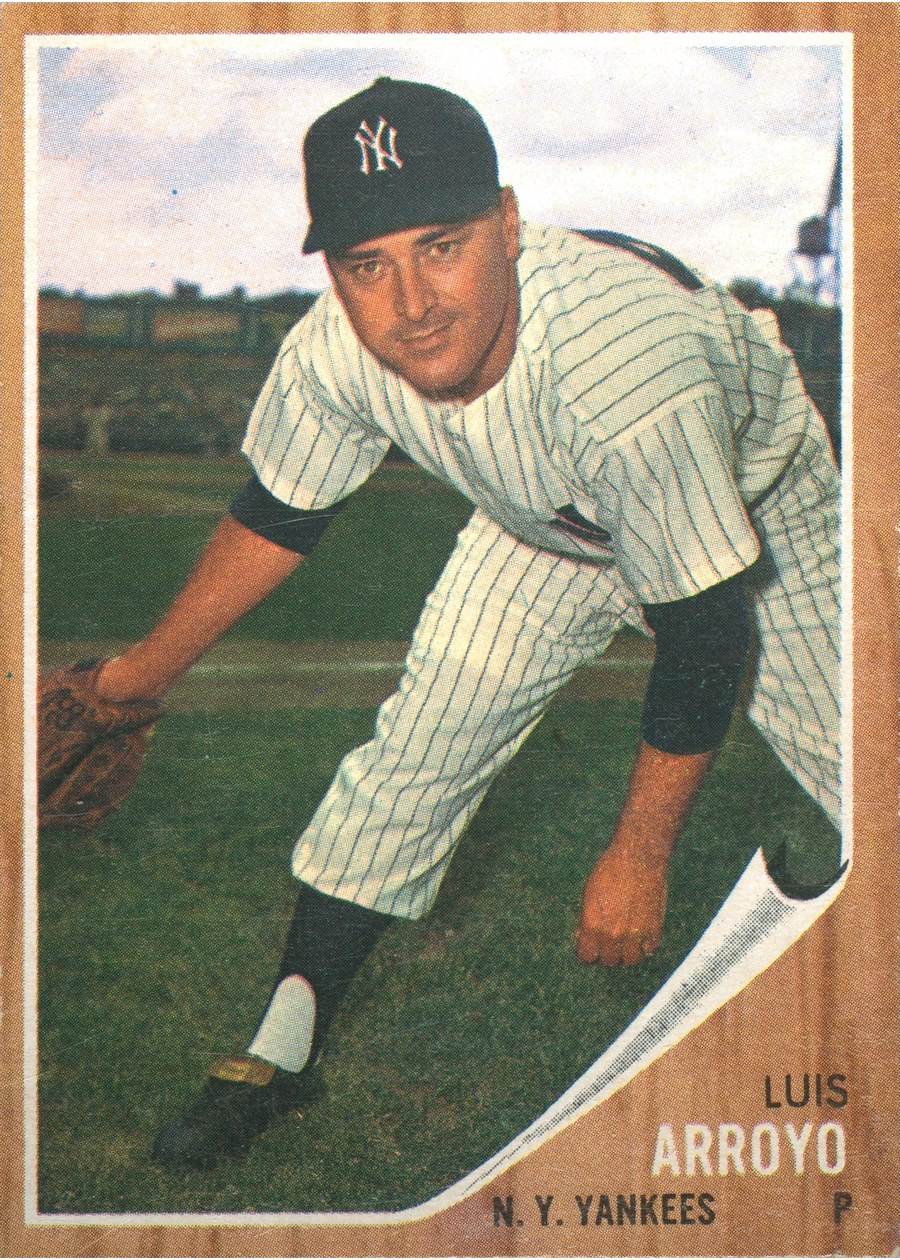
1962 Topps #455 Luis Arroyo
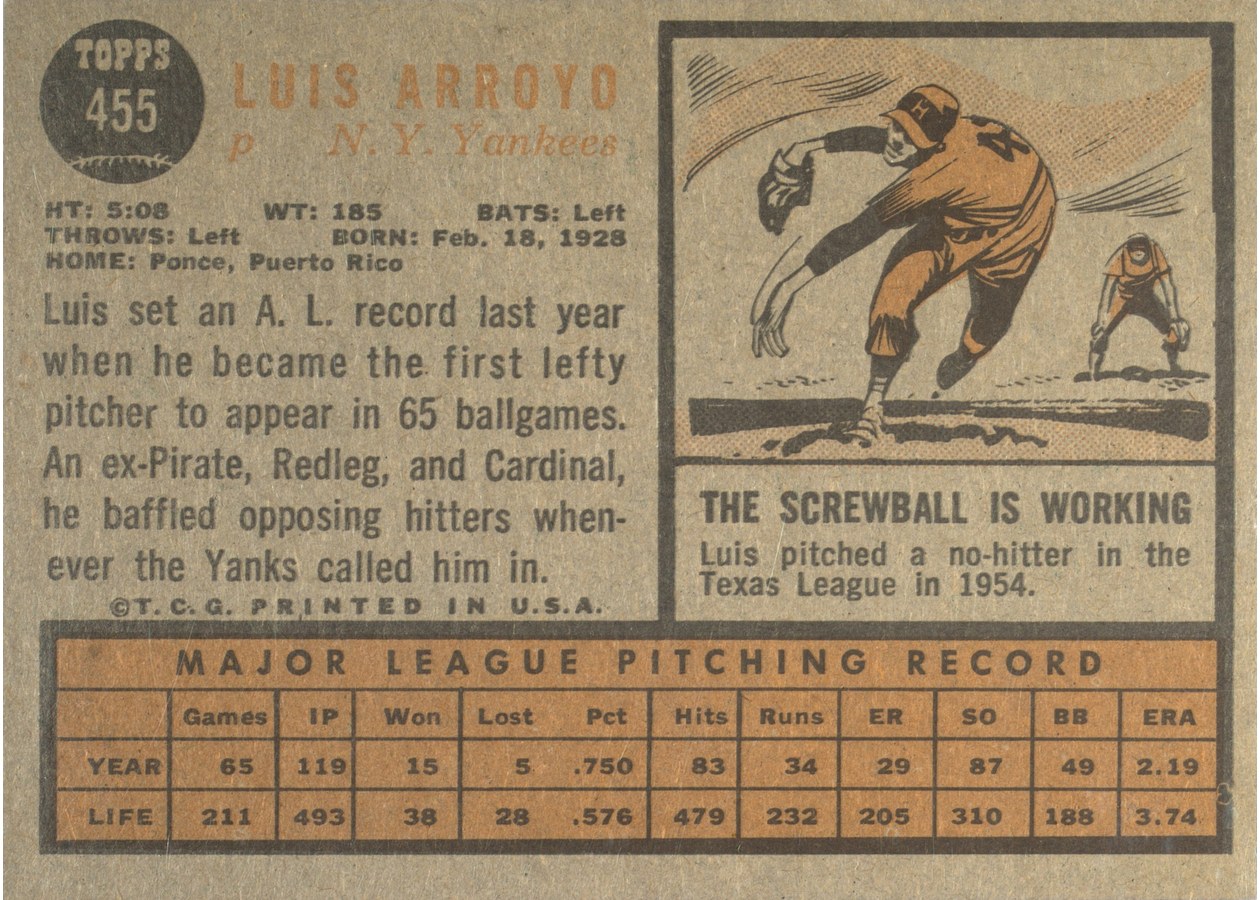
The card back prints an incorrect birth year; Arroyo was born February 18, 1927.
Uncorrected error: The back gives the wrong birth year - Arroyo was born in 1927
About Luis Arroyo
Number 455 rides in series 6 of the 1962 Topps set, a late-run card. It catches Arroyo at his peak, fresh off 1961: 15-5 with a 2.19 ERA over 119 innings of relief, his 65 appearances and 29 saves both leading the American League, and only five home runs allowed all year. Thirteen of those saves came behind Whitey Ford. He was picked for his second All-Star team, named Sporting News American League Fireman of the Year, finished sixth in the MVP vote, and won Game Three of the World Series against Cincinnati. One quirk for collectors: the back prints the wrong birth year - Arroyo was born February 18, 1927.
Luis Enrique Arroyo was a stocky left-handed screwball specialist from Penuelas, Puerto Rico, who pitched in the majors from 1955 to 1963 for the Cardinals, Pirates, Reds and Yankees. He and Vic Power became the first Puerto Ricans selected to an MLB All-Star Game, in 1955, when Arroyo was primarily a starter for St. Louis. Traded to Pittsburgh the following May for Max Surkont, he moved to the bullpen and bounced between organizations until the Yankees purchased his contract from Jersey City on July 20, 1960, making him the first Puerto Rican to play for the Yankees in the majors. American League hitters had little success against his screwball, and in 1961 he anchored the New York bullpen, leading the league in games pitched and saves as the Yankees won the World Series. He was named Sporting News American League Fireman of the Year and finished sixth in the MVP voting. An arm injury the following spring ended his effectiveness, and the Yankees announced his retirement on September 27, 1963; he finished 40-32 with a 3.93 ERA. Arroyo won 110 games over 19 seasons in the Puerto Rican Winter League, where he was the 1960-61 most valuable player, and he was inducted into the Puerto Rican Baseball Hall of Fame in 1992.
Sources: Wikipedia · SABR BioProject · Baseball-Reference
Graded population (PSA & SGC)
| Grader | Total | 10 | 9 | 8 | 7 | 6 | 5 | 1-4 | Auth |
|---|---|---|---|---|---|---|---|---|---|
| PSA | 265 | 0 | 17 | 84 | 92 | 44 | 14 | 14 | 0 |
| SGC | 21 | 2 | 3 | 4 | 5 | 2 | 4 | 1 | 0 |
Graded population — a scarcity guide, not a price. Snapshot 2026-09-24. Half-grades fold down (8.5→8), and PSA's qualified grades are counted separately from the straight-grade rows shown here. Slabs of the three cards printed #139 are joined by description, never by number alone. PSA registers the green tints as a separate set; a tint's population is listed under that state of the card it belongs to.
Find this card
Search T206 Cards Live auctions Buy It Now on eBay Sold prices
As an eBay Partner Network affiliate, T206Cards.com may earn from qualifying purchases.
Related cards
Team card: #251 New York Yankees Team
More New York Yankees cards:
- #1 Roger Maris
- #18 Managers' Dream
- #31 Tom Tresh
- #48 Ralph Terry
- #65 Bobby Richardson
- #88 Ralph Houk
- #93 John Blanchard
- #110 Bill Skowron
- #136 Babe Ruth Special: Babe Joins Yanks
- #137 Babe Ruth Special: Babe and Mgr. Huggins
- #138 Babe Ruth Special: The Famous Slugger
- #139a Hal Reniff
- #139b Hal Reniff
- #139c Babe Ruth Special: Babe Hits 60
Frequently asked questions
What is the 1962 Topps #455 card?
It is card #455 of the 600-card 1962 Topps Baseball set, picturing Luis Arroyo of the New York Yankees.
Does 1962 Topps #455 have an error?
The back gives the wrong birth year - Arroyo was born in 1927. It was never corrected, so there is no variation to chase - every copy of #455 reads the same way.
How many cards are in the 1962 Topps Baseball set?
600 cards, tracked as 708 collectible states. The numbers run from 1 to 598 with no gaps, but three different cards were printed #139 - two Hal Reniff poses, catalogued 139a and 139b, and the Babe Hits 60 Babe Ruth Special, 139c - so 598 numbers make 600 cards; 93 cards carry catalogued print variations, the series-2 green tints among them, that the master set counts separately.
Sources: Baseball Almanac, Trading Card Database, PSA CardFacts, Cardboard Connection, BaseballCardPedia, The Topps Archives, Baseball-Reference, the SABR BioProject and the National Baseball Hall of Fame, PSA & SGC population reports. Card data compiled and maintained by T206Cards.com. Page last updated 2026-10-03.