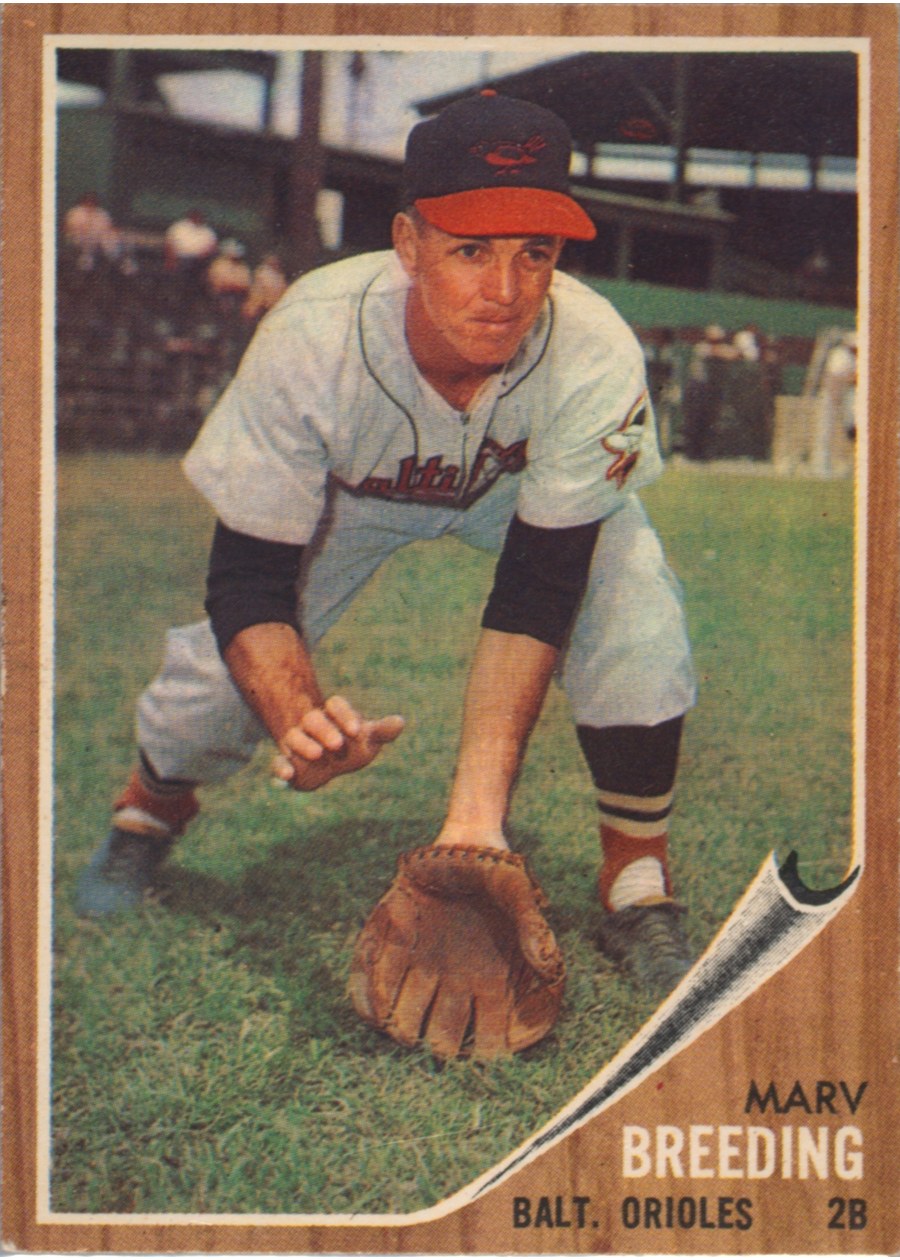
1962 Topps #6 Marv Breeding
About Marv Breeding
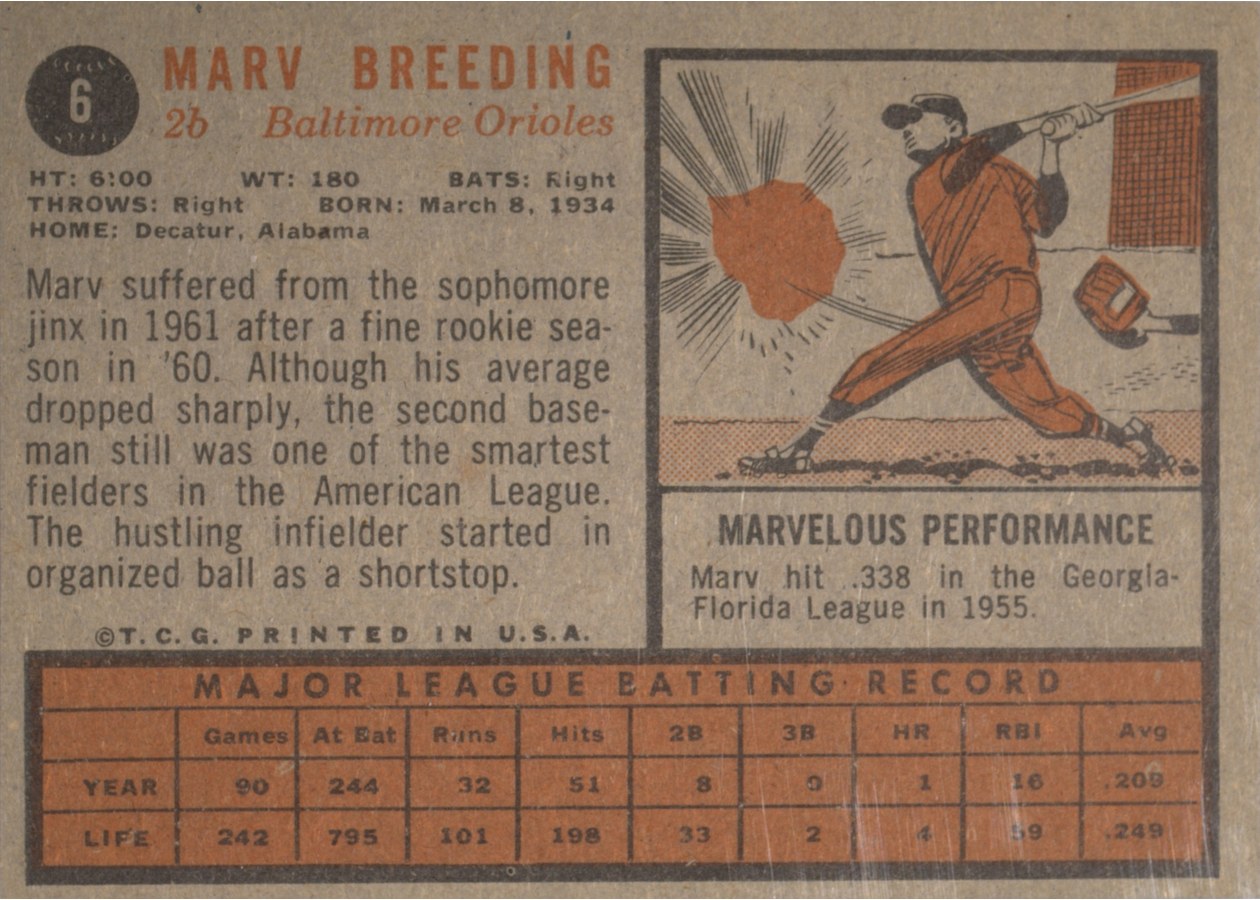
The 1962 card, #6 in the first series, catches Breeding after a season cut nearly in half. Jerry Adair moved into the Orioles' second-base job in 1961 and played 107 games there, leaving Breeding with 90 games, 244 at-bats, a .209 average, 51 hits and 16 RBI. After 1960 he never again reached 250 at-bats in a season.
Marvin Eugene Breeding was born March 8, 1934, in Decatur, Alabama, played college baseball at Samford University, and signed with the Baltimore Orioles in 1955. He did not reach the majors until April 19, 1960, at age 26, but arrived as Baltimore's regular second baseman and set every one of his career highs in that first season. Jerry Adair took over the position the next year, and Breeding spent his remaining Baltimore time moving around the infield. Before the 1963 season the Orioles sent him to the new Washington Senators in a five-player deal, and a midseason trade shipped him on to the Los Angeles Dodgers for pitcher Ed Roebuck. He sat on the bench that October while the Dodgers swept the New York Yankees in the World Series. His four-year career closed after 1963 at .250 with 317 hits, seven home runs and 92 RBI in 415 games. Breeding then played five more seasons of Triple-A ball, retiring in 1968. He worked afterward as a manufacturer's representative and built Marve Breeding Enterprises, which included the M&B Industries machine shop in his hometown. He was selected to the Samford Baseball Hall of Fame in February 2006 and died at home in Decatur on December 31, 2006, at age 72.
Sources: Wikipedia · SABR BioProject · Baseball-Reference
Graded population (PSA & SGC)
| Grader | Total | 10 | 9 | 8 | 7 | 6 | 5 | 1-4 | Auth |
|---|---|---|---|---|---|---|---|---|---|
| PSA | 239 | 0 | 3 | 36 | 108 | 45 | 22 | 25 | 0 |
| SGC | 12 | 0 | 0 | 2 | 6 | 1 | 1 | 2 | 0 |
Graded population — a scarcity guide, not a price. Snapshot 2026-09-24. Half-grades fold down (8.5→8), and PSA's qualified grades are counted separately from the straight-grade rows shown here. Slabs of the three cards printed #139 are joined by description, never by number alone. PSA registers the green tints as a separate set; a tint's population is listed under that state of the card it belongs to.
Find this card
Search T206 Cards Live auctions Buy It Now on eBay Sold prices
As an eBay Partner Network affiliate, T206Cards.com may earn from qualifying purchases.
Related cards
Team card: #476 Baltimore Orioles Team
More Baltimore Orioles cards:
- #34 Johnny Temple
- #45 Brooks Robinson
- #64 Russ Snyder
- #75 Milt Pappas
- #99 John Powell
- #112 Hank Foiles
- #121 Billy Hitchcock
- #134 Billy Hoeft
- #165 Jackie Brandt
- #189 Dick Hall
- #203 Jack Fisher
- #221 Bill Short
- #245 Ron Hansen
- #272 Earl Robinson
Frequently asked questions
What is the 1962 Topps #6 card?
It is card #6 of the 600-card 1962 Topps Baseball set, picturing Marv Breeding of the Baltimore Orioles.
How many cards are in the 1962 Topps Baseball set?
600 cards, tracked as 708 collectible states. The numbers run from 1 to 598 with no gaps, but three different cards were printed #139 - two Hal Reniff poses, catalogued 139a and 139b, and the Babe Hits 60 Babe Ruth Special, 139c - so 598 numbers make 600 cards; 93 cards carry catalogued print variations, the series-2 green tints among them, that the master set counts separately.
Sources: Baseball Almanac, Trading Card Database, PSA CardFacts, Cardboard Connection, BaseballCardPedia, The Topps Archives, Baseball-Reference, the SABR BioProject and the National Baseball Hall of Fame, PSA & SGC population reports. Card data compiled and maintained by T206Cards.com. Page last updated 2026-10-03.