
1962 Topps #99 John Powell
The age in the back's write-up runs a year high: Powell was 18, not 19.
Uncorrected error: The back says "when he was 19" - he was 18
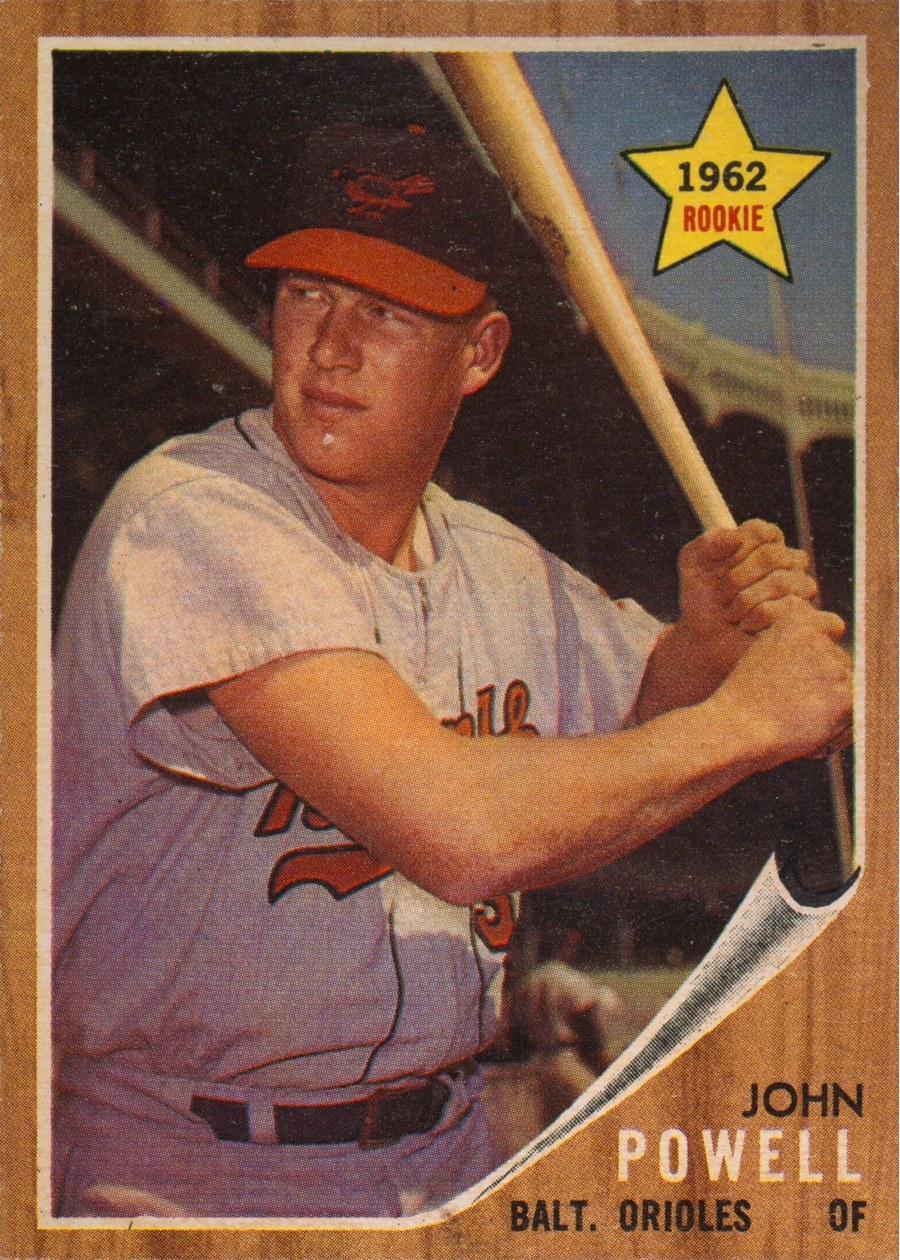
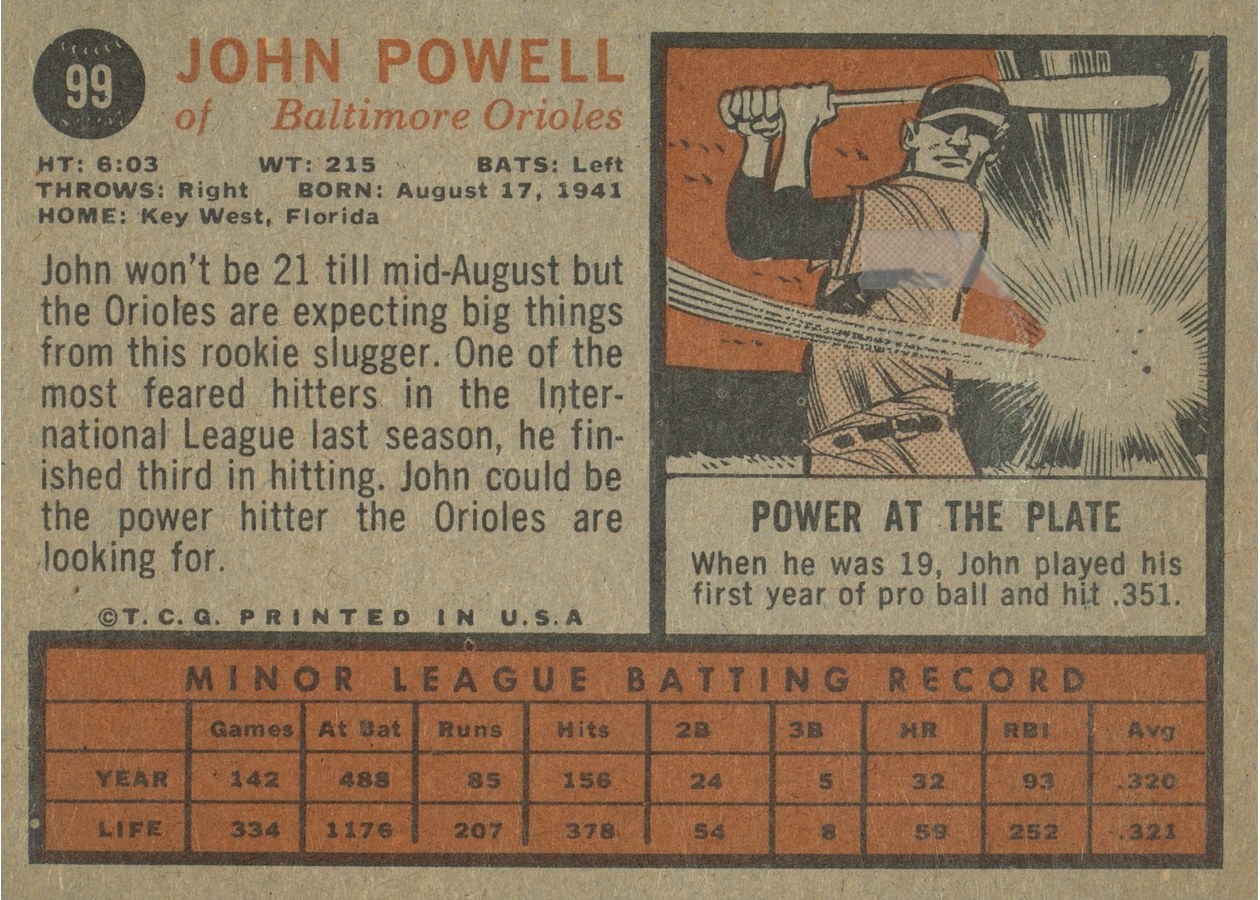
About John Powell
Card #99, from the opening series, follows a September 1961 call-up and is his recognised rookie card. Manager Billy Hitchcock put the big kid in left field rather than at first base, where veteran Jim Gentile was entrenched, and Powell answered on May 2 at Minnesota with the first two home runs of his career, both two-run shots, in the same game. Injuries then bit: a deep bruise above the knee after he ran into the left-field fence in Detroit, and a June beaning that carried him off on a stretcher. He still played 124 games and batted .243 with 15 home runs and 53 runs batted in. One quirk for back-readers: the write-up ages him by a year, calling him 19 when he was 18.
John Wesley Powell was born August 17, 1941, in Lakeland, Florida, and moved to Key West as a teenager, starring in football, basketball and baseball at Key West High School before signing with the Baltimore Orioles as an amateur free agent in 1959. A huge left-handed hitter, he climbed the farm system fast and led the International League in home runs for Rochester in 1961, the summer Baltimore called him up in September. Powell spent his first three seasons as a slow-footed left fielder before shifting to first base in 1965, and he supplied the power in the middle of the Orioles order that won four American League pennants and two World Series between 1966 and 1971, hitting alongside Frank Robinson and Brooks Robinson. He led the league in slugging in 1964, made four straight All-Star teams from 1968 through 1971, and was the American League's Most Valuable Player in 1970. He finished up with the Cleveland Indians and the Los Angeles Dodgers, retiring in 1977 with a .266 average, 339 home runs and 1,187 runs batted in over 17 seasons. Baltimore elected him to the Orioles Hall of Fame in 1979, and he has been a Camden Yards fixture since opening his barbecue stand there in 1992.
Sources: SABR BioProject · Baseball-Reference
Graded population (PSA & SGC)
| Grader | Total | 10 | 9 | 8 | 7 | 6 | 5 | 1-4 | Auth |
|---|---|---|---|---|---|---|---|---|---|
| PSA | 1,357 | 0 | 9 | 175 | 352 | 336 | 217 | 266 | 2 |
| SGC | 290 | 0 | 1 | 15 | 59 | 78 | 73 | 60 | 4 |
Graded population — a scarcity guide, not a price. Snapshot 2026-09-24. Half-grades fold down (8.5→8), and PSA's qualified grades are counted separately from the straight-grade rows shown here. Slabs of the three cards printed #139 are joined by description, never by number alone. PSA registers the green tints as a separate set; a tint's population is listed under that state of the card it belongs to.
Find this card
Search T206 Cards Live auctions Buy It Now on eBay Sold prices
As an eBay Partner Network affiliate, T206Cards.com may earn from qualifying purchases.
Related cards
Team card: #476 Baltimore Orioles Team
More Baltimore Orioles cards:
- #6 Marv Breeding
- #34 Johnny Temple
- #45 Brooks Robinson
- #64 Russ Snyder
- #75 Milt Pappas
- #112 Hank Foiles
- #121 Billy Hitchcock
- #134 Billy Hoeft
- #165 Jackie Brandt
- #189 Dick Hall
- #203 Jack Fisher
- #221 Bill Short
- #245 Ron Hansen
- #272 Earl Robinson
Frequently asked questions
What is the 1962 Topps #99 card?
It is card #99 of the 600-card 1962 Topps Baseball set, picturing John Powell of the Baltimore Orioles.
Is 1962 Topps #99 a rookie card?
Yes - #99 is the 1962 Topps rookie card of John Powell.
Does 1962 Topps #99 have an error?
The back says "when he was 19" - he was 18. It was never corrected, so there is no variation to chase - every copy of #99 reads the same way.
How many cards are in the 1962 Topps Baseball set?
600 cards, tracked as 708 collectible states. The numbers run from 1 to 598 with no gaps, but three different cards were printed #139 - two Hal Reniff poses, catalogued 139a and 139b, and the Babe Hits 60 Babe Ruth Special, 139c - so 598 numbers make 600 cards; 93 cards carry catalogued print variations, the series-2 green tints among them, that the master set counts separately.
Sources: Baseball Almanac, Trading Card Database, PSA CardFacts, Cardboard Connection, BaseballCardPedia, The Topps Archives, Baseball-Reference, the SABR BioProject and the National Baseball Hall of Fame, PSA & SGC population reports. Card data compiled and maintained by T206Cards.com. Page last updated 2026-10-03.