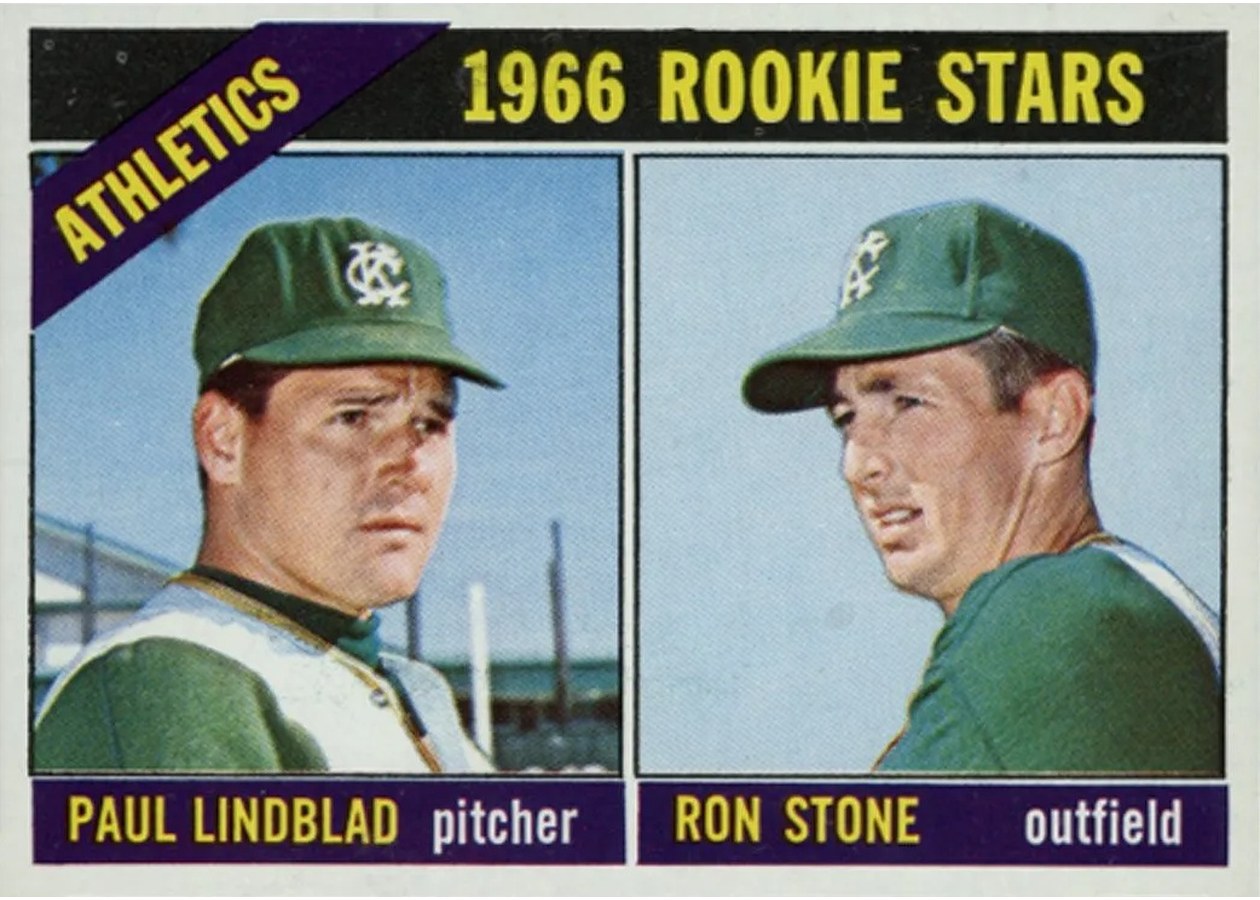
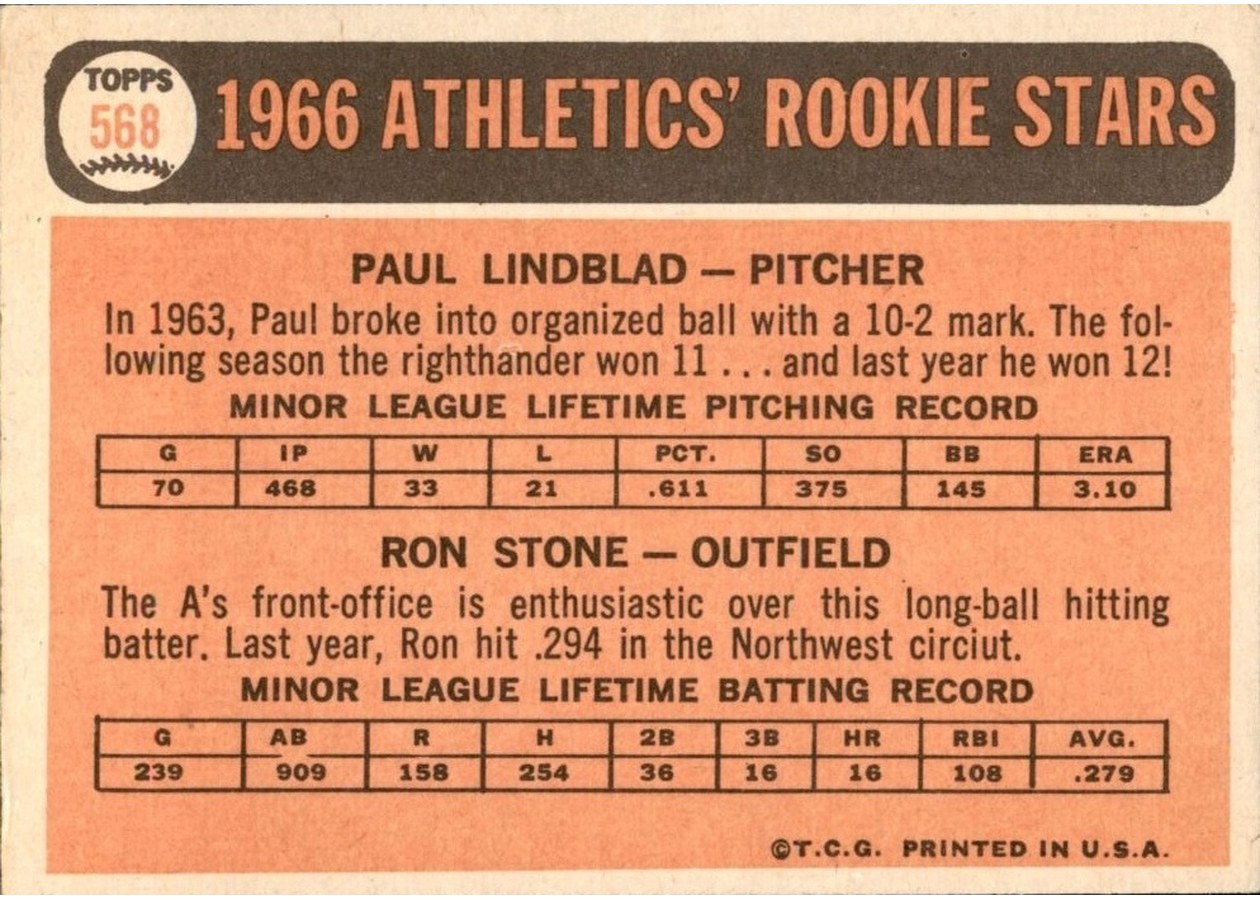
1966 Topps #568 Athletics Rookie Stars - Paul Lindblad / Ron Stone
On this card: Paul Lindblad, Ron Stone
About this card
The 46 Rookie Stars cards group a club's prospects under one number - except #553, which mixes Braves and Angels, and #591 NL Rookie Stars, which mixes Dodgers and Phillies. The class is headlined by #254 (Ferguson Jenkins, with Bill Sorrell) and #288 (Don Sutton, with Bill Singer).
The story on this card
Lindblad shares this high-number Rookie Stars card with fellow Kansas City Athletics prospect Ron Stone; card 568 falls in the seventh series and stands as Lindblad's rookie card. On the field in 1966 the 24-year-old moved between starting and relieving for Kansas City, going 5-10 with a 4.17 ERA over 38 games, 14 as a starter, striking out 69 in 121 innings and picking up his first career save. A left-handed relief specialist for 14 major league seasons, mostly with the Kansas City/Oakland Athletics, Paul Lindblad won three World Series rings and set a big league record with 385 consecutive errorless games between 1966 and 1974.
Stone's rookie card arrives in the 1966 Topps set's seventh series as card #568, a high number in the Kansas City Athletics Rookie Stars subset shared with pitcher Paul Lindblad. That season Stone made his major-league debut in April, appearing in 26 games for Kansas City, mostly as a pinch-hitter or defensive replacement, before being returned to the Orioles organization in June. A left-handed outfielder from Corning, California, Ron Stone reached the majors in 1966 with Kansas City after a Rule 5 selection, then spent three seasons as Philadelphia's dependable fourth outfielder, valued for speed, defense and a strong arm.
Sources: Wikipedia (Paul Lindblad) · Wikipedia (Ron Stone) · SABR BioProject (Paul Lindblad) · SABR BioProject (Ron Stone)
Graded population (PSA & SGC)
| Grader | Total | 10 | 9 | 8 | 7 | 6 | 5 | 1-4 | Auth |
|---|---|---|---|---|---|---|---|---|---|
| PSA | 398 | 0 | 41 | 201 | 98 | 36 | 14 | 6 | 2 |
| SGC | 26 | 0 | 1 | 14 | 5 | 3 | 3 | 0 | 0 |
Graded population — a scarcity guide, not a price. Data as of 2026-09-04. Half grades fold down for both graders (8.5→8); PSA qualified slabs (OC, ST, PD, MC and the like) are not counted. Where SGC registers no separate row for a variation state, its slabs of that card are listed under the base state.
Find this card
Search T206 Cards Shop 1966 Topps cards Live auctions Buy It Now on eBay Sold prices
As an eBay Partner Network affiliate, T206Cards.com may earn from qualifying purchases.
Related cards
Team card: #492 Kansas City Athletics
More Kansas City Athletics cards:
- #18 Roland Sheldon
- #36 Jim Hunter
- #55 Ken Harrelson
- #74 Don Mossi
- #107 Athletics 1966 Rookie Stars
- #143 Jose Tartabull
- #157 Rene Lachemann
- #175 Bert Campaneris
- #201 Jim Dickson
- #236 Mike Hershberger
- #256 Lew Krausse
- #287 Jack Aker
- #309 Diego Segui
- #332 Billy Bryan
Frequently asked questions
What is the 1966 Topps #568 card?
It is card #568 of the 598-card 1966 Topps Baseball set, picturing Paul Lindblad and Ron Stone. The 46 Rookie Stars cards group a club's prospects under one number - except #553, which mixes Braves and Angels, and #591 NL Rookie Stars, which mixes Dodgers and Phillies. The class is headlined by #254 (Ferguson Jenkins, with Bill Sorrell) and #288 (Don Sutton, with Bill Singer).
Is 1966 Topps #568 a rookie card?
Yes - #568 is a rookie card for every player pictured on it: Paul Lindblad and Ron Stone.
Why is #568 harder to find?
It is a high number card from the seventh and last print series, #523-598 - the scarce end of the set. Forty-three of its 76 cards are short prints, so scarcity is stated for the series as a whole.
How many cards are in the 1966 Topps Baseball set?
598 cards, tracked as 613 collectible states. Numbers run from 1 to 598 with no gaps and no number used twice, and 14 cards carry catalogued print variations - five checklists, the trade and sold statement backs, the three-state #43 Don Landrum, three team-card dot pairs and the #161 Jerry Lumpe white streak - that the master set counts separately.
Sources: Trading Card Database, PSA CardFacts, Cardboard Connection, Baseball Almanac, Baseball-Reference, the SABR BioProject and the National Baseball Hall of Fame, PSA & SGC population reports. Card data compiled and maintained by T206Cards.com. Page last updated 2026-10-11.