
1966 Topps #30 Pete Rose
Topps ran this card twice on the printing sheet, so the double print turns up more often than the cards printed once beside it.
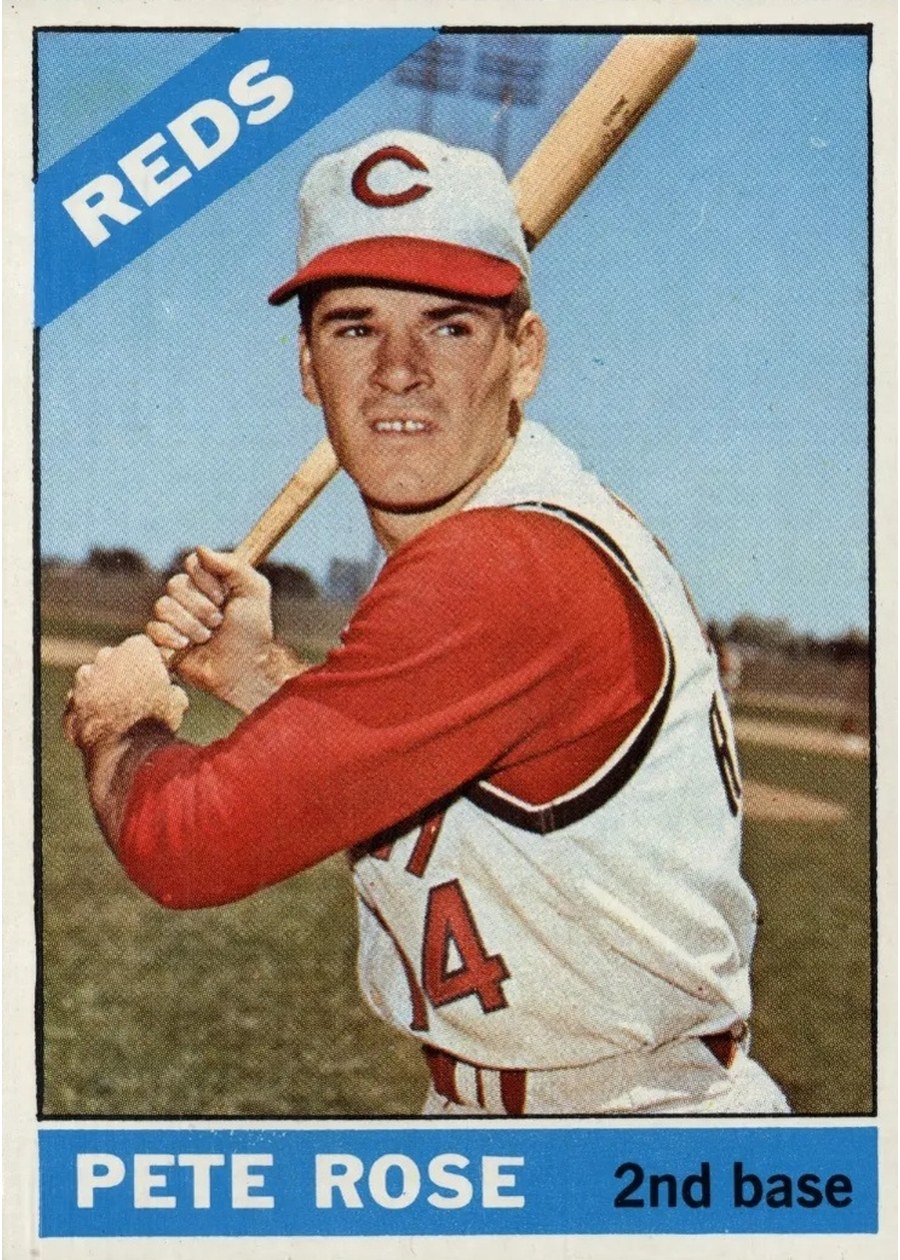
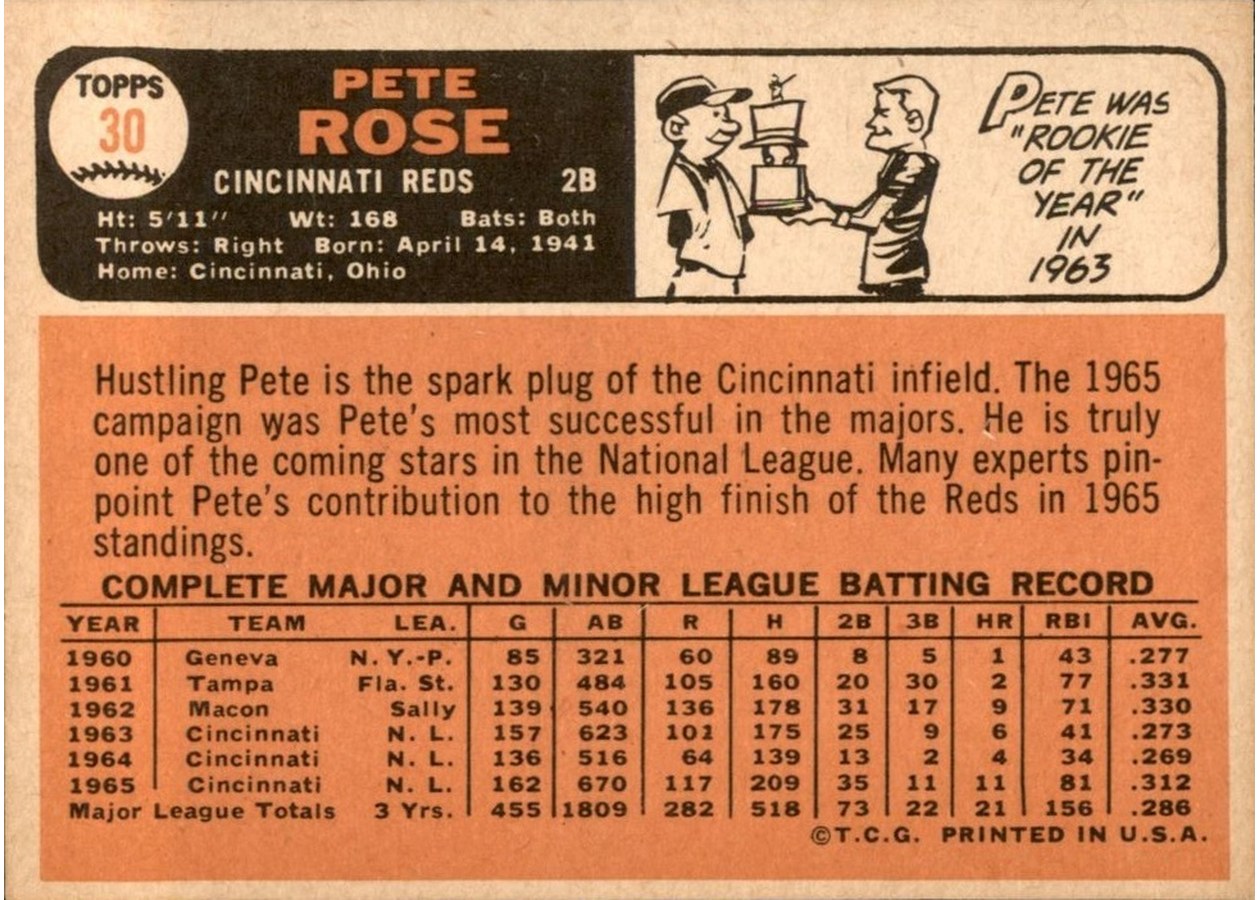
About Pete Rose
Pete Rose hit .313 in 1966 with 205 hits, 38 doubles and a career-high 16 home runs. He put up those numbers while still an infielder, playing 140 games at second base and another 16 at third, one year before the Reds sent him to the outfield. Topps double-printed his card, so it turns up more often than most in the set.
Peter Edward Rose Sr. (April 14, 1941 - September 30, 2024) grew up in Cincinnati and signed with his hometown Reds out of Western Hills High School in 1960, at the urging of his uncle Buddy Bloebaum, a bird-dog scout for the club. He reached the majors in 1963 and won National League Rookie of the Year, by then already carrying the nickname Charlie Hustle. A switch-hitter who played 24 seasons for the Reds, Phillies and Expos, he came up at second base and later worked in left field, right field, third base and first base, making 17 All-Star teams at an unequaled five different positions. He was the leadoff man and catalyst of the Big Red Machine, taking the 1973 NL MVP award, three batting titles, two Gold Gloves and back-to-back championships in 1975 and 1976, then a third with the 1980 Phillies. On September 11, 1985, as Reds player-manager, he passed Ty Cobb, and he left the game with 4,256 hits, 3,562 games and 14,053 at-bats, all still records. He managed Cincinnati until August 1989, when a gambling investigation put him on baseball's permanently ineligible list. The Reds Hall of Fame took him in 2016, and Major League Baseball removed him from that list posthumously in May 2025.
Sources: Wikipedia · SABR BioProject · Baseball-Reference · Baseball Almanac · MLB.com · BaseballCardPedia
Graded population (PSA & SGC)
| Grader | Total | 10 | 9 | 8 | 7 | 6 | 5 | 1-4 | Auth |
|---|---|---|---|---|---|---|---|---|---|
| PSA | 7,009 | 0 | 72 | 537 | 859 | 1,189 | 1,192 | 3,143 | 17 |
| SGC | 2,365 | 0 | 3 | 34 | 147 | 306 | 560 | 1,277 | 38 |
Graded population — a scarcity guide, not a price. Data as of 2026-09-04. Half grades fold down for both graders (8.5→8); PSA qualified slabs (OC, ST, PD, MC and the like) are not counted. Where SGC registers no separate row for a variation, its slabs of that card are listed under the base version.
Find this card
Search T206 Cards Shop 1966 Topps cards Live auctions Buy It Now on eBay Sold prices
As an eBay Partner Network affiliate, T206Cards.com may earn from qualifying purchases.
Related cards
Team card: #59 Cincinnati Reds
More Cincinnati Reds cards:
- #12 John Tsitouris
- #72 Tony Perez
- #89 Ted Davidson
- #119 Art Shamsky
- #140 Jim Maloney
- #159 Chico Ruiz
- #180 Vada Pinson
- #196 Don Pavletich
- #214 Tommy Harper
- #219 National League 1965 RBI Leaders
- #233 Dom Zanni
- #250 Sam Ellis
- #269 Don Heffner
- #272 Jack Baldschun
Frequently asked questions
What is the 1966 Topps #30 card?
It is card #30 of the 598-card 1966 Topps Baseball set, picturing Pete Rose of the Cincinnati Reds.
What are the key cards in the 1966 Topps set?
#1 Willie Mays opens the set and #598 Gaylord Perry closes it. The #50 Mickey Mantle anchors it, with #30 Pete Rose, #100 Sandy Koufax (his last solo Topps card), #300 Bob Clemente, #500 Hank Aaron (his first base card as an Atlanta Brave) and #215 National League 1965 Batting Leaders (Clemente, Aaron and Mays on one card) among the headliners, and three Hall of Fame rookies: #126 Jim Palmer, #254 Phillies Rookie Stars (Ferguson Jenkins) and #288 Dodgers Rookie Stars (Don Sutton). The 76-card high series (#523-598) holds 43 short prints by the hobby count.
Is 1966 Topps #30 a scarce card?
It is a double print card (cards 30, 36, 50, 90, 93, 100). Six first-series cards were printed in double quantity: Pete Rose, Catfish Hunter, Mickey Mantle, Luis Aparicio, Jim Lonborg (#93) and Sandy Koufax. A double print is more plentiful, not scarcer - Mantle stays a set keystone regardless.
How many cards are in the 1966 Topps Baseball set?
598 cards plus 15 variations (613 in the master set), issued in seven series. The full breakdown is on the 1966 Topps Baseball checklist page.
Sources: Trading Card Database, PSA CardFacts, Cardboard Connection, Baseball Almanac, Baseball-Reference, the SABR BioProject and the National Baseball Hall of Fame, PSA & SGC population reports. Card data compiled and maintained by T206Cards.com. Page last updated 2026-11-02.