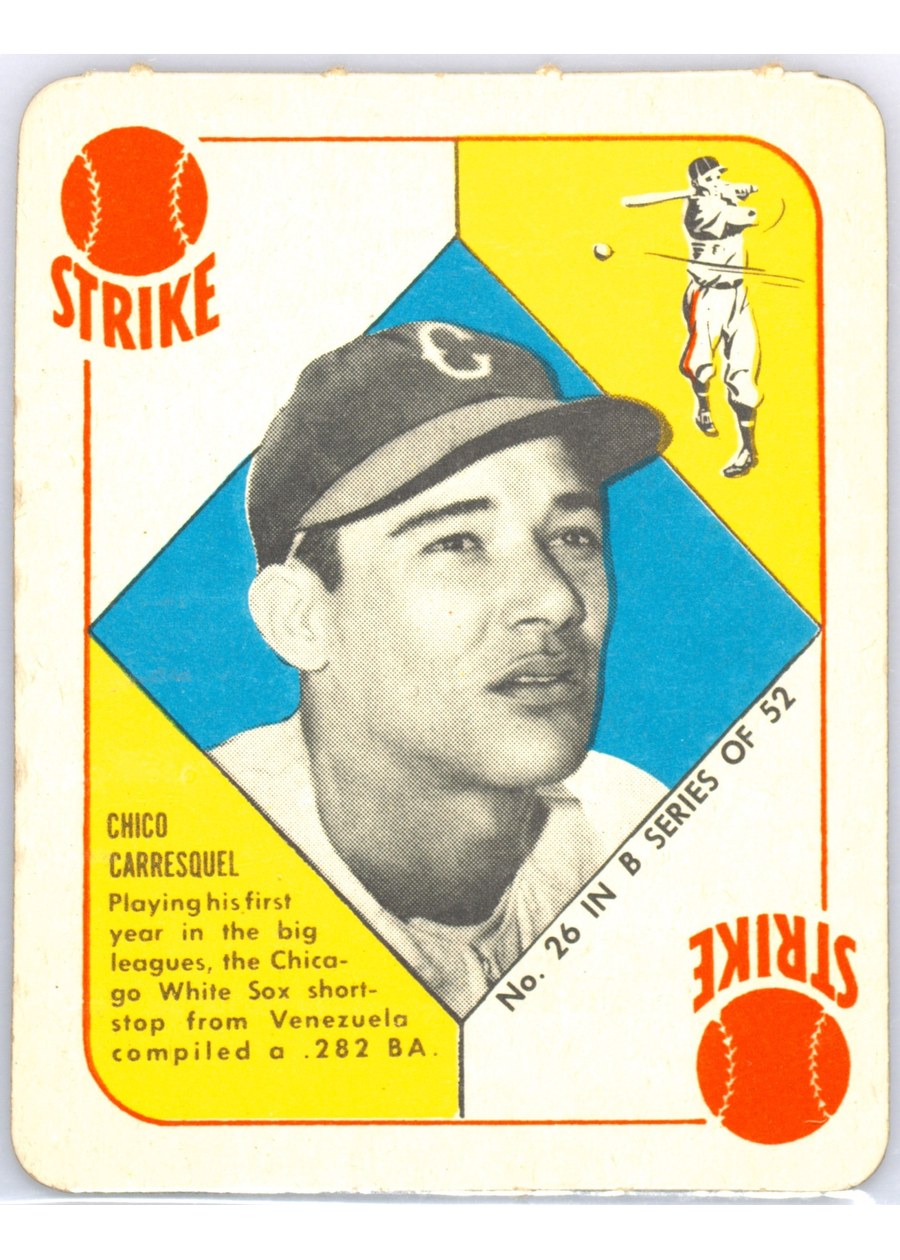
1951 Topps Blue Back #26 Chico Carresquel
About Chico Carresquel
Carrasquel opened 1950 as Luke Appling's successor at shortstop and handled six chances without an error in his April 18 debut against the St. Louis Browns. His .282 average that year stood as the best of his career, and a 24-game hitting streak ran until Ellis Kinder of the Red Sox stopped it. On July 16, between games of a Yankee Stadium doubleheader broadcast in Spanish across Latin America, he was given an automobile, a television set, a watch and 16,300 bolivars, about $5,000 and five times his signing bonus. Torn knee cartilage cost him the last week of the season and required an operation, and he finished third in Rookie of the Year voting behind Walt Dropo and Whitey Ford.
Chico Carrasquel was the shortstop who took over from Luke Appling on the 1950 Chicago White Sox and became the first Venezuelan star in the major leagues. A nephew of Alex Carrasquel, the first Venezuelan big leaguer, he signed with the Brooklyn Dodgers for a $1,000 bonus, hit .315 at Fort Worth in 1949, and went to Chicago that October for $25,000 and two minor leaguers. Fans voted him the American League starter over Phil Rizzuto in 1951, the first time a Latin American started an All-Star Game, and he started again in 1953 and 1954 before a reserve selection in 1955. In 1951 he handled 297 consecutive chances without an error, a shortstop record. Paired with Nellie Fox, he had his best year as the 1954 leadoff man, with 12 home runs, 62 RBI and 106 runs. Chicago traded him and Jim Busby to Cleveland for Larry Doby in October 1955, clearing the way for Luis Aparicio, and he closed with Kansas City and Baltimore, a .258 hitter with 55 home runs. He later managed the Leones del Caracas to the 1982 Caribbean Series title, called White Sox games in Spanish from 1990 to 1996, and entered the Venezuelan Baseball Hall of Fame with its first class in 2003. He died in Caracas on May 26, 2005.
Sources: Wikipedia · SABR BioProject · Baseball-Reference
Graded population (PSA & SGC)
| Grader | Total | 10 | 9 | 8 | 7 | 6 | 5 | 1-4 | Auth |
|---|---|---|---|---|---|---|---|---|---|
| PSA | 148 | 0 | 9 | 40 | 10 | 19 | 36 | 34 | 0 |
| SGC | 14 | 0 | 1 | 2 | 1 | 0 | 1 | 9 | 0 |
Graded population — a scarcity guide, not a price. Data as of 2026-10-19. Half grades fold down for both graders (8.5→8); PSA qualified slabs (OC, ST, PD, MC and the like) are not counted.
Find this card
Search T206 Cards Shop 1951 Topps cards Live auctions Buy It Now on eBay Sold prices
As an eBay Partner Network affiliate, T206Cards.com may earn from qualifying purchases.
Related cards
Team card: Team card Chicago White Sox
More Chicago White Sox cards:
- Red Back #36 Gus Zernial
- Red Back #49 Al Zarilla
- Red Back #51 Eddie Robinson
- Blue Back #2 Hank Majeski
- Blue Back #19 Phil Masi
- Blue Back #45 Bill Pierce
- Connie Mack's All-Star Eddie Collins
Frequently asked questions
What is the 1951 Topps Blue Back #26 card?
It is Blue Back #26 in the 135-card 1951 Topps Baseball checklist, picturing Chico Carresquel of the Chicago White Sox.
Is 1951 Topps Blue Back #26 a rookie card?
Yes - Blue Back #26 is the rookie card of Chico Carresquel.
How many cards are in the 1951 Topps Baseball set?
135 cards across five issues - the Red Backs and Blue Backs (52 each), nine Team cards, and eleven each of Connie Mack's All-Stars and the Major League All-Stars. With the Zernial and Holmes variations and both versions of each Team card the master set is 146. All 135 count toward the full set; Jim Konstanty, Robin Roberts and Eddie Stanky, the three rarest Major League All-Stars, are so rarely seen that collectors often count a complete set as 132 without them.
Sources: PSA, BaseballCardPedia, Trading Card Database, Baseball-Reference, PSA & SGC population reports. Card data compiled and maintained by T206Cards.com. Page last updated 2026-10-26.