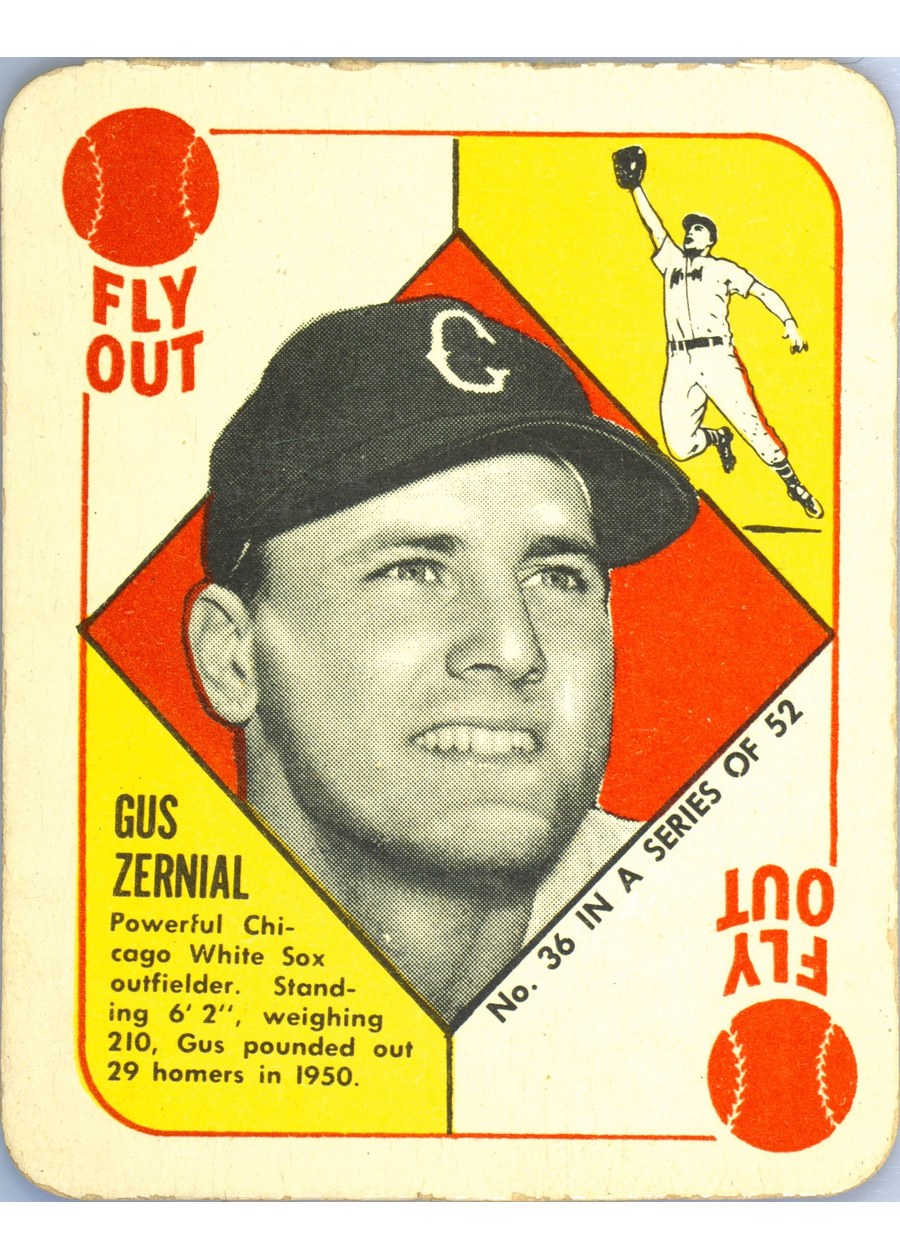
1951 Topps Red Back #36 Gus Zernial
About Gus Zernial
Zernial hit 29 home runs for the 1950 White Sox, fifth in the American League, after five in 73 games the year before, and he saved the biggest day for the finale. In the doubleheader on October 1, 1950, he hit four home runs, making him only the fourth player to do it, a mark that stood until Stan Musial hit five in 1954. Chicago traded him to the Athletics after four games of 1951, which is why Topps issued the card with both a Chicago and a Philadelphia version.
Gus Zernial was a right-handed outfielder from Beaumont, Texas, and one of the most prolific power hitters of the 1950s. After three years in the Navy in World War II, he hit 41 home runs for Burlington in the Carolina League in 1946 and later starred for the Hollywood Stars, where he picked up the nickname Ozark Ike. He reached the White Sox in 1949, then went to the Philadelphia Athletics in a three-team trade in 1951 and led the American League with 33 home runs and all of the majors with 129 runs batted in. He hit a career-high 42 homers in 1953, when he started in left field in the All-Star Game, and stayed with the Athletics when they moved to Kansas City. He finished with Detroit in 1959, with 237 home runs and a .265 average in 1,234 games. Twice he broke a collarbone making diving catches. He was later honored on the Philadelphia Baseball Wall of Fame and is in the Fresno Athletic Hall of Fame.
Sources: Wikipedia · SABR BioProject · Baseball-Reference · BaseballCardPedia
Variations
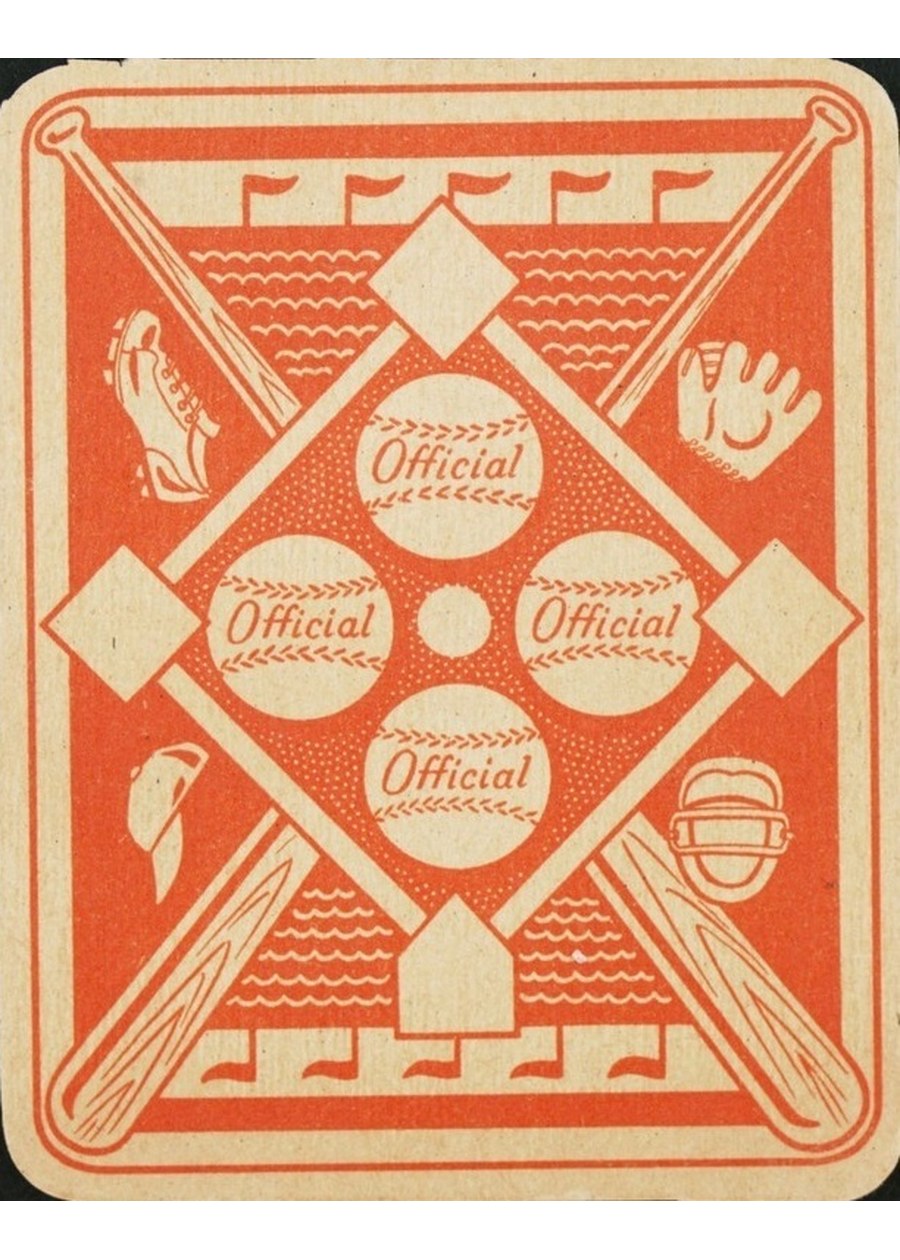
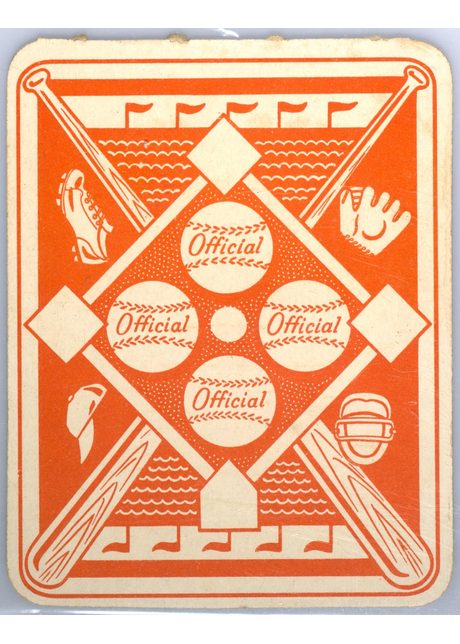
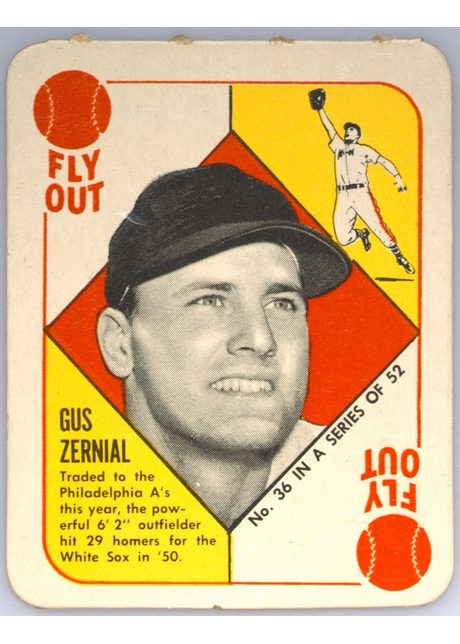
This card comes in two versions: #36a - Chicago and #36b - Philadelphia. The difference is on the back of the card.
Variations catalogued by the PSA master set registry and the Trading Card Database.
As an eBay Partner Network affiliate, T206Cards.com may earn from qualifying purchases.
Graded population (PSA & SGC)
| Grader | Total | 10 | 9 | 8 | 7 | 6 | 5 | 1-4 | Auth |
|---|---|---|---|---|---|---|---|---|---|
| #36a - Chicago | |||||||||
| PSA | 184 | 1 | 31 | 42 | 15 | 23 | 25 | 47 | 0 |
| SGC | 15 | 0 | 0 | 2 | 0 | 2 | 3 | 8 | 0 |
| #36b - Philadelphia | |||||||||
| PSA | 222 | 1 | 25 | 68 | 27 | 31 | 34 | 36 | 0 |
| SGC | 20 | 0 | 1 | 3 | 1 | 0 | 5 | 10 | 0 |
| Not designated by SGC | |||||||||
| SGC | 12 | 0 | 1 | 1 | 3 | 0 | 4 | 3 | 0 |
Graded population — a scarcity guide, not a price. Data as of 2026-10-19. Half grades fold down for both graders (8.5→8); PSA qualified slabs (OC, ST, PD, MC and the like) are not counted. Where a grader registers a variation separately its population is listed under that variation; SGC slabs whose label names no variation are listed as not designated, while PSA slabs whose label names no variation are counted under #36a - Chicago.
Find this card
Search T206 Cards Shop 1951 Topps cards Live auctions Buy It Now on eBay Sold prices
As an eBay Partner Network affiliate, T206Cards.com may earn from qualifying purchases.
Related cards
Team card: Team card Chicago White Sox
More Chicago White Sox cards:
- Red Back #49 Al Zarilla
- Red Back #51 Eddie Robinson
- Blue Back #2 Hank Majeski
- Blue Back #19 Phil Masi
- Blue Back #26 Chico Carresquel
- Blue Back #45 Bill Pierce
- Connie Mack's All-Star Eddie Collins
Frequently asked questions
What is the 1951 Topps Red Back #36 card?
It is Red Back #36 in the 135-card 1951 Topps Baseball checklist, picturing Gus Zernial of the Chicago White Sox.
Does 1951 Topps Red Back #36 have variations?
Yes. It comes in two versions: #36a - Chicago (The biography names Chicago and says nothing about a trade) and #36b - Philadelphia (The biography names Philadelphia and mentions his trade to the Athletics). Either one fills its place in the set; the master set takes both.
How many cards are in the 1951 Topps Baseball set?
135 cards across five issues - the Red Backs and Blue Backs (52 each), nine Team cards, and eleven each of Connie Mack's All-Stars and the Major League All-Stars. With the Zernial and Holmes variations and both versions of each Team card the master set is 146. All 135 count toward the full set; Jim Konstanty, Robin Roberts and Eddie Stanky, the three rarest Major League All-Stars, are so rarely seen that collectors often count a complete set as 132 without them.
Sources: PSA, BaseballCardPedia, Trading Card Database, Baseball-Reference, PSA & SGC population reports. Card data compiled and maintained by T206Cards.com. Page last updated 2026-10-26.