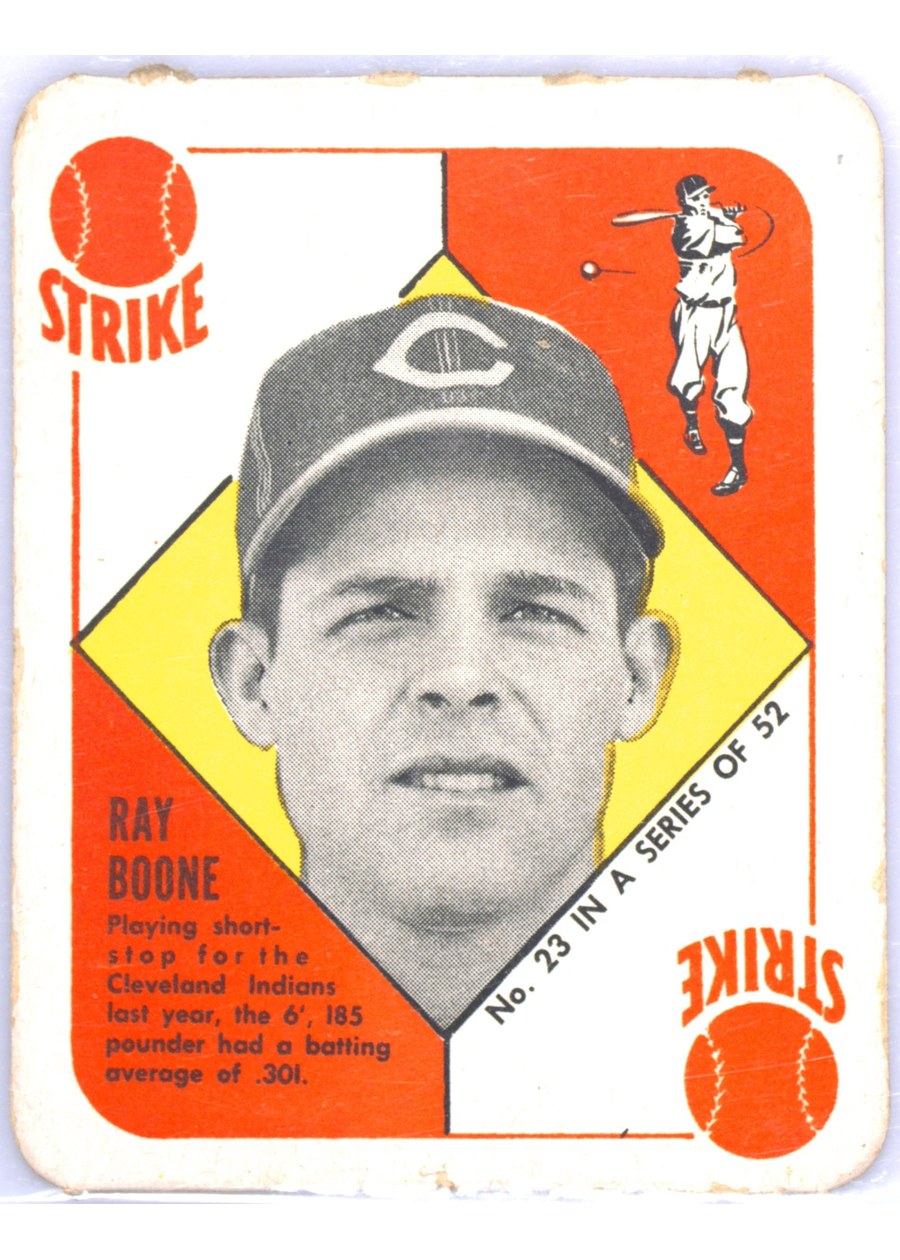
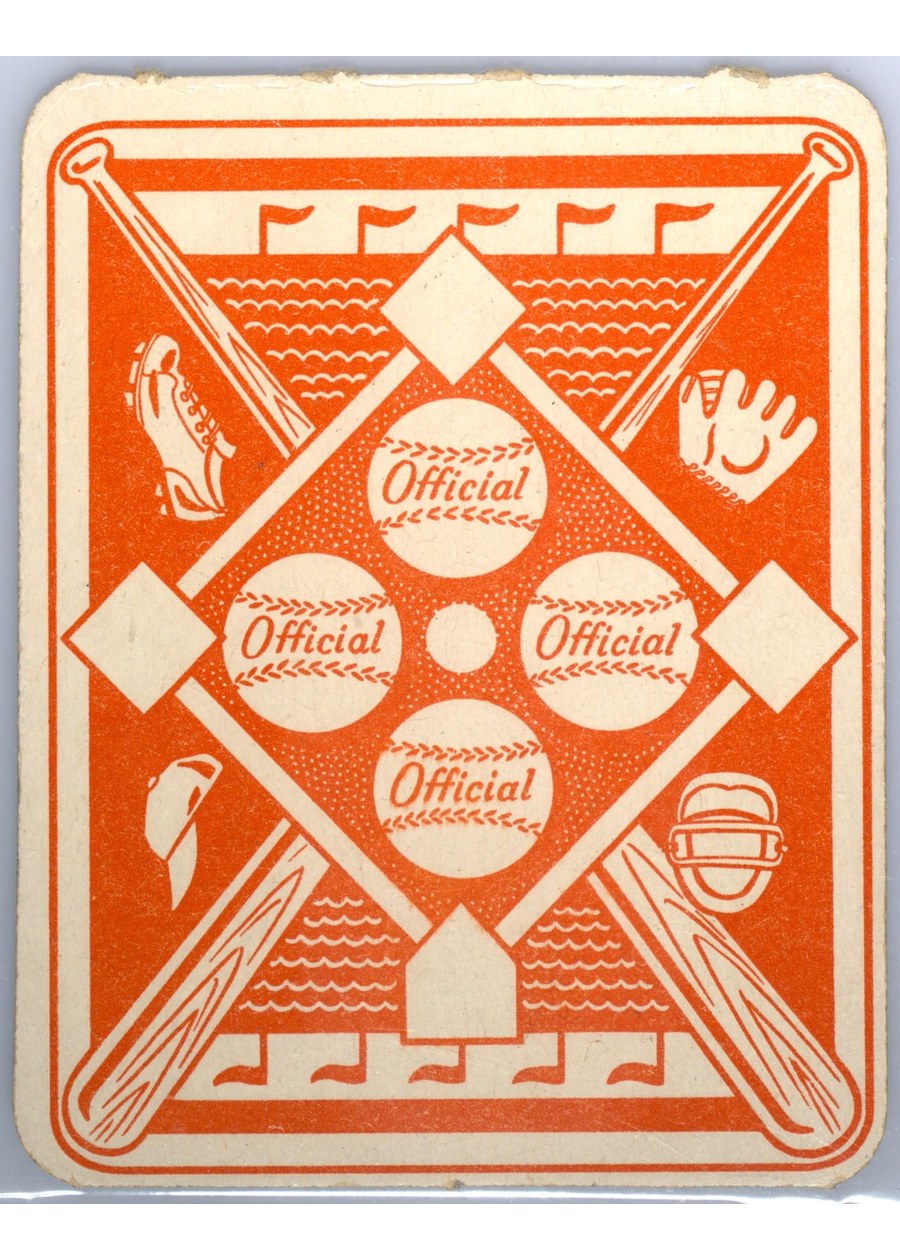
1951 Topps Red Back #23 Ray Boone
About Ray Boone
Lou Boudreau had first named Boone his starting shortstop on June 6, 1949, and in 1950 the player-manager left the job to him full time. Boone, Al Rosen and Bobby Avila were all out of minor-league options, so Cleveland could not send any of them down without risking losing him. Boone answered with a .301 average in 109 games, up 49 points from his .252 of 1949, and only Larry Doby and Dale Mitchell hit higher on the club. His 110 hits came with 7 home runs and 58 RBIs as the Indians finished fourth, six games behind the Yankees. Cleveland released Boudreau on November 21, 1950, and the position belonged to Boone alone.
Ray Boone was a converted catcher who played shortstop for Cleveland and third base for Detroit, where he became a two-time All-Star and the 1955 American League co-leader in RBIs. Born in San Diego, he signed with the Indians in 1942 at 18 and spent the next three years in the Navy. Cleveland called him up in September 1948, in time to pinch-hit in the World Series the Indians won over the Boston Braves. He succeeded Lou Boudreau at shortstop, but errors dogged him, and in June 1953 Cleveland sent him to Detroit. Moved to third base, he tied a then major-league record with four grand slams that season. He homered off Robin Roberts in the 1954 All-Star Game, made the team again in 1956, and in 1955 tied Jackie Jensen for the league lead with 116 RBIs. Bad knees moved him to first base in 1957. He passed through the White Sox, Athletics, Braves and Red Sox and retired after 1960 with a .275 average and 151 home runs. He scouted for Boston for over 30 years and signed Curt Schilling in 1986. His son Bob and grandsons Bret and Aaron followed him to the majors, the first three-generation family to do so, and San Diego's Hall of Champions inducted him into its Breitbard Hall of Fame in 1973.
Sources: Wikipedia · SABR BioProject · Baseball-Reference
Graded population (PSA & SGC)
| Grader | Total | 10 | 9 | 8 | 7 | 6 | 5 | 1-4 | Auth |
|---|---|---|---|---|---|---|---|---|---|
| PSA | 261 | 1 | 31 | 51 | 31 | 50 | 46 | 51 | 0 |
| SGC | 31 | 0 | 2 | 2 | 0 | 1 | 8 | 18 | 0 |
Graded population — a scarcity guide, not a price. Data as of 2026-10-19. Half grades fold down for both graders (8.5→8); PSA qualified slabs (OC, ST, PD, MC and the like) are not counted.
Find this card
Search T206 Cards Shop 1951 Topps cards Live auctions Buy It Now on eBay Sold prices
As an eBay Partner Network affiliate, T206Cards.com may earn from qualifying purchases.
Related cards
More Cleveland Indians cards:
- Red Back #8 Early Wynn
- Red Back #12 Jim Hegan
- Red Back #13 Dale Mitchell
- Red Back #22 Bob Feller
- Red Back #26 Luke Easter
- Red Back #29 Bob Kennedy
- Red Back #35 Al Rosen
- Red Back #40 Mike Garcia
- Blue Back #31 Lou Brissie
- Blue Back #52 Sam Chapman
- Connie Mack's All-Star Tris Speaker
- Major League All-Star Larry Doby
- Major League All-Star Bob Lemon
Frequently asked questions
What is the 1951 Topps Red Back #23 card?
It is Red Back #23 in the 135-card 1951 Topps Baseball checklist, picturing Ray Boone of the Cleveland Indians.
Is 1951 Topps Red Back #23 a rookie card?
Yes - Red Back #23 is the rookie card of Ray Boone.
How many cards are in the 1951 Topps Baseball set?
135 cards across five issues - the Red Backs and Blue Backs (52 each), nine Team cards, and eleven each of Connie Mack's All-Stars and the Major League All-Stars. With the Zernial and Holmes variations and both versions of each Team card the master set is 146. All 135 count toward the full set; Jim Konstanty, Robin Roberts and Eddie Stanky, the three rarest Major League All-Stars, are so rarely seen that collectors often count a complete set as 132 without them.
Sources: PSA, BaseballCardPedia, Trading Card Database, Baseball-Reference, PSA & SGC population reports. Card data compiled and maintained by T206Cards.com. Page last updated 2026-10-26.