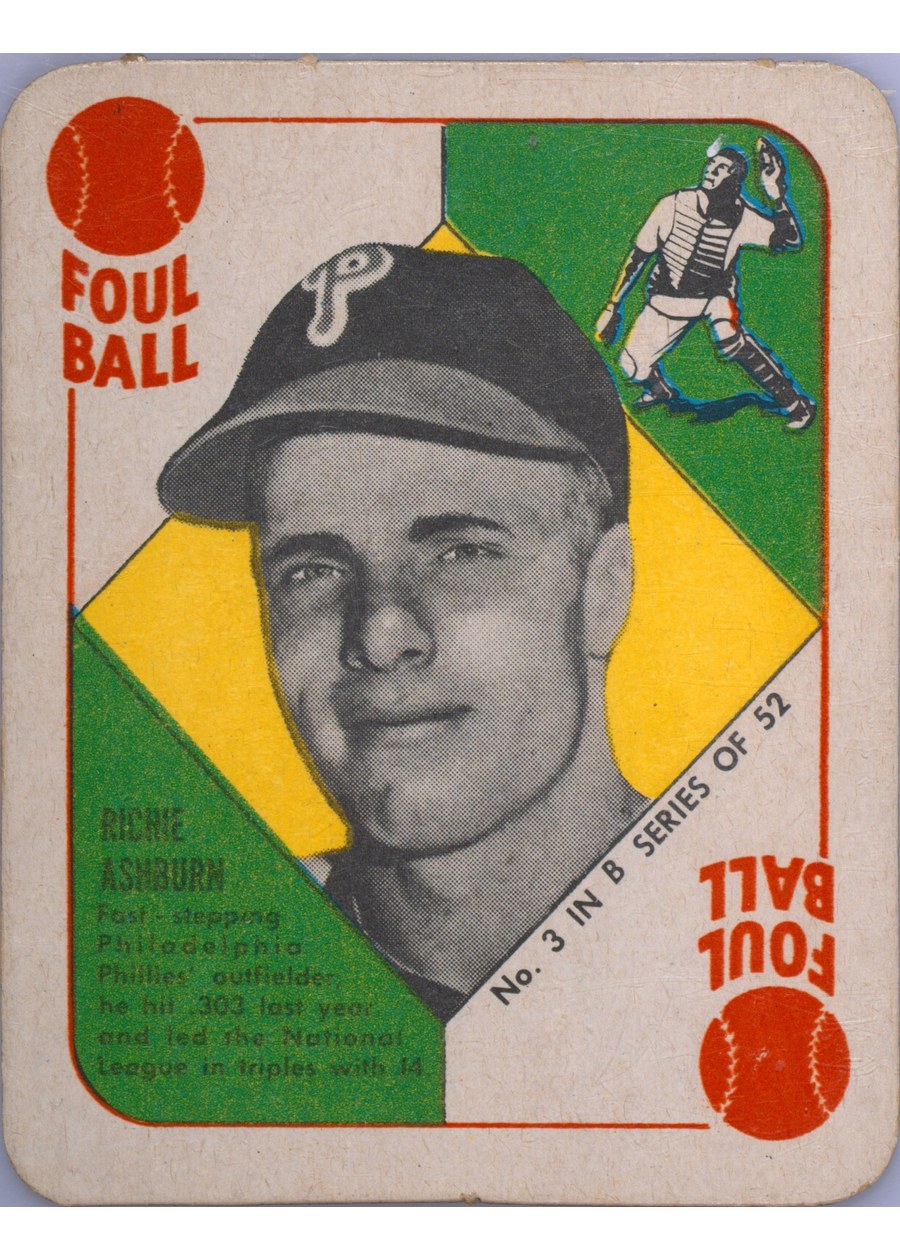
1951 Topps Blue Back #3 Richie Ashburn
About Richie Ashburn
Ashburn opened 1950 hitting .370, slumped in June and finished at .303, his 14 triples the most in the National League. When clubs crept their infielders in against his slaps and bunts, he answered with a heavier bat borrowed from Del Ennis. On October 1 at Ebbets Field, the score 1-1 with nobody out in the ninth, he charged Duke Snider's liner to center and threw Cal Abrams out at the plate, saving the Phillies from a playoff; Dick Sisler's three-run homer in the 10th won the pennant.
Don Richard Ashburn - Whitey to the minor-league teammates who named him for his light-blond hair - was a slap-and-run leadoff man and center fielder who spent his first twelve big-league seasons (1948-1959) with the Philadelphia Phillies. He debuted as a 21-year-old on Opening Day 1948 and started that summer's All-Star Game as a rookie. A left-handed spray hitter with almost no power, he won National League batting titles in 1955 (.338) and 1958 (.350), earned five All-Star selections, and patrolled center field for the pennant-winning 1950 Whiz Kids, who were swept by the Yankees in that year's World Series. His glove drew as much notice as his bat: he had 400 or more outfield putouts in nine seasons, a record, cleared 500 four times, and still ranks third all-time among center fielders in putouts behind only Willie Mays and Tris Speaker. Philadelphia traded him to the Chicago Cubs in January 1960 for three players; after two seasons at Wrigley Field the expansion New York Mets bought him for their first year. He retired following 1962 with a .308 average, 2,574 hits and 234 steals, then sat in the Phillies broadcast booth from 1963 until his death in 1997. The writers gave him 2.1 percent in 1968, his first year on the ballot; the Veterans Committee elected him in 1995.
Sources: Wikipedia · SABR BioProject · Baseball-Reference · National Baseball Hall of Fame · Baseball Almanac · Retrosheet
Graded population (PSA & SGC)
| Grader | Total | 10 | 9 | 8 | 7 | 6 | 5 | 1-4 | Auth |
|---|---|---|---|---|---|---|---|---|---|
| PSA | 325 | 0 | 30 | 68 | 24 | 32 | 62 | 109 | 0 |
| SGC | 48 | 0 | 3 | 6 | 5 | 6 | 10 | 18 | 0 |
Graded population — a scarcity guide, not a price. Data as of 2026-10-19. Half grades fold down for both graders (8.5→8); PSA qualified slabs (OC, ST, PD, MC and the like) are not counted.
Find this card
Search T206 Cards Shop 1951 Topps cards Live auctions Buy It Now on eBay Sold prices
As an eBay Partner Network affiliate, T206Cards.com may earn from qualifying purchases.
Related cards
Team card: Team card Philadelphia Phillies
More Philadelphia Phillies cards:
- Red Back #45 Andy Seminick
- Blue Back #4 Del Ennis
- Blue Back #8 Dick Sisler
- Blue Back #29 Granville Hamner
- Blue Back #43 Willie Jones
- Blue Back #51 Eddie Waitkus
- Major League All-Star Jim Konstanty
- Major League All-Star Robin Roberts
Frequently asked questions
What is the 1951 Topps Blue Back #3 card?
It is Blue Back #3 in the 135-card 1951 Topps Baseball checklist, picturing Richie Ashburn of the Philadelphia Phillies.
What are the key cards in 1951 Topps?
The three rarest are the Major League All-Stars of Jim Konstanty, Robin Roberts and Eddie Stanky, the three short prints of the issue. Red Back #1 Yogi Berra leads the Red Backs and Blue Back #3 Richie Ashburn the Blue Backs, with Blue Back #50 Johnny Mize and Blue Back #37 Bobby Doerr next; Red Back #49 Al Zarilla and Blue Back #51 Eddie Waitkus are the hardest of the two decks to find in top condition. Of the Team cards, the Boston Red Sox (Ted Williams' first Topps card) and the St. Louis Cardinals are the scarcest, and the Brooklyn Dodgers card pictures Jackie Robinson, Duke Snider, Pee Wee Reese and Roy Campanella. Babe Ruth and Lou Gehrig lead Connie Mack's All-Stars, and Yogi Berra the Major League All-Stars.
How many cards are in the 1951 Topps Baseball set?
135 cards across five issues - the Red Backs and Blue Backs (52 each), nine Team cards, and eleven each of Connie Mack's All-Stars and the Major League All-Stars. With the Zernial and Holmes variations and both versions of each Team card the master set is 146. All 135 count toward the full set; Jim Konstanty, Robin Roberts and Eddie Stanky, the three rarest Major League All-Stars, are so rarely seen that collectors often count a complete set as 132 without them.
Sources: PSA, BaseballCardPedia, Trading Card Database, Baseball-Reference, PSA & SGC population reports. Card data compiled and maintained by T206Cards.com. Page last updated 2026-10-26.