1952 Topps #168 Charlie Silvera
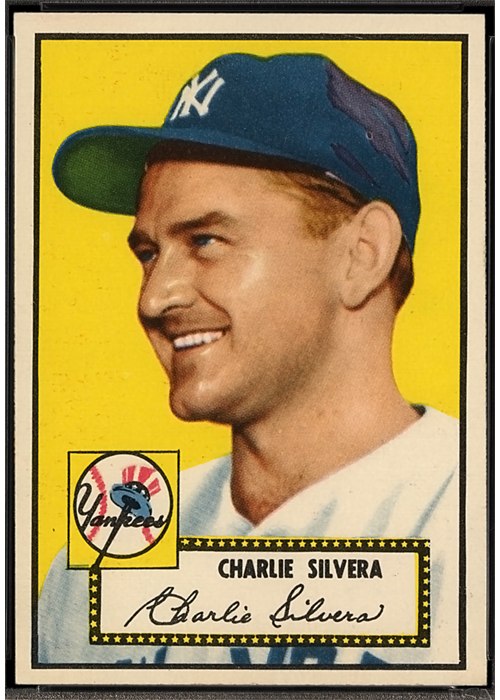
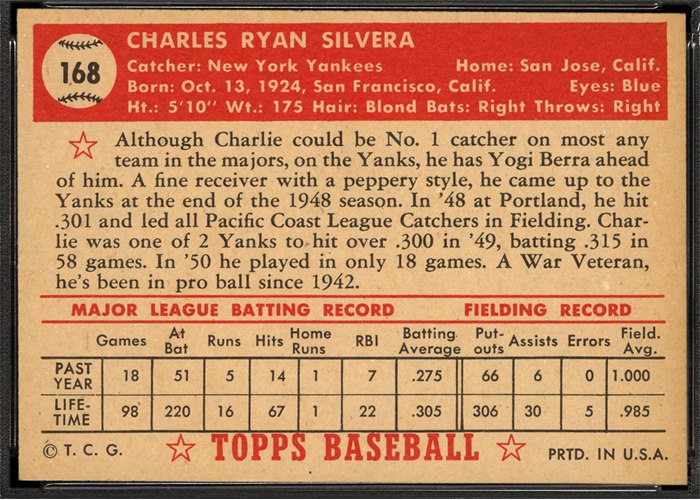
About Charlie Silvera
A San Francisco native born in 1924, Charlie Silvera signed with the New York Yankees organization in 1942 and reported to the Wellsville club of the PONY League before his career was interrupted by World War II service in the Army Air Forces, which took him to Pacific outposts such as Saipan and Tinian. He debuted for the Yankees on September 29, 1948, going 3-for-4 with a triple, then settled in as the steady right-handed backup catcher to Hall of Famer Yogi Berra. Silvera spent nine seasons in pinstripes (1948-1956) and closed his career with the Chicago Cubs in 1957, batting .282 with 1 home run and 52 RBI over 227 big-league games. Nicknamed "Swede," he became a fixture of the Yankees dynasty, collecting six World Series rings (1949-1953 and 1956) despite appearing in just one Series game, going hitless in two at-bats against Preacher Roe in Game 2 of the 1949 Fall Classic. This 1952 Topps card is Silvera's rookie card, part of the landmark first Topps flagship set, and is found with both white and gray back-stock variations.
Sources: Wikipedia · Baseball-Reference
Variations & how to tell them apart
White Back / Gray Back Series 3 (cards 131-190)
The third series exists on two different card stocks. The standard issue is on white/cream stock; a much scarcer parallel was printed on gray cardboard. The gray stock was used at the END of the series-3 run — leftover stock run through the same press, not a separate or foreign printing. Gray backs have a duller, gloss-less front and are never found with gum stains.
- White Back: Standard issue. White/cream card stock, normal red-ink back. Sharper, glossier front.
- Gray Back — scarcer: Scarce parallel on gray card stock. Duller, gloss-less front; never gum-stained. #189 Pete Reiser is the rarest of the run; #146 Frank House appears with a pale/yellow Tiger logo. NOTE: long mislabeled 'Canadian' (borrowed from the genuinely-Canadian 1954 Topps issue) — there is no evidence the 1952 grays were a Canadian release. TCDB catalogs these as 'Grey Back' against the normal 'Red Back'.
Graded population (PSA & SGC)
| Grader | Total | 10 | 9 | 8 | 7 | 6 | 5 | 1-4 | Auth |
|---|---|---|---|---|---|---|---|---|---|
| PSA | 665 | 0 | 6 | 47 | 102 | 155 | 161 | 189 | 5 |
| SGC | 128 | 0 | 0 | 2 | 8 | 13 | 44 | 59 | 2 |
SGC by variation: Standard 126 · (Authentic) 1 · Gray Back 1
Graded population — a scarcity guide, not a price. Snapshot 2026-06-22. Half-grades fold down (8.5→8); totals are summed across each grader's listed variations.
Find this card
Search T206 Cards Find on eBay
As an eBay Partner Network affiliate, T206Cards.com may earn from qualifying purchases.
More New York Yankees cards
- Bobby Hogue
- Phil Rizzuto
- Joe Page
- Johnny Sain
- Ed Lopat
- Allie Reynolds
- Bob Kuzava
- Gene Woodling
- Jack Jensen
- Don Bollweg
- Johnny Mize
- Frank Overmire
- Billy Martin
- Yogi Berra
Frequently asked questions
What is the 1952 Topps Charlie Silvera card?
It is card #168 of 407 in the 1952 Topps set - Topps' first flagship issue and the cornerstone of the postwar hobby. It pictures the New York Yankees player, and is his rookie card.
Does the 1952 Topps Charlie Silvera have back variations?
Yes. The third series exists on two different card stocks. The standard issue is on white/cream stock; a much scarcer parallel was printed on gray cardboard. The gray stock was used at the END of the series-3 run — leftover stock run through the same press, not a separate or foreign printing. Gray backs have a duller, gloss-less front and are never found with gum stains.
Is the 1952 Topps Charlie Silvera valuable?
Value depends on grade and (where it applies) the back variation. Use the links above to check current T206 Cards inventory and live eBay listings.
Sources: the Trading Card Database, Baseball-Reference, and PSA & SGC population reports. Card data & population compiled and maintained by T206Cards.com. Page last updated 2026-07-01.