
1952 Topps #24 Luke Easter

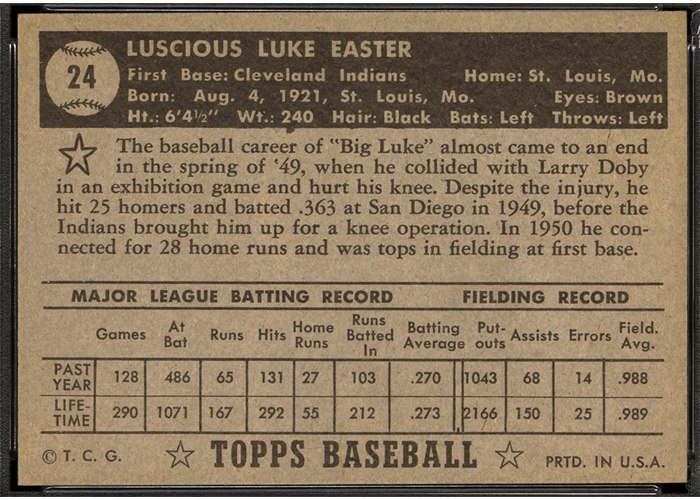
About Luke Easter
Luscious "Luke" Easter was a towering left-handed-hitting first baseman who reached the majors only after starring in Black baseball, having entered the pro ranks with the semipro St. Louis Titanium Giants in 1937 before joining the Negro Leagues with the Cincinnati Crescents and then the Homestead Grays. With the Grays in 1948 he batted .363, tied for the Negro National League home-run lead, led the loop in RBIs, and powered Homestead to the 1948 Negro World Series title; that July 18 he became the first player to drive a home run into the Polo Grounds' distant center-field bleachers, a blast estimated near 490 feet. Signed by Bill Veeck, Easter debuted for the Cleveland Indians on August 11, 1949, and manned first base through 1954, hitting a career .274 with 93 home runs and 340 RBI. He belted 28 homers as a 1950 rookie and, on June 23, 1950, launched a 477-foot shot that stood as the longest home run in Cleveland Stadium history (matched only by Mickey Mantle). His prodigious drives were nicknamed "Easter Eggs." After the majors he became an International League legend, winning the 1957 IL MVP with the Buffalo Bisons and later starring for Rochester; he was inducted into the International League Hall of Fame in 2008. Easter was tragically shot and killed in Euclid, Ohio, in 1979 while carrying payroll funds for coworkers. As a first-series card, #24 exists with the set's standard black- and red-back color variations.
Sources: Wikipedia · Baseball-Reference · SABR
Variations & how to tell them apart
Black Back / Red Back Series 1 (cards 1-80)
Every card in the first series exists with the back printed in either black or red ink. The black backs are the first printing and are scarcer; red backs (the second printing onward) are more common.
- Black Back — scarcer: First printing. Reverse printed in black ink. Scarcer, and typically carries a small premium over the red back.
- Red Back: Second printing onward. Reverse printed in red ink. The more common of the two.
Graded population (PSA & SGC)
| Grader | Total | 10 | 9 | 8 | 7 | 6 | 5 | 1-4 | Auth |
|---|---|---|---|---|---|---|---|---|---|
| PSA | 861 | 0 | 3 | 52 | 109 | 185 | 202 | 306 | 4 |
| SGC | 153 | 0 | 1 | 1 | 10 | 16 | 32 | 92 | 1 |
SGC by variation: Black Back 90 · Red Back 63
Graded population — a scarcity guide, not a price. Snapshot 2026-06-22. Half-grades fold down (8.5→8); totals are summed across each grader's listed variations.
Find this card
Search T206 Cards Find on eBay
As an eBay Partner Network affiliate, T206Cards.com may earn from qualifying purchases.
More Cleveland Indians cards
- Al Rosen
- Jim Hegan
- Merrill Combs
- Ray Boone
- Bob Kennedy
- Bob Feller
- Dale Mitchell
- Bob Chakales
- Pete Reiser
- Harry Simpson
- George Zuverink
- Mickey Harris
- George Stirnweiss
- Larry Doby
Frequently asked questions
What is the 1952 Topps Luke Easter card?
It is card #24 of 407 in the 1952 Topps set - Topps' first flagship issue and the cornerstone of the postwar hobby. It pictures the Cleveland Indians player.
Does the 1952 Topps Luke Easter have back variations?
Yes. Every card in the first series exists with the back printed in either black or red ink. The black backs are the first printing and are scarcer; red backs (the second printing onward) are more common.
Is the 1952 Topps Luke Easter valuable?
Value depends on grade and (where it applies) the back variation. Use the links above to check current T206 Cards inventory and live eBay listings.
Sources: the Trading Card Database, Baseball-Reference, and PSA & SGC population reports. Card data & population compiled and maintained by T206Cards.com. Page last updated 2026-07-01.