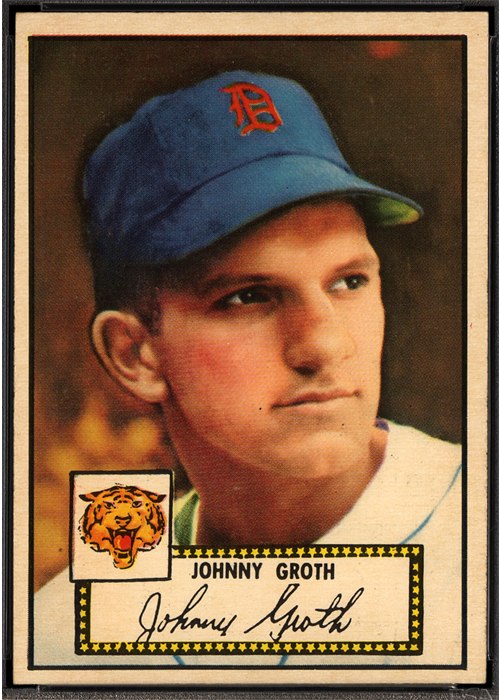
1952 Topps #25 Johnny Groth
About Johnny Groth
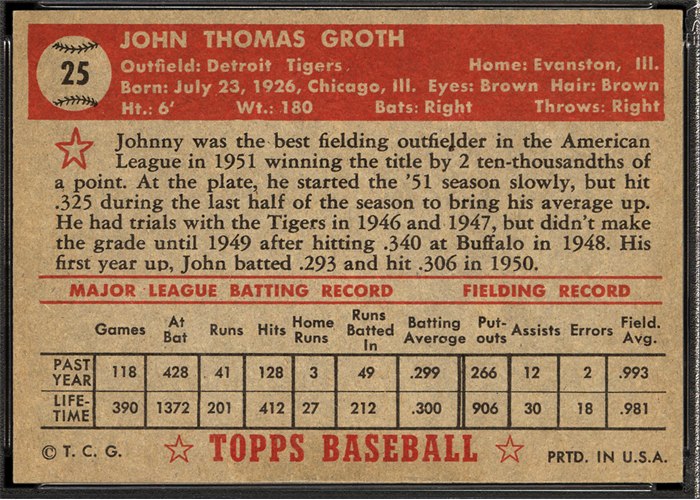
A right-handed center fielder from Chicago, Johnny Groth was signed by the Detroit Tigers in August 1946 after his discharge from the Navy, and he tore through the minors—hitting .340 with 40 home runs for Triple-A Buffalo in 1948 while leading the International League in hits and runs. That performance made him a national sensation; the Tigers billed the 20-year-old as "the next DiMaggio," and magazines like Time, Collier's and Life predicted stardom. Groth's finest year came in 1950, when he batted .306 with career highs of 12 home runs and 85 RBI, played all 157 of Detroit's games, and struck out just 27 times. Over 15 major-league seasons (1946–1960) he suited up for the Tigers, St. Louis Browns, Chicago White Sox, Washington Senators and Kansas City Athletics, finishing with a .279 average, 1,064 hits, 60 home runs and 486 RBI across 1,248 games while earning a reputation as a smooth, sure-handed defensive outfielder. He never quite matched the DiMaggio hype and was not selected to an All-Star team, but he remained a dependable regular and later scouted for the Braves and Cardinals into 1990. This card is an early low-number issue in the landmark first Topps flagship set, found with both the black-back and red-back color variations.
Sources: Wikipedia · Baseball-Reference · SABR
Variations & how to tell them apart
Black Back / Red Back Series 1 (cards 1-80)
Every card in the first series exists with the back printed in either black or red ink. The black backs are the first printing and are scarcer; red backs (the second printing onward) are more common.
- Black Back — scarcer: First printing. Reverse printed in black ink. Scarcer, and typically carries a small premium over the red back.
- Red Back: Second printing onward. Reverse printed in red ink. The more common of the two.
Graded population (PSA & SGC)
| Grader | Total | 10 | 9 | 8 | 7 | 6 | 5 | 1-4 | Auth |
|---|---|---|---|---|---|---|---|---|---|
| PSA | 866 | 0 | 0 | 43 | 98 | 180 | 198 | 341 | 6 |
| SGC | 101 | 0 | 0 | 3 | 1 | 13 | 25 | 58 | 1 |
SGC by variation: Black Back 53 · Red Back 48
Graded population — a scarcity guide, not a price. Snapshot 2026-06-22. Half grades fold down for both graders (8.5→8); PSA qualified slabs (OC, ST, PD, MC and the like) are not counted. Totals are summed across each grader's listed variations.
Find this card
Search T206 Cards Live auctions Buy It Now Sold prices
As an eBay Partner Network affiliate, T206Cards.com may earn from qualifying purchases.
More Detroit Tigers cards
- Jerry Priddy
- Dizzy Trout
- Ted Gray
- Johnny Lipon
- Cliff Mapes
- Don Kolloway
- Fred Hutchinson
- Frank House
- Bob Swift
- Myron Ginsberg
- Marlin Stuart
- Hoot Evers
- Matt Batts
- Steve Souchock
Frequently asked questions
What is the 1952 Topps Johnny Groth card?
It is card #25 of 407 in the 1952 Topps set - Topps' first flagship issue and the cornerstone of the postwar hobby. It pictures the Detroit Tigers player.
Does the 1952 Topps Johnny Groth have back variations?
Yes. Every card in the first series exists with the back printed in either black or red ink. The black backs are the first printing and are scarcer; red backs (the second printing onward) are more common.
Is the 1952 Topps Johnny Groth valuable?
Value depends on grade and (where it applies) the back variation. Use the links above to check current T206 Cards inventory and live eBay listings.
Sources: the Trading Card Database, Baseball-Reference, and PSA & SGC population reports. Card data & population compiled and maintained by T206Cards.com. Page last updated 2026-10-05.