
1952 Topps #146 Frank House
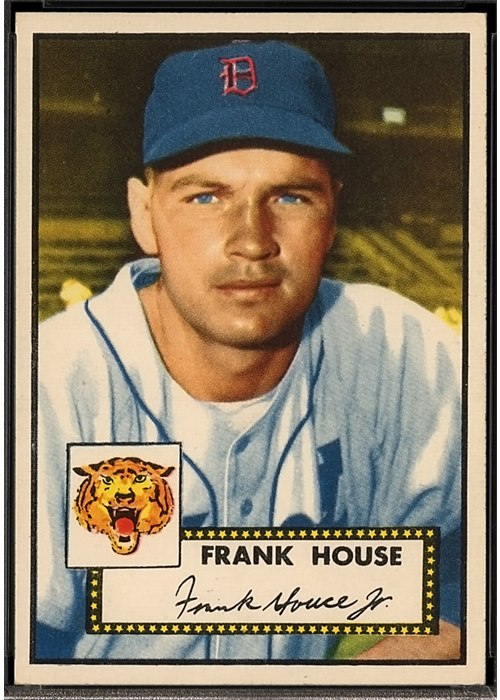

About Frank House
Henry Franklin "Pig" House was a catcher signed by the Detroit Tigers out of Hueytown High School in Alabama in 1948 for $75,000 and two automobiles, one of the largest bonuses in baseball to that point. Born February 18, 1930 in Bessemer, Alabama (d. March 13, 2005), the left-handed-hitting backstop debuted July 21, 1950 and, across a 10-season career, played for the Tigers (1950-51, 1954-57, 1961), the Kansas City Athletics (1958-59), and the Cincinnati Reds (1960). He earned his living chiefly on defense, prized for a quick release, a strong arm, and his ability to block the plate. His best year came in 1955, when he hit .259 with 15 home runs and 53 RBI in 102 games; over 653 career games he batted .248 with 47 home runs and 235 RBI. The nickname "Pig" traced to his infancy, when relatives said he was "big as a house" and the toddler twisted "big" into "pig." After baseball House served in the Alabama Legislature and helped create the Alabama Sports Hall of Fame in 1967, into which he was inducted in 1975. This third-series card is House's Topps rookie card and is collected in white-back and scarcer gray-back stock, the gray stock appearing at the very end of the third-series print run.
Sources: Wikipedia · Baseball-Reference
Variations & how to tell them apart
White Back / Gray Back Series 3 (cards 131-190)
The third series exists on two different card stocks. The standard issue is on white/cream stock; a much scarcer parallel was printed on gray cardboard. The gray stock was used at the END of the series-3 run — leftover stock run through the same press, not a separate or foreign printing. Gray backs have a duller, gloss-less front and are never found with gum stains.
- White Back: Standard issue. White/cream card stock, normal red-ink back. Sharper, glossier front.
- Gray Back — scarcer: Scarce parallel on gray card stock. Duller, gloss-less front; never gum-stained. #189 Pete Reiser is the rarest of the run; #146 Frank House appears with a pale/yellow Tiger logo. NOTE: long mislabeled 'Canadian' (borrowed from the genuinely-Canadian 1954 Topps issue) — there is no evidence the 1952 grays were a Canadian release. TCDB catalogs these as 'Grey Back' against the normal 'Red Back'.
Tiger logo color + gray back
Exists with a yellow-and-orange Tigers logo, a yellow Tiger logo, and on gray stock. The fading red ink in House's logo across the run is the evidence that the gray stock was used at the very end of the third-series printing.
Graded population (PSA & SGC)
| Grader | Total | 10 | 9 | 8 | 7 | 6 | 5 | 1-4 | Auth |
|---|---|---|---|---|---|---|---|---|---|
| PSA | 881 | 0 | 0 | 50 | 109 | 173 | 169 | 371 | 9 |
| SGC | 133 | 0 | 0 | 2 | 12 | 18 | 25 | 72 | 4 |
SGC by variation: Standard 103 · Gray Back 1 · Yellow Tiger 28 · Yellow Tiger Gray Back 1
Graded population — a scarcity guide, not a price. Snapshot 2026-06-22. Half grades fold down for both graders (8.5→8); PSA qualified slabs (OC, ST, PD, MC and the like) are not counted. Totals are summed across each grader's listed variations.
Find this card
Search T206 Cards Live auctions Buy It Now Sold prices
As an eBay Partner Network affiliate, T206Cards.com may earn from qualifying purchases.
More Detroit Tigers cards
- Johnny Groth
- Jerry Priddy
- Dizzy Trout
- Ted Gray
- Johnny Lipon
- Cliff Mapes
- Don Kolloway
- Fred Hutchinson
- Bob Swift
- Myron Ginsberg
- Marlin Stuart
- Hoot Evers
- Matt Batts
- Steve Souchock
Frequently asked questions
What is the 1952 Topps Frank House card?
It is card #146 of 407 in the 1952 Topps set - Topps' first flagship issue and the cornerstone of the postwar hobby. It pictures the Detroit Tigers player, and is his rookie card.
Does the 1952 Topps Frank House have back variations?
Yes. The third series exists on two different card stocks. The standard issue is on white/cream stock; a much scarcer parallel was printed on gray cardboard. The gray stock was used at the END of the series-3 run — leftover stock run through the same press, not a separate or foreign printing. Gray backs have a duller, gloss-less front and are never found with gum stains.
Is the 1952 Topps Frank House valuable?
Value depends on grade and (where it applies) the back variation. Use the links above to check current T206 Cards inventory and live eBay listings.
Sources: the Trading Card Database, Baseball-Reference, and PSA & SGC population reports. Card data & population compiled and maintained by T206Cards.com. Page last updated 2026-10-05.