
1962 Topps #550 Art Mahaffey
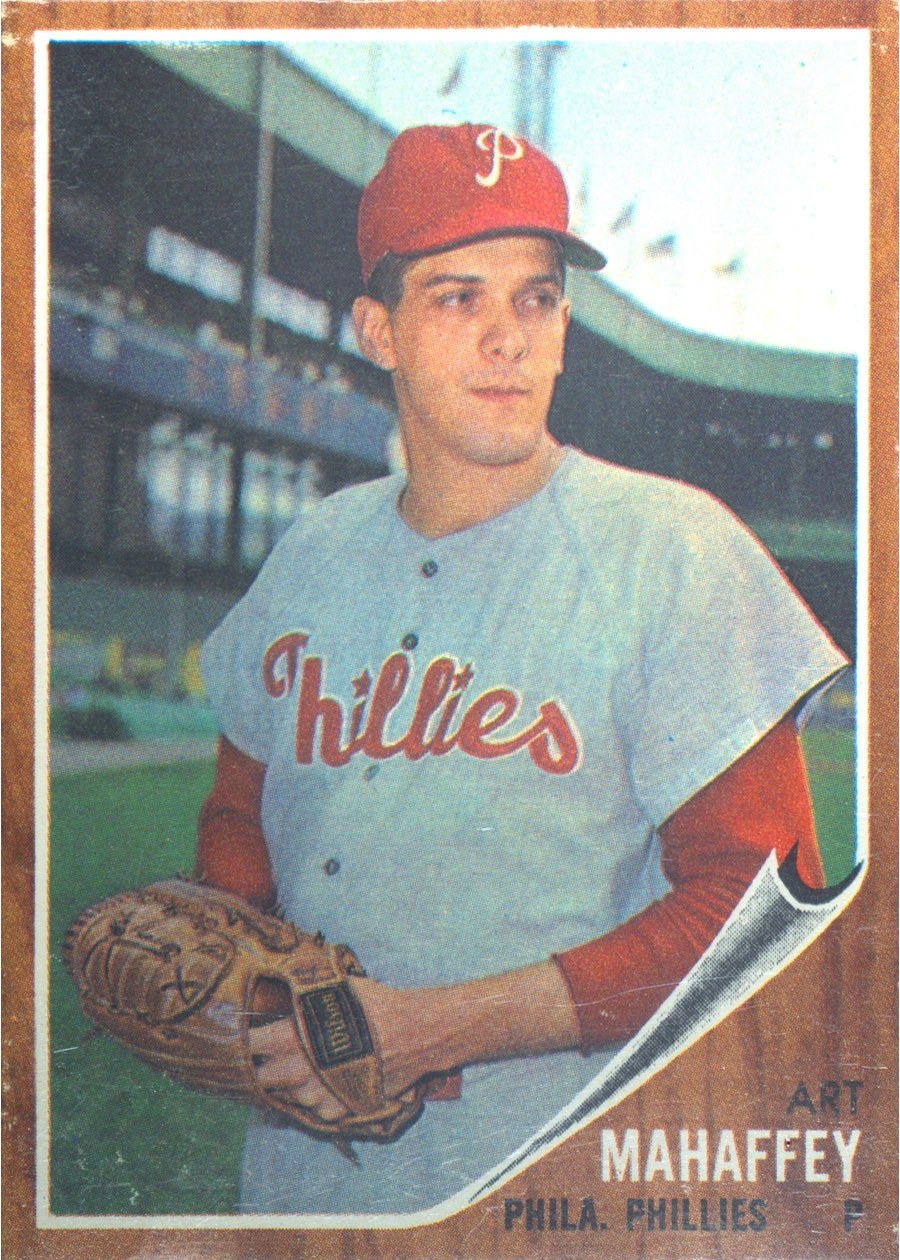
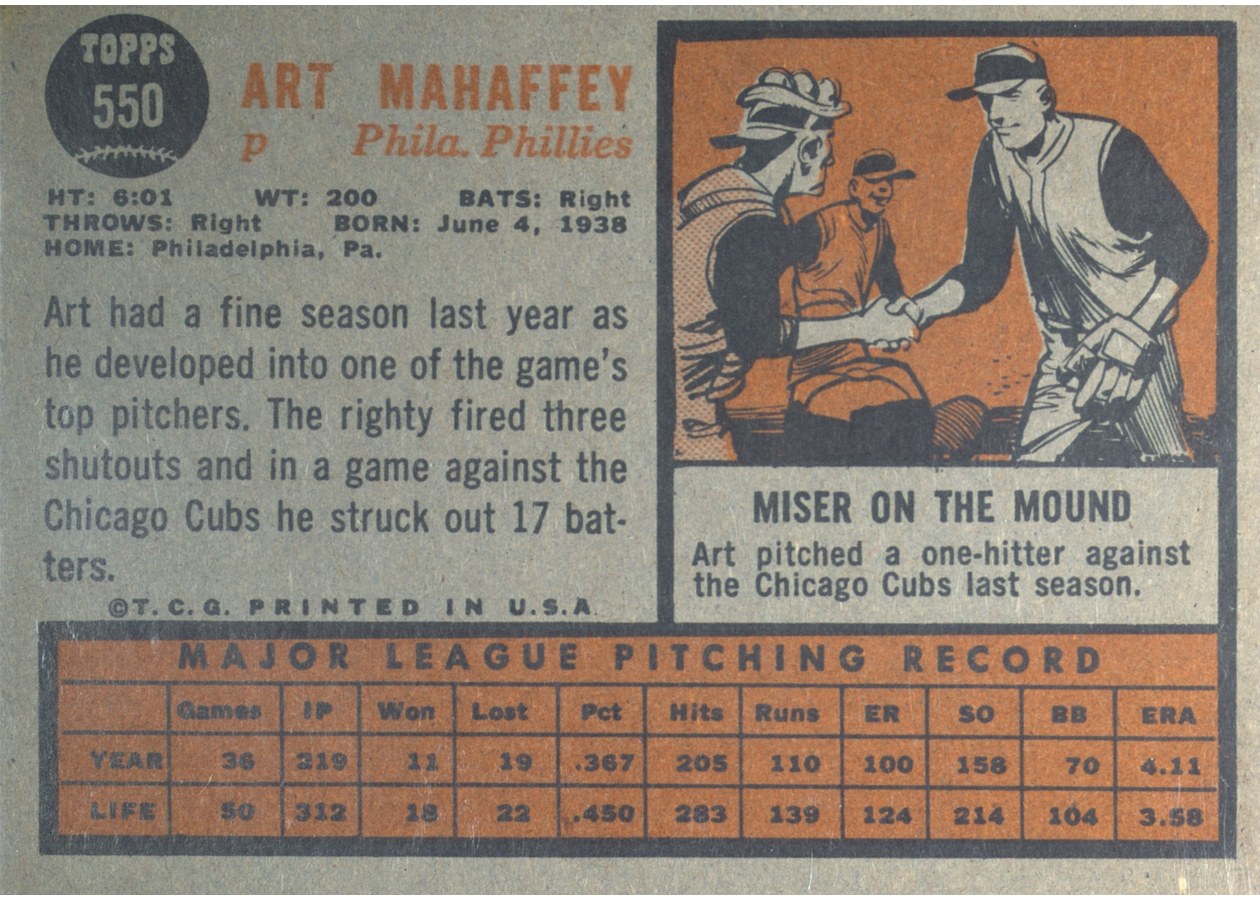
About Art Mahaffey
A short-printed high number from the seventh series, issued the year after the roughest kind of good season. Mahaffey lost 19 games in 1961, more than anyone else in the National League, but he did it with a 4.10 ERA over 219 innings for a Phillies club that went 47-107 and once lost 23 straight. Both National League All-Star teams that summer carried his name - two games were played each year then - and he worked two scoreless innings in the second. A throw from Reds shortstop Eddie Kasko struck him in the face that September, fracturing a cheekbone and ending his season.
Arthur Mahaffey Jr. was born June 4, 1938, in Cincinnati, Ohio, to a father who had boxed professionally as a teenager. He pitched for Western Hills High School and for Joe Hawk's powerhouse Bentley Post American Legion club, and signed with the Philadelphia Phillies on June 29, 1956, for a $4,000 bonus. Four and a half seasons in the farm system followed before he reached the majors on July 30, 1960. A tall right-hander with a three-quarter delivery and a famously quick pickoff move, he became the ace of a dreadful Phillies staff almost at once, made the National League All-Star team in both 1961 and 1962, and set a club record with 17 strikeouts in a game. He hurt his arm early in 1962, pitched 274 innings anyway, and said later that he never felt right again. Philadelphia traded him to the St. Louis Cardinals after the 1965 season, and he finished a seven-year career at 59-64 with a 4.17 ERA, 46 complete games, nine shutouts and 639 strikeouts in 999 innings.
Sources: Wikipedia · SABR BioProject · Baseball-Reference
Graded population (PSA & SGC)
| Grader | Total | 10 | 9 | 8 | 7 | 6 | 5 | 1-4 | Auth |
|---|---|---|---|---|---|---|---|---|---|
| PSA | 295 | 0 | 12 | 107 | 115 | 40 | 16 | 5 | 0 |
| SGC | 42 | 0 | 4 | 15 | 13 | 5 | 4 | 0 | 1 |
Graded population — a scarcity guide, not a price. Snapshot 2026-09-24. Half-grades fold down (8.5→8), and PSA's qualified grades are counted separately from the straight-grade rows shown here. Slabs of the three cards printed #139 are joined by description, never by number alone. PSA registers the green tints as a separate set; a tint's population is listed under that state of the card it belongs to.
Find this card
Search T206 Cards Live auctions Buy It Now on eBay Sold prices
As an eBay Partner Network affiliate, T206Cards.com may earn from qualifying purchases.
Related cards
Team card: #294 Philadelphia Phillies Team
More Philadelphia Phillies cards:
- #17 Johnny Callison
- #46 Jack Baldschun
- #77 Tony Taylor
- #104 Ted Savage
- #111 Dallas Green
- #146 Don Demeter
- #157 Wes Covington
- #181 Paul Brown
- #212 Jim Owens
- #220 Roy Sievers
- #249 Ed Keegan
- #269 Bob Oldis
- #284 Ruben Amaro
- #303 Frank Torre
Frequently asked questions
What is the 1962 Topps #550 card?
It is card #550 of the 600-card 1962 Topps Baseball set, picturing Art Mahaffey of the Philadelphia Phillies.
Why is #550 harder to find?
It is a high number card (cards 523-598) from the seventh print series, distributed last and in the smallest quantity - the toughest cards in the set and home to all 42 short prints and the Rookie Parade. It is also a short print card (42 cards, all in 523-598). Printed in smaller quantity than the rest of the seventh series.
How many cards are in the 1962 Topps Baseball set?
600 cards, tracked as 708 collectible states. The numbers run from 1 to 598 with no gaps, but three different cards were printed #139 - two Hal Reniff poses, catalogued 139a and 139b, and the Babe Hits 60 Babe Ruth Special, 139c - so 598 numbers make 600 cards; 93 cards carry catalogued print variations, the series-2 green tints among them, that the master set counts separately.
Sources: Baseball Almanac, Trading Card Database, PSA CardFacts, Cardboard Connection, BaseballCardPedia, The Topps Archives, Baseball-Reference, the SABR BioProject and the National Baseball Hall of Fame, PSA & SGC population reports. Card data compiled and maintained by T206Cards.com. Page last updated 2026-10-03.