1962 Topps #17 Johnny Callison
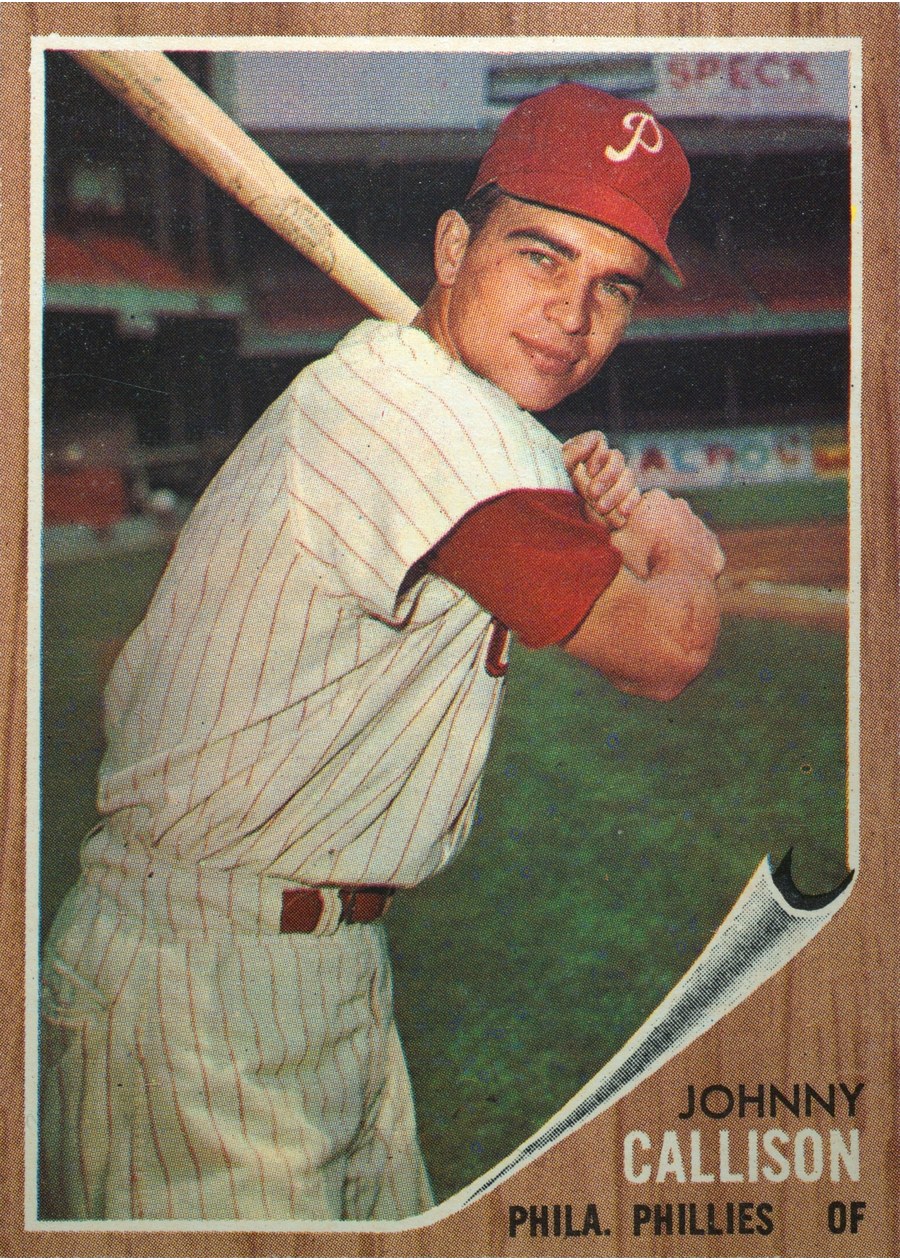
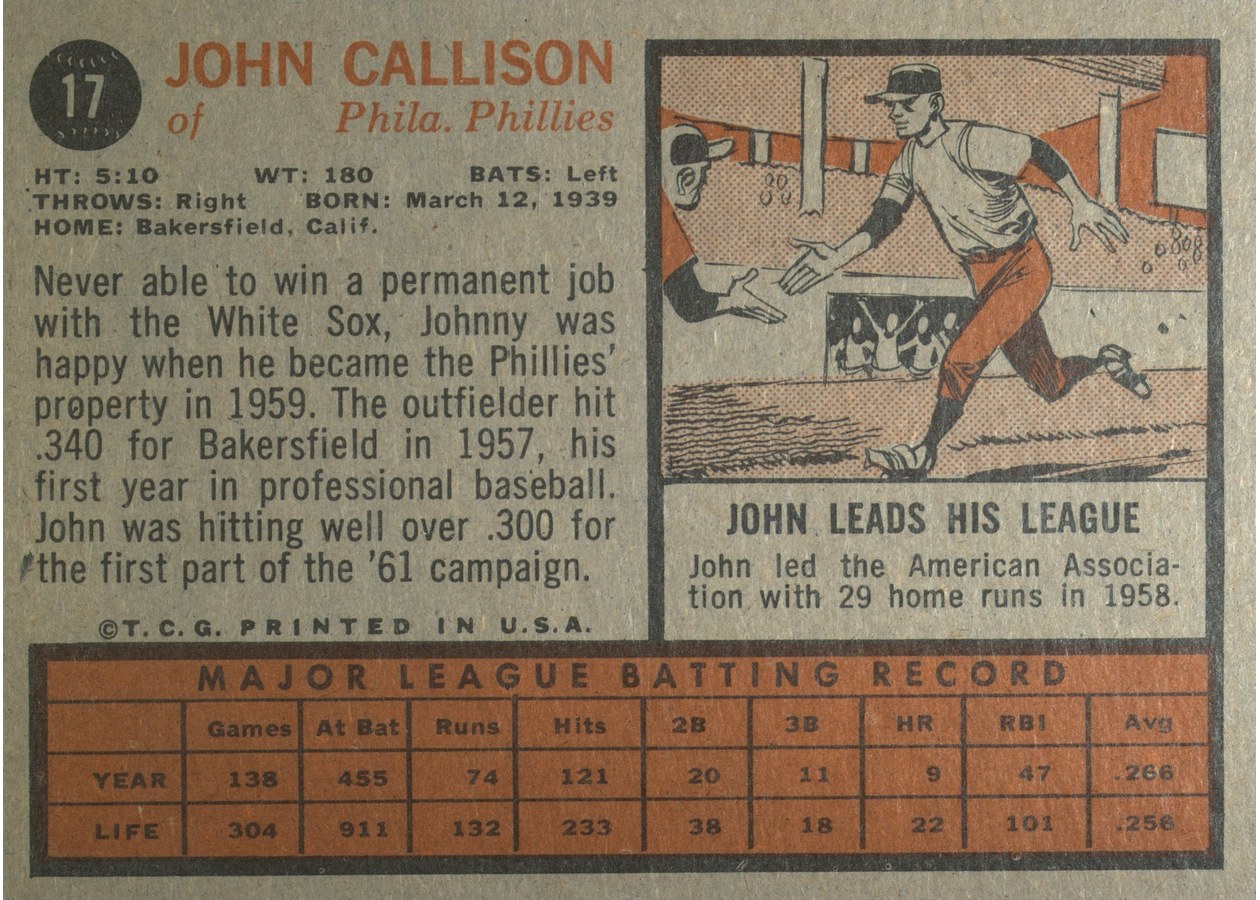
About Johnny Callison
Nineteen sixty-two was the breakthrough. Callison moved to right field for good, played 151 games there, and led National League outfielders with 24 assists and seven double plays. At the plate he hit an even .300, the only time he reached it, and Gene Mauch sat him on the final day to keep it there, with 181 hits, 23 home runs, 83 RBI, 107 runs scored and an NL-best 10 triples. He was picked for the All-Star squad for the first time, in a year when the majors staged two All-Star Games. Card #17 comes early, in the first print series.
Johnny Callison batted left-handed, threw right-handed, and spent sixteen major league seasons with the Chicago White Sox, Philadelphia Phillies, Chicago Cubs and New York Yankees. The White Sox signed him out of East Bakersfield High School in 1957 and recalled him in September 1958, then traded him to Philadelphia in December 1959 for third baseman Gene Freese, the deal that made his career. Ten Phillies seasons followed, and from 1962 through 1966 he was the idol of the city and its most popular player. He hit an even .300 in 1962, led the National League in triples in 1962 and 1965 and in doubles in 1966, earned All-Star selections in three seasons, and, with one of the decade's great throwing arms, topped the league in outfield assists four years running. His signature moment came on July 7, 1964, at Shea Stadium, where a ninth-inning three-run homer off Dick Radatz won the All-Star Game and made him its MVP; that fall he finished second to Ken Boyer for the NL Most Valuable Player award as the Phillies collapsed down the stretch. He retired with a .264 average, 226 home runs, 1,757 hits and 159 outfield assists, and was named to the Philadelphia Baseball Wall of Fame in 1997 and the Philadelphia Sports Hall of Fame in 2012.
Sources: Wikipedia · SABR BioProject · Baseball-Reference
Graded population (PSA & SGC)
| Grader | Total | 10 | 9 | 8 | 7 | 6 | 5 | 1-4 | Auth |
|---|---|---|---|---|---|---|---|---|---|
| PSA | 274 | 0 | 3 | 56 | 123 | 49 | 20 | 23 | 0 |
| SGC | 18 | 0 | 1 | 1 | 7 | 6 | 2 | 1 | 0 |
Graded population — a scarcity guide, not a price. Snapshot 2026-09-24. Half-grades fold down (8.5→8), and PSA's qualified grades are counted separately from the straight-grade rows shown here. Slabs of the three cards printed #139 are joined by description, never by number alone. PSA registers the green tints as a separate set; a tint's population is listed under that state of the card it belongs to.
Find this card
Search T206 Cards Live auctions Buy It Now on eBay Sold prices
As an eBay Partner Network affiliate, T206Cards.com may earn from qualifying purchases.
Related cards
Team card: #294 Philadelphia Phillies Team
More Philadelphia Phillies cards:
- #46 Jack Baldschun
- #77 Tony Taylor
- #104 Ted Savage
- #111 Dallas Green
- #146 Don Demeter
- #157 Wes Covington
- #181 Paul Brown
- #212 Jim Owens
- #220 Roy Sievers
- #249 Ed Keegan
- #269 Bob Oldis
- #284 Ruben Amaro
- #303 Frank Torre
- #328 Ken Walters
Frequently asked questions
What is the 1962 Topps #17 card?
It is card #17 of the 600-card 1962 Topps Baseball set, picturing Johnny Callison of the Philadelphia Phillies.
How many cards are in the 1962 Topps Baseball set?
600 cards, tracked as 708 collectible states. The numbers run from 1 to 598 with no gaps, but three different cards were printed #139 - two Hal Reniff poses, catalogued 139a and 139b, and the Babe Hits 60 Babe Ruth Special, 139c - so 598 numbers make 600 cards; 93 cards carry catalogued print variations, the series-2 green tints among them, that the master set counts separately.
Sources: Baseball Almanac, Trading Card Database, PSA CardFacts, Cardboard Connection, BaseballCardPedia, The Topps Archives, Baseball-Reference, the SABR BioProject and the National Baseball Hall of Fame, PSA & SGC population reports. Card data compiled and maintained by T206Cards.com. Page last updated 2026-10-03.