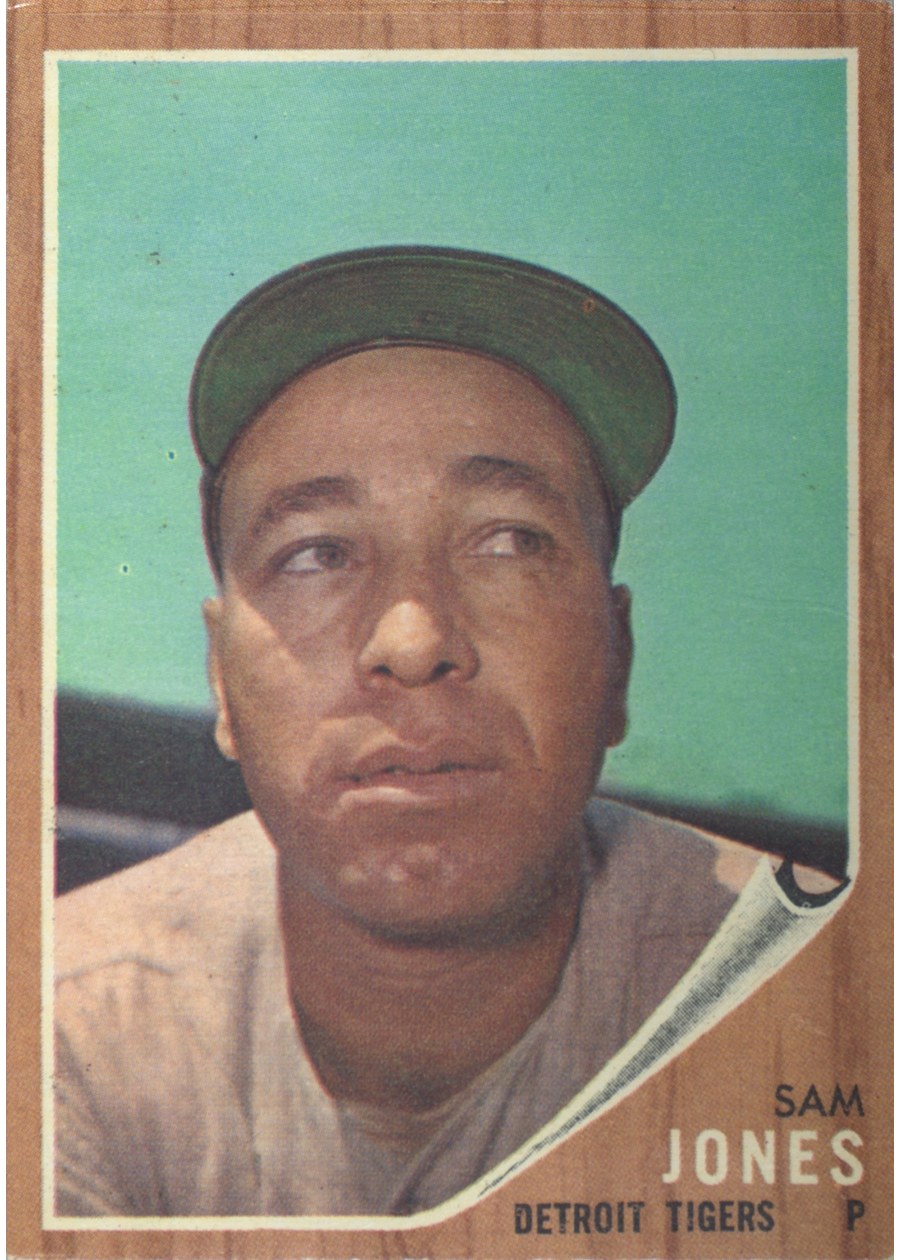
1962 Topps #92 Sam Jones
About Sam Jones
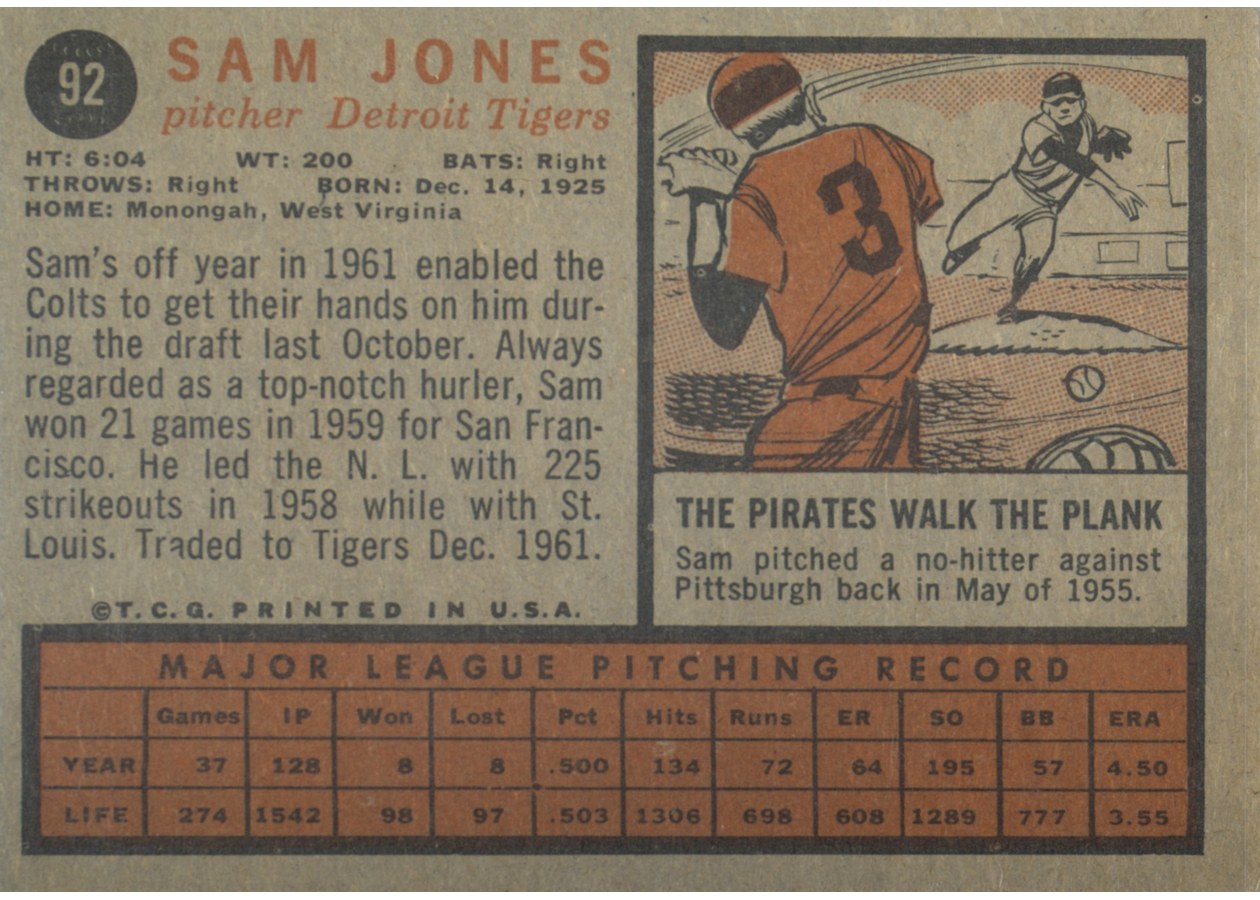
Card #92 comes out of the series-1 print run. It puts Jones in a Detroit cap because Houston traded him to the Tigers on December 1, 1961 for Bob Bruce and Manny Montejo. He was a sick man by Opening Day. A stiff neck in February camp led the Detroit trainer to two swollen nodes, surgery followed on March 1, and later tests came back malignant. Jones took cobalt treatments into September and still pitched 30 games, going 2-4 with a 3.65 ERA and six spot starts, and hit the only home run of his major league career that April. Detroit released him on September 28. The cancer returned nine years later and killed him.
Sam Jones was a rangy six-foot-four right-hander who threw hard, chewed a flat toothpick on the mound that made him Toothpick Sam, and snapped off a curveball Stan Musial called the best he ever saw. Born in Stewartsville, Ohio, and raised in the West Virginia coal country around Monongah, he came to the game late, pitched for the Oakland Larks in 1946 and then the Cleveland Buckeyes of the Negro American League, and reached the majors with the Cleveland Indians in September 1951. Wildness came bundled with the power: in 1955, 1956 and 1958 he led the National League in both strikeouts and walks. On May 12, 1955, with the Cubs, he no-hit Pittsburgh 4-0 at Wrigley Field to become the first African American to throw a major league no-hitter, and he did it the hard way, walking the bases loaded in the ninth before striking out Dick Groat, Roberto Clemente and Frank Thomas. His best year was 1959 in San Francisco: 21-15, a league-leading 2.83 ERA, a share of the NL lead in wins, and Pitcher of the Year honors from The Sporting News. He was an All-Star in 1955 and 1959 and pitched for six clubs through 1964. Neck cancer found in 1962 came back and took his life in 1971, at 45.
Sources: Wikipedia · SABR BioProject · Baseball-Reference
Graded population (PSA & SGC)
| Grader | Total | 10 | 9 | 8 | 7 | 6 | 5 | 1-4 | Auth |
|---|---|---|---|---|---|---|---|---|---|
| PSA | 256 | 0 | 8 | 111 | 102 | 24 | 5 | 6 | 0 |
| SGC | 14 | 0 | 1 | 7 | 4 | 1 | 1 | 0 | 0 |
Graded population — a scarcity guide, not a price. Snapshot 2026-09-24. Half-grades fold down (8.5→8), and PSA's qualified grades are counted separately from the straight-grade rows shown here. Slabs of the three cards printed #139 are joined by description, never by number alone. PSA registers the green tints as a separate set; a tint's population is listed under that state of the card it belongs to.
Find this card
Search T206 Cards Live auctions Buy It Now on eBay Sold prices
As an eBay Partner Network affiliate, T206Cards.com may earn from qualifying purchases.
Related cards
Team card: #24 Detroit Tigers Team
More Detroit Tigers cards:
- #20 Rocky Colavito
- #62 Steve Boros
- #72 Bob's Pupils
- #87 Mike Roarke
- #105 Don Mossi
- #114 Howie Koplitz
- #150 Al Kaline
- #173 Chico Fernandez
- #196 Terry Fox
- #216 Ron Kline
- #250 Norm Cash
- #261 George Alusik
- #299 Don Wert
- #314 Rocky Colavito
Frequently asked questions
What is the 1962 Topps #92 card?
It is card #92 of the 600-card 1962 Topps Baseball set, picturing Sam Jones of the Detroit Tigers.
How many cards are in the 1962 Topps Baseball set?
600 cards, tracked as 708 collectible states. The numbers run from 1 to 598 with no gaps, but three different cards were printed #139 - two Hal Reniff poses, catalogued 139a and 139b, and the Babe Hits 60 Babe Ruth Special, 139c - so 598 numbers make 600 cards; 93 cards carry catalogued print variations, the series-2 green tints among them, that the master set counts separately.
Sources: Baseball Almanac, Trading Card Database, PSA CardFacts, Cardboard Connection, BaseballCardPedia, The Topps Archives, Baseball-Reference, the SABR BioProject and the National Baseball Hall of Fame, PSA & SGC population reports. Card data compiled and maintained by T206Cards.com. Page last updated 2026-10-03.