
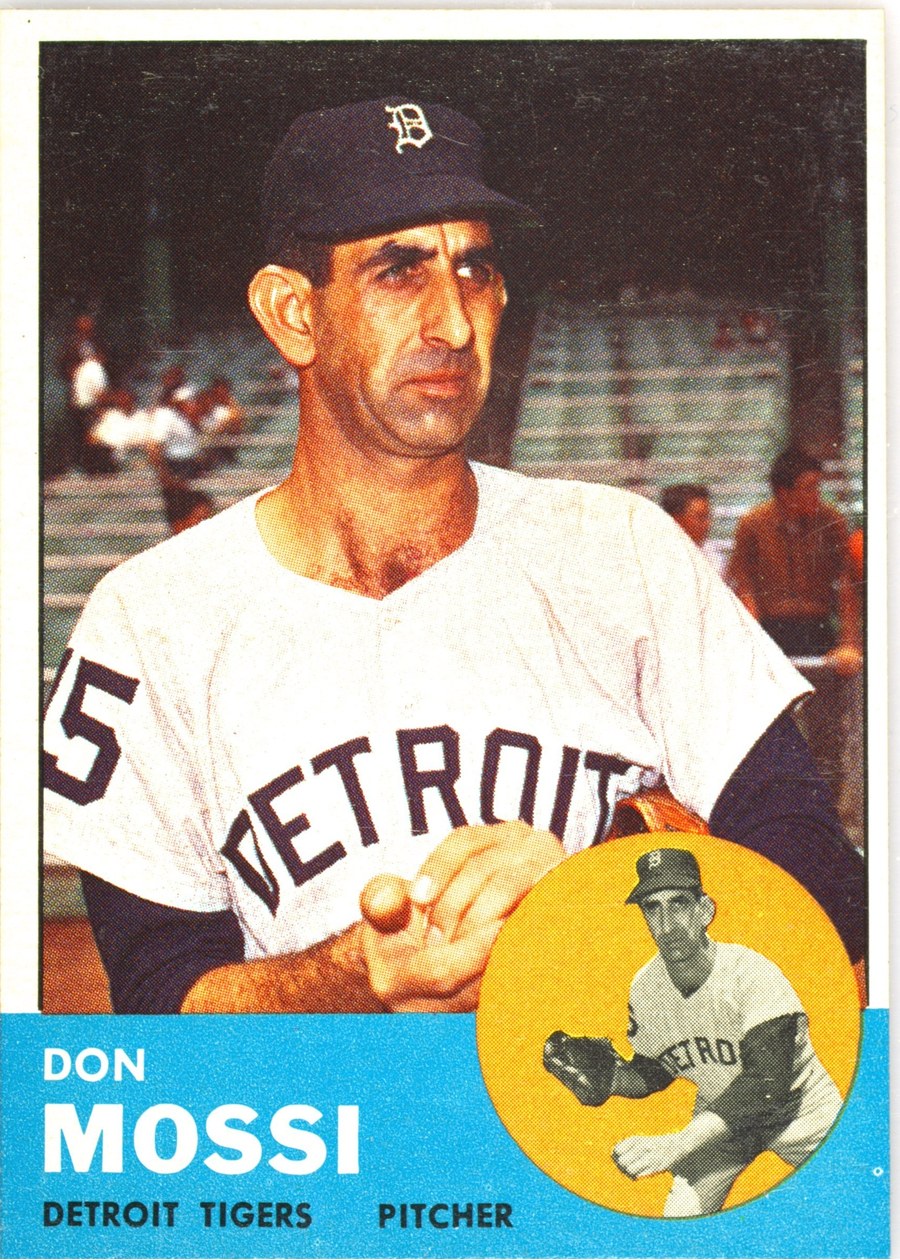
1963 Topps #530 Don Mossi
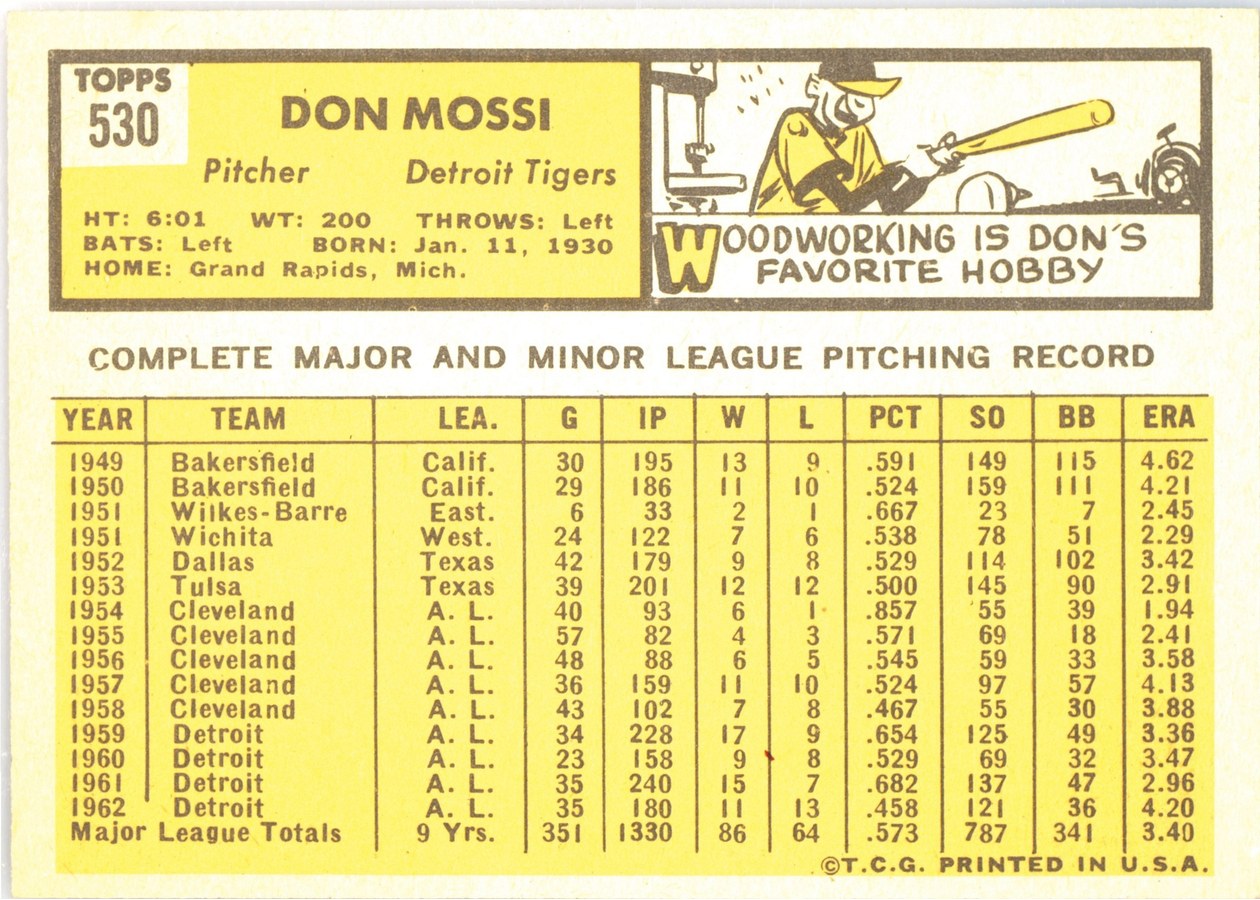
The card's back lists Mossi's birth date as January 11, 1930; he was actually born January 11, 1929.
Uncorrected error: The back says born Jan. 11, 1930; his birth date is Jan. 11, 1929.
About Don Mossi
The 1963 Topps set gives Mossi two cards. Number 218, from the third print series, is the Tiger Twirlers combination card he shares with Detroit rotation mates Frank Lary and Jim Bunning. Number 530 is his own card, a high number from the seventh and final series and the harder of the pair to find. On the mound in 1963 he lost his rotation spot to young Mickey Lolich and finished 7-7 with a 3.74 ERA in 122.2 innings, walking just 17 batters in that span. It was his last season in Detroit.
Don Mossi pitched twelve big-league seasons, from 1954 to 1965, as a left-handed control specialist for the Cleveland Indians, Detroit Tigers, Chicago White Sox and Kansas City Athletics, finishing 101-80 with 50 saves and a 3.43 ERA. Born January 11, 1929 in St. Helena, California and raised in Daly City, he signed with Cleveland out of Jefferson High School and began his pro career at Class C Bakersfield in 1949. Five minor-league seasons went into taming his control before his 1954 debut, when the pennant-winning Indians paired him in the bullpen with roommate Ray Narleski. Mossi posted a 1.94 ERA that rookie year and worked four scoreless innings in the 1954 World Series, the only one he ever reached. Cleveland moved him into the rotation in 1957; he was named an American League All-Star and, entering that game in the ninth, struck out Eddie Mathews. Traded to Detroit after the 1958 season, he became a full-time starter and had his best year in 1961, leading the league in strikeout-to-walk ratio. Arm trouble shortened his later Tiger seasons, and he closed out as a short reliever with the White Sox and Athletics. His .990 career fielding percentage was the best any pitcher had recorded when he retired, and Cleveland later named him one of its 100 Greatest Indians.
Sources: Wikipedia · SABR BioProject · Baseball-Reference
Graded population (PSA & SGC)
| Grader | Total | 10 | 9 | 8 | 7 | 6 | 5 | 1-4 | Auth |
|---|---|---|---|---|---|---|---|---|---|
| PSA | 279 | 0 | 14 | 147 | 79 | 26 | 9 | 4 | 0 |
| SGC | 18 | 0 | 0 | 9 | 6 | 2 | 1 | 0 | 0 |
Graded population — a scarcity guide, not a price. Snapshot 2026-09-24. Half-grades fold down (8.5→8), and PSA's qualified grades are counted separately from the straight-grade rows shown here.
Find this card
Search T206 Cards Live auctions Buy It Now on eBay Sold prices
As an eBay Partner Network affiliate, T206Cards.com may earn from qualifying purchases.
Related cards
More Don Mossi in this set: #218 Combo
Team card: #552 Detroit Tigers
More Detroit Tigers cards:
- #4 1962 American League Home Run Leaders
- #6 1962 American League E.R.A. Leaders
- #8 1962 American League Pitching Leaders
- #10 1962 American League Strikeout Leaders
- #25 Al Kaline
- #44 Terry Fox
- #64 Dick McAuliffe
- #84 Ron Kline
- #134 Bob Scheffing
- #140 Frank Lary
- #164 Bubba Morton
- #169 1963 Rookie Stars
- #177 Bubba Phillips
- #218 Tiger Twirlers
Frequently asked questions
What is the 1963 Topps #530 card?
It is card #530 of the 576-card 1963 Topps Baseball set, picturing Don Mossi of the Detroit Tigers.
Does 1963 Topps #530 have an error?
The back says born Jan. 11, 1930; his birth date is Jan. 11, 1929. It was never corrected, so there is no variation to chase - every copy of #530 reads the same way.
Why is #530 harder to find?
It is a high number card from the seventh print series, #512-576 - the last and scarcest run in the set. Price guides often band the highs as #523-576, but the printing break falls between #511 and #512.
How many cards are in the 1963 Topps Baseball set?
576 cards, tracked as 583 collectible states. The numbers run from 1 to 576 with no gaps and no number used twice, and seven cards carry a catalogued print variation - three checklists, the two Rookie Stars cards also printed with a "1962" heading, and the #341 Jack Baldschun and #454 Art Fowler print states - that the master set counts separately.
Sources: Trading Card Database, PSA CardFacts, Cardboard Connection, BaseballCardPedia, The Topps Archives, Baseball-Reference, the SABR BioProject and the National Baseball Hall of Fame, PSA & SGC population reports. Card data compiled and maintained by T206Cards.com. Page last updated 2026-10-03.