
1966 Topps #528 Jesse Gonder
All four published short-print lists include this high number, but the lists disagree on other cards, so scarcity is stated for the seventh series as a whole.
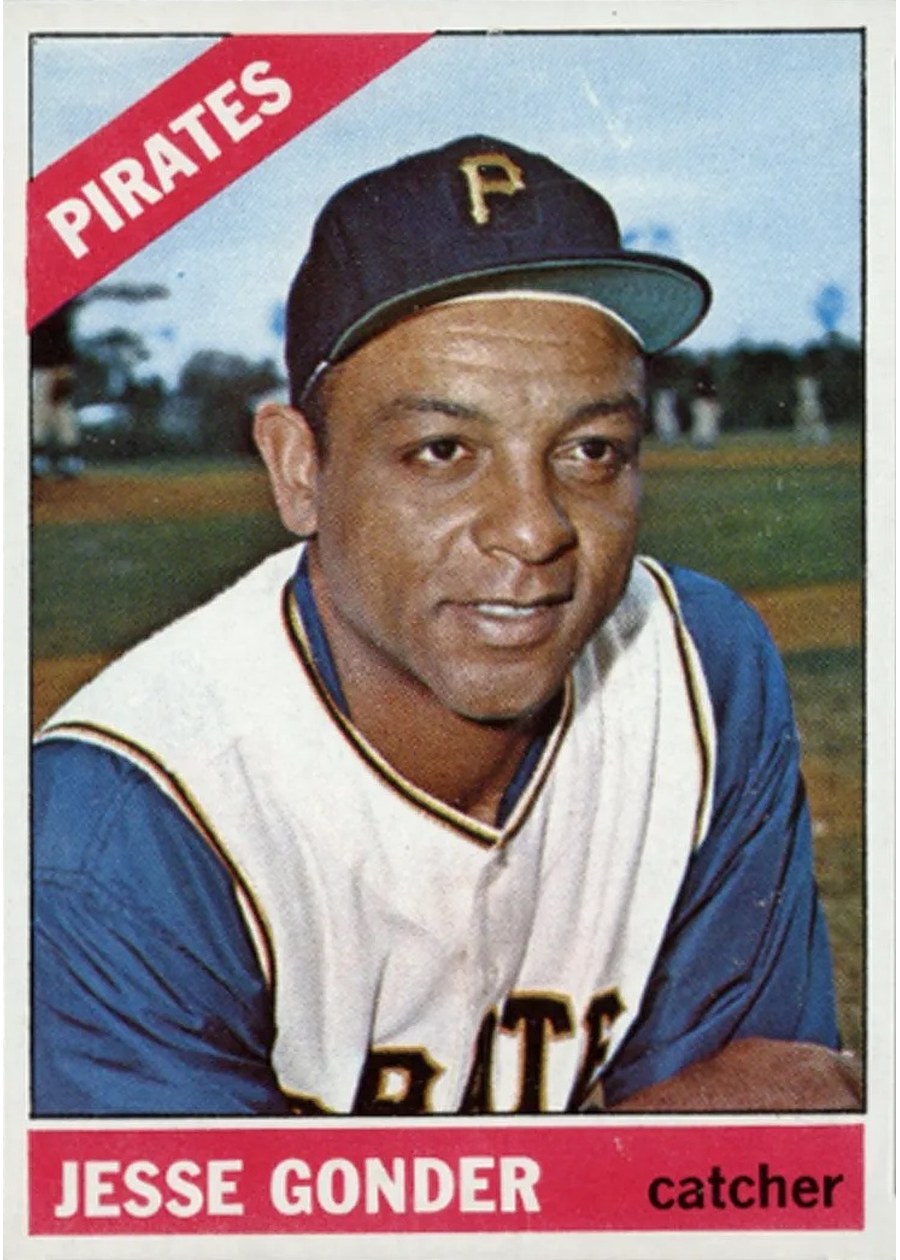
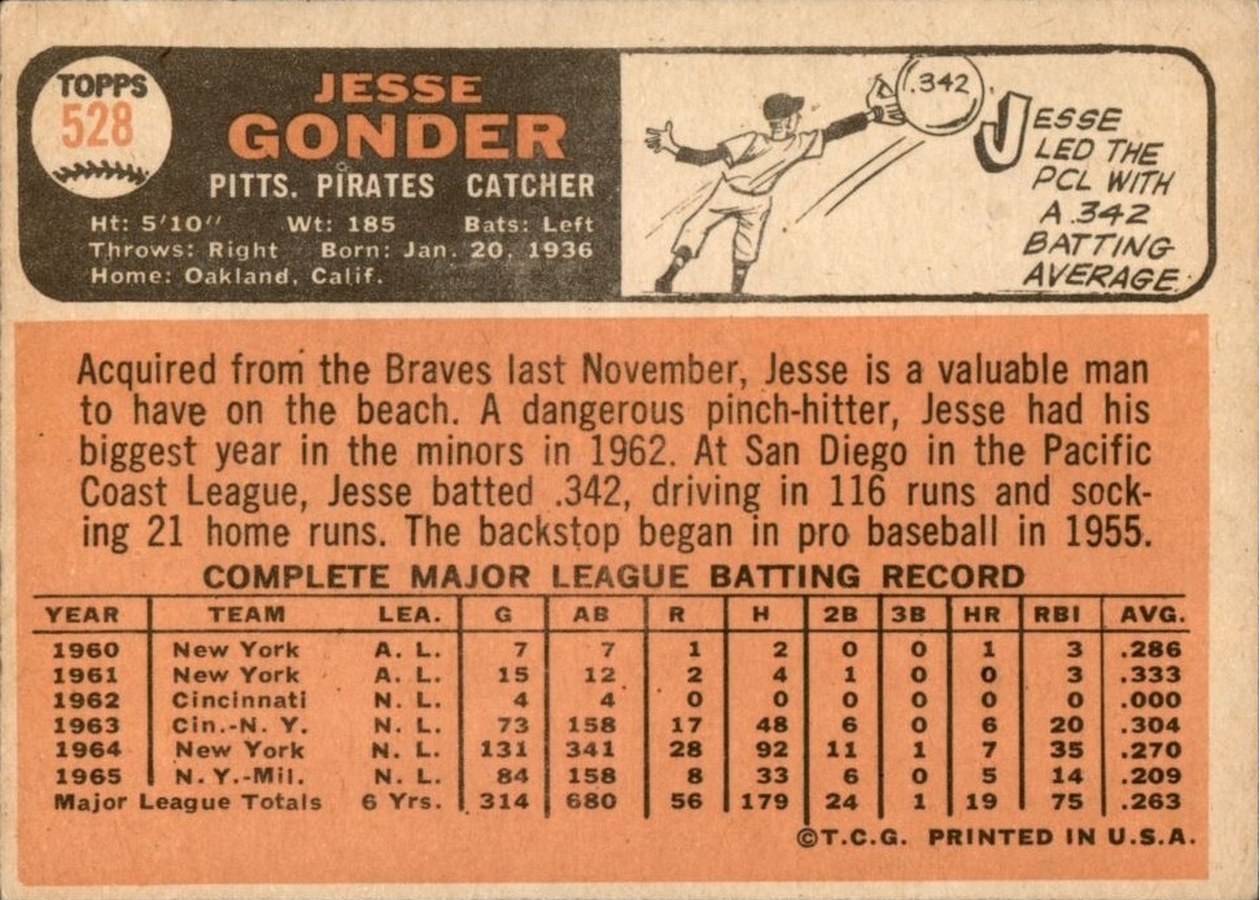
About Jesse Gonder
1966 Topps #528 sits in the set's seventh series as a high number, and shows Jesse Gonder with the Pittsburgh Pirates. Pittsburgh had taken him from Milwaukee in the Rule 5 draft on November 29, 1965. He reported to camp 21 pounds lighter hoping to win the starting job, lost out to Jim Pagliaroni, then got the most work he had seen in two years once Pagliaroni was hurt, batting .225 in 160 at-bats over 59 games. On April 18 he became the only National League catcher that season credited with an assist in a triple play. In July, after Jim Wynn homered off a fastball he had called, Gonder and manager Harry Walker argued it out before nearly 44,000 fans in the Astrodome.
Jesse Lemar Gonder (Jan 20, 1936 - Nov 14, 2004) was born in Monticello, Arkansas, and raised in West Oakland, California, where he caught for coach George Powles at McClymonds High School, the program that also produced Frank Robinson, Vada Pinson and Curt Flood. A left-handed hitter, he signed with Cincinnati in 1955 and worked his way through the minors - Mexico, the Havana Sugar Kings, Triple-A Richmond - before debuting with the New York Yankees in September 1960; his first big-league hit was a pinch home run. Over eight seasons with the Yankees, Reds, Mets, Braves and Pirates he batted .251 with 220 hits, 26 home runs and 94 RBIs in 876 at-bats. The bat was never the question: in 1962 he won the Pacific Coast League batting title and RBI crown and was named the league's Most Valuable Player. His catching drew constant criticism, which he disputed all his life. After he complained about the segregated spring-training lodging he and his Black teammates faced in Florida, Cincinnati became the first club to integrate player housing there - and Gonder was tagged a troublemaker, a label he believed cut his career short. He drove a Bay Area transit bus for more than 20 years and died in Oakland in 2004.
Sources: Wikipedia · SABR BioProject · Baseball-Reference · Baseball Almanac
Graded population (PSA & SGC)
| Grader | Total | 10 | 9 | 8 | 7 | 6 | 5 | 1-4 | Auth |
|---|---|---|---|---|---|---|---|---|---|
| PSA | 315 | 4 | 25 | 142 | 86 | 34 | 13 | 11 | 0 |
| SGC | 25 | 0 | 1 | 6 | 8 | 5 | 5 | 0 | 0 |
Graded population — a scarcity guide, not a price. Data as of 2026-09-04. Half grades fold down for both graders (8.5→8); PSA qualified slabs (OC, ST, PD, MC and the like) are not counted. Where SGC registers no separate row for a variation state, its slabs of that card are listed under the base state.
Find this card
Search T206 Cards Shop 1966 Topps cards Live auctions Buy It Now on eBay Sold prices
As an eBay Partner Network affiliate, T206Cards.com may earn from qualifying purchases.
Related cards
Team card: #404 Pittsburgh Pirates
More Pittsburgh Pirates cards:
- #15 Vern Law
- #33 Jim Pagliaroni
- #54 Jose Pagan
- #71 Frank Carpin
- #99 Buc Belters
- #112 Manny Mota
- #123 Pirates 1966 Rookie Stars
- #144 Don Schwall
- #182 Jerry Lynch
- #210 Bill Mazeroski
- #215 National League 1965 Batting Leaders
- #221 National League 1965 ERA Leaders
- #225 National League 1965 Strikeout Leaders
- #235 Don Cardwell
Frequently asked questions
What is the 1966 Topps #528 card?
It is card #528 of the 598-card 1966 Topps Baseball set, picturing Jesse Gonder of the Pittsburgh Pirates.
Why is #528 harder to find?
It is a high number card from the seventh and last print series, #523-598 - the scarce end of the set. Forty-three of its 76 cards are short prints, so scarcity is stated for the series as a whole.
How many cards are in the 1966 Topps Baseball set?
598 cards, tracked as 613 collectible states. Numbers run from 1 to 598 with no gaps and no number used twice, and 14 cards carry catalogued print variations - five checklists, the trade and sold statement backs, the three-state #43 Don Landrum, three team-card dot pairs and the #161 Jerry Lumpe white streak - that the master set counts separately.
Sources: Trading Card Database, PSA CardFacts, Cardboard Connection, Baseball Almanac, Baseball-Reference, the SABR BioProject and the National Baseball Hall of Fame, PSA & SGC population reports. Card data compiled and maintained by T206Cards.com. Page last updated 2026-10-11.