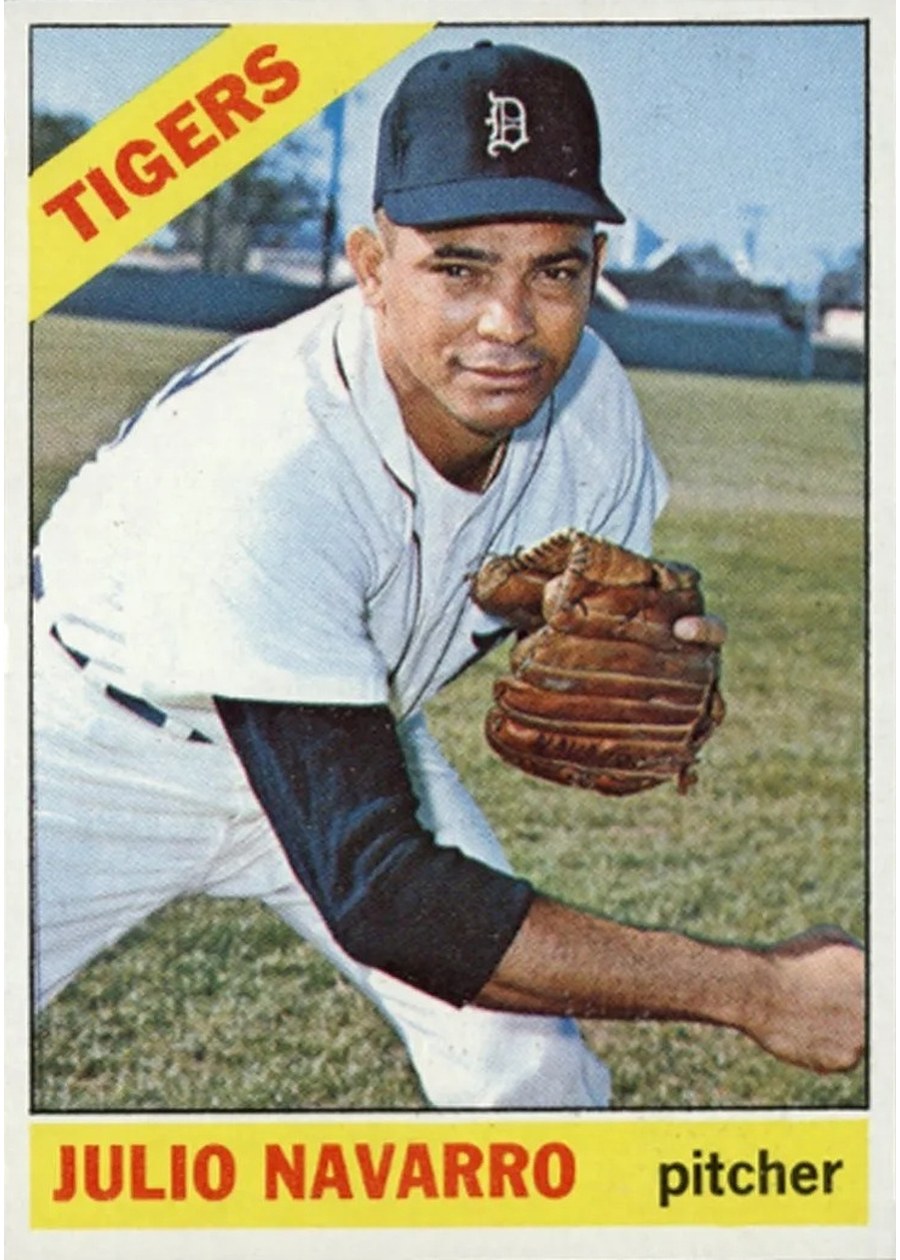
1966 Topps #527 Julio Navarro
Some checklists tag this high number as a short print, but they do not agree with each other on which cards in the last series were short-printed, so read the scarcity as a property of the series rather than a settled fact about this one card.
About Julio Navarro
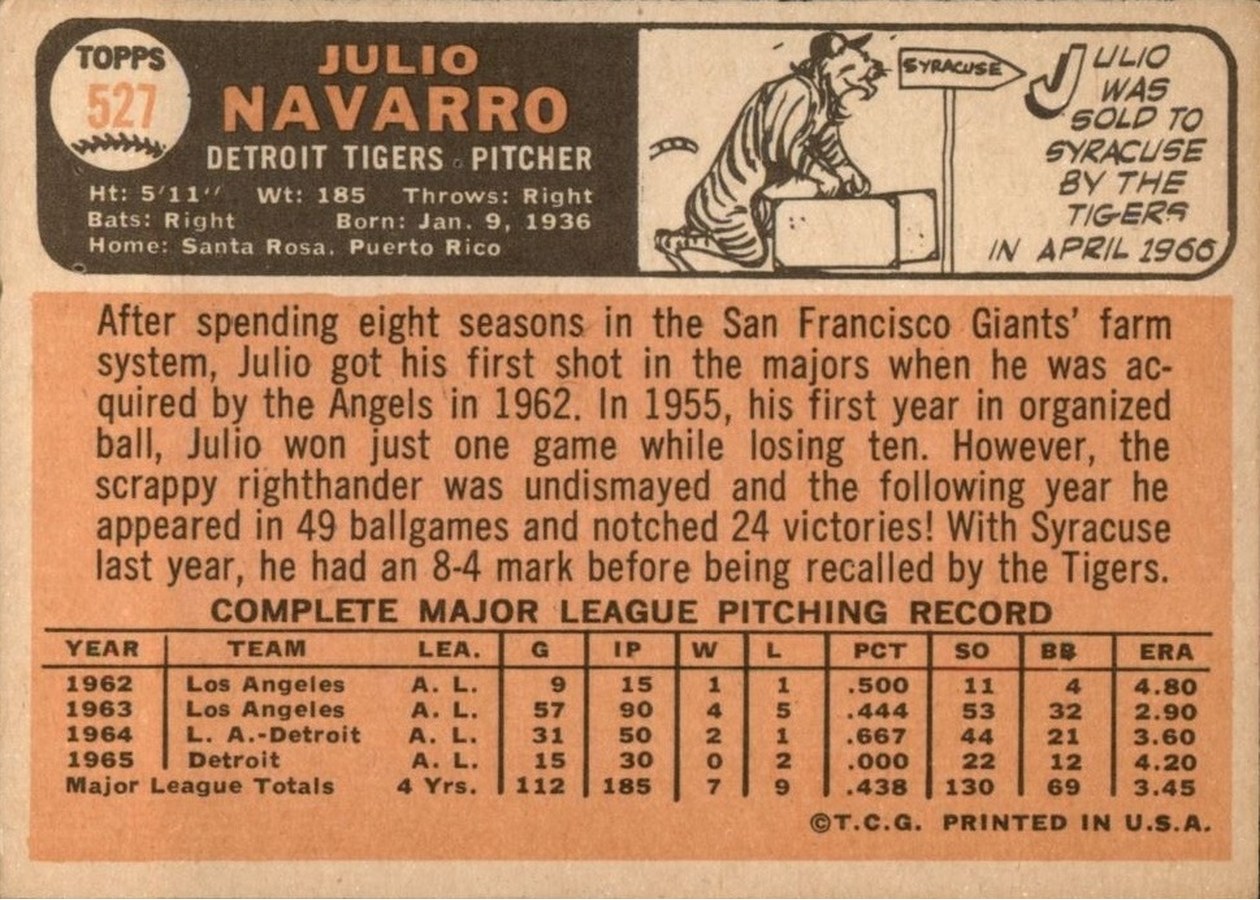
Navarro's 1966 lasted one afternoon. He came on in relief on April 17 and never retired a batter: he hit Fred Valentine, gave up a pinch-hit grand slam to Bob Chance and a solo homer to Ken McMullen, and left with no outs recorded, which is why the season shows no innings pitched and an infinite ERA. On June 21 the Tigers sent him to Boston as the player to be named in the Earl Wilson trade. He never pitched for the Red Sox, and four years passed before he resurfaced in the majors with Atlanta in 1970. Card 527 is a seventh-series card and a high number, though the published checklists disagree on which cards in that last series were printed in shorter supply.
Julio Navarro Ventura, born January 9, 1934 in Vieques, Puerto Rico, is the only player from that small island ever to reach the major leagues. His family left when the Navy took over the Vieques cane fields, and he learned the game on St. Croix in the U.S. Virgin Islands alongside future big leaguers Joe Christopher and Elmo Plaskett. The Giants signed him in 1955, and he spent seven years in their system before the Angels bought his contract on September 2, 1962. He debuted the next day at Yankee Stadium, a 28-year-old rookie everyone believed was 26, having quietly shaved two years off his age. The 5-foot-11 right-hander worked almost entirely in relief over six big league seasons between 1962 and 1970 for the Angels, Tigers and Braves, throwing mostly sidearm with an occasional overhand delivery to fool hitters and mixing a sinker, slider, screwball and fastball. He finished 7-9 with a 3.65 ERA and 17 saves in 130 games. The rest of the career dwarfs that: twenty minor league seasons and 22 winters in the Puerto Rican league, tied for second in that league's history. He was inducted into the Puerto Rican Sports Hall of Fame in 2006, fathered big league pitcher Jaime Navarro, and died January 24, 2018.
Sources: Wikipedia · SABR BioProject · Baseball-Reference · Baseball Almanac
Graded population (PSA & SGC)
| Grader | Total | 10 | 9 | 8 | 7 | 6 | 5 | 1-4 | Auth |
|---|---|---|---|---|---|---|---|---|---|
| PSA | 290 | 2 | 31 | 137 | 70 | 32 | 14 | 4 | 0 |
| SGC | 19 | 0 | 0 | 10 | 2 | 1 | 3 | 2 | 1 |
Graded population — a scarcity guide, not a price. Data as of 2026-09-04. Half grades fold down for both graders (8.5→8); PSA qualified slabs (OC, ST, PD, MC and the like) are not counted. Where SGC registers no separate row for a variation state, its slabs of that card are listed under the base state.
Find this card
Search T206 Cards Shop 1966 Topps cards Live auctions Buy It Now on eBay Sold prices
As an eBay Partner Network affiliate, T206Cards.com may earn from qualifying purchases.
Related cards
Team card: #583 Detroit Tigers
More Detroit Tigers cards:
- #20 Willie Horton
- #38 Ron Nischwitz
- #58 Dave Wickersham
- #81 Ray Oyler
- #98 Don Demeter
- #113 Hank Aguirre
- #145 Bill Freehan
- #161 Jerry Lumpe
- #187 Chuck Dressen
- #198 Mickey Stanley
- #209 Tigers 1966 Rookie Stars
- #218 American League 1965 Home Run Leaders
- #220 American League 1965 RBI Leaders
- #226 American League 1965 Strikeout Leaders
Frequently asked questions
What is the 1966 Topps #527 card?
It is card #527 of the 598-card 1966 Topps Baseball set, picturing Julio Navarro of the Detroit Tigers.
Why is #527 harder to find?
It is a high number card from the seventh and last print series, #523-598 - the scarce end of the set. Forty-three of its 76 cards are short prints, so scarcity is stated for the series as a whole.
How many cards are in the 1966 Topps Baseball set?
598 cards, tracked as 613 collectible states. Numbers run from 1 to 598 with no gaps and no number used twice, and 14 cards carry catalogued print variations - five checklists, the trade and sold statement backs, the three-state #43 Don Landrum, three team-card dot pairs and the #161 Jerry Lumpe white streak - that the master set counts separately.
Sources: Trading Card Database, PSA CardFacts, Cardboard Connection, Baseball Almanac, Baseball-Reference, the SABR BioProject and the National Baseball Hall of Fame, PSA & SGC population reports. Card data compiled and maintained by T206Cards.com. Page last updated 2026-10-11.