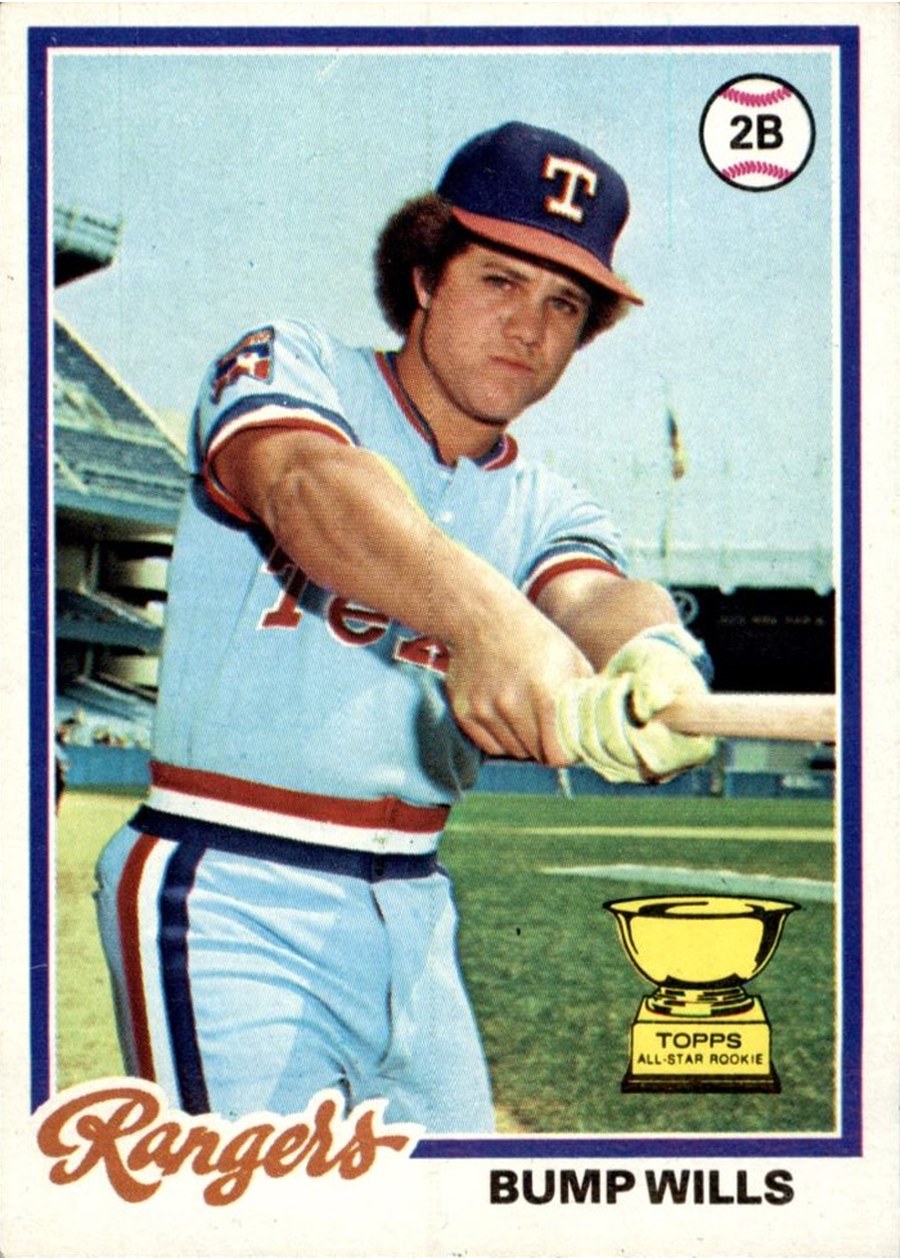
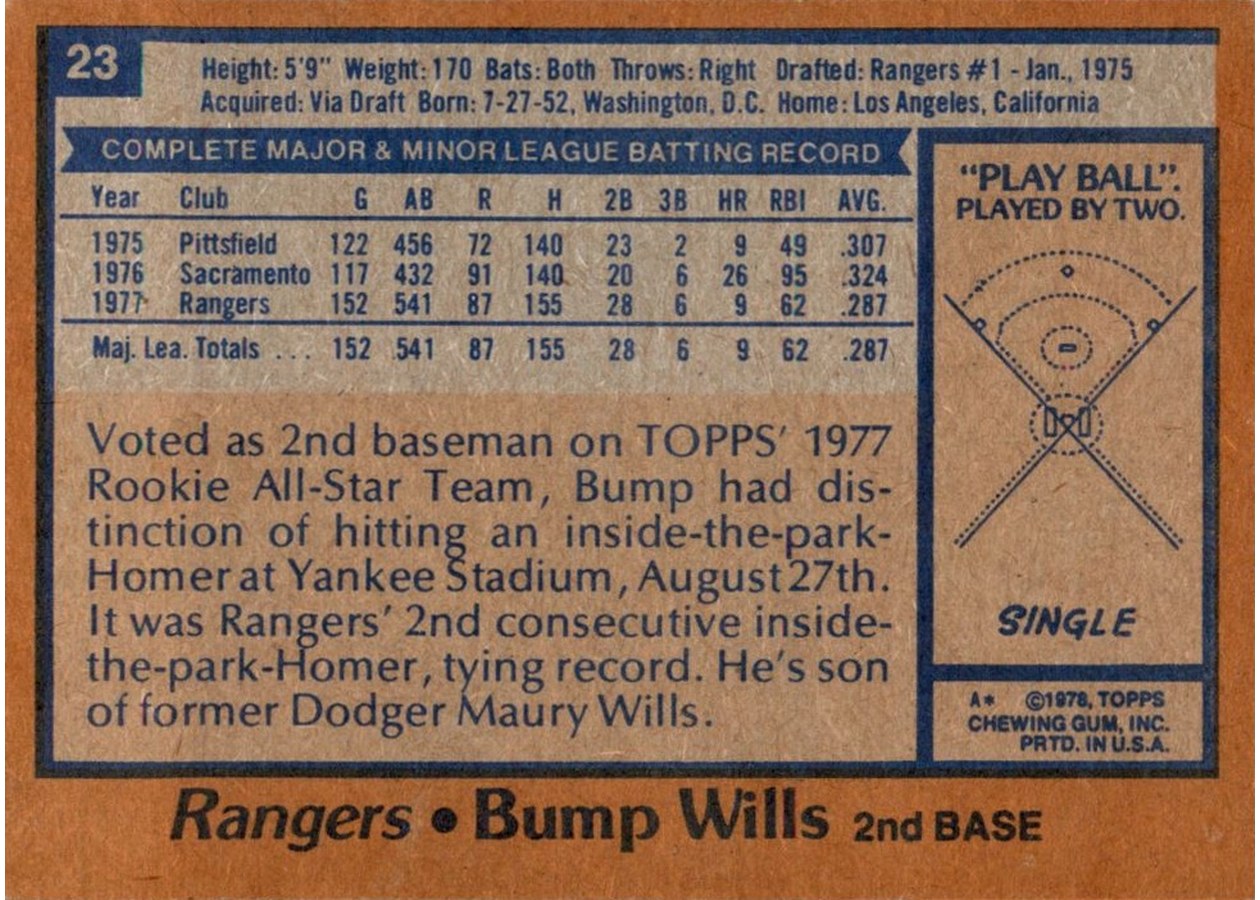
1978 Topps #23 Bump Wills
About Bump Wills
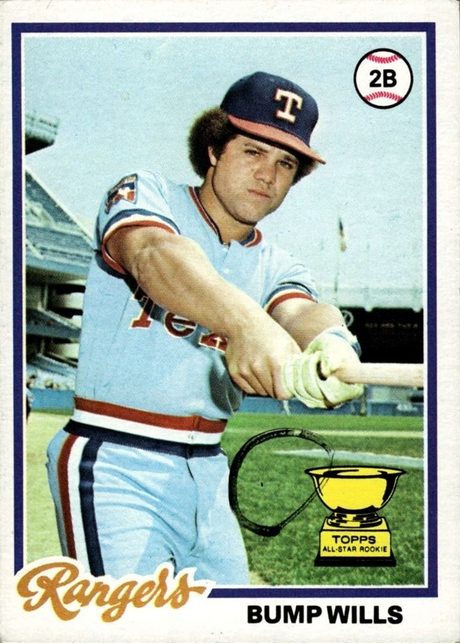
Wills stole 52 bases in 1978, surpassing Dave Nelson's 1972 Rangers record of 51, and led major league second basemen in assists. A .225 average before the All-Star break rose to .250 by season's end. His #23 card carries the Topps All-Star Rookie cup and has printings with and without a black circle.
Bump Wills was a switch-hitting second baseman who played for the Texas Rangers from 1977 to 1981 and the Chicago Cubs in 1982, then spent two seasons with the Hankyu Braves in Japan. He was the son of Maury Wills, the Dodgers shortstop who won the 1962 National League MVP award. Born Elliott Taylor Wills, he explained the nickname as a tribute his father paid to Michigan halfback Bump Elliott; his mother said it grew from Bumpy, for the way he kicked before birth.
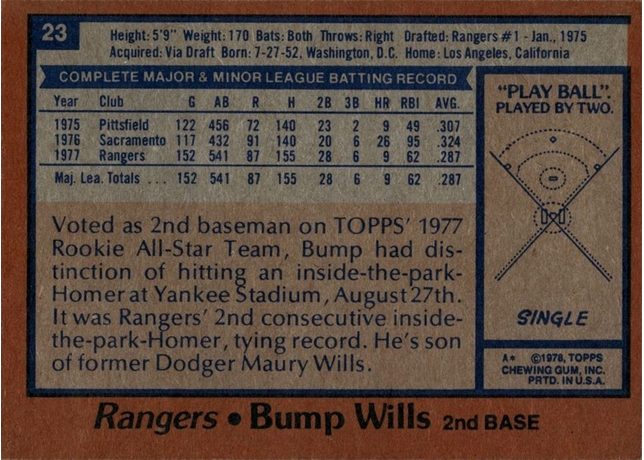
At Arizona State under coach Jim Brock he batted .383 with 25 steals as a senior second baseman in 1974, then broke his leg on a baserunning drill two weeks before that June's draft. The Padres took him in the 12th round and he did not sign; the Rangers made him the sixth overall pick in January 1975. He hit .324 with 26 home runs for Triple-A Sacramento in 1976. On August 27, 1977, he and Toby Harrah hit back-to-back inside-the-park home runs at Yankee Stadium, on consecutive pitches.
He led the Rangers in runs scored (102) and steals (34) in 1980 and led the Cubs with 35 steals in 1982. He finished with a .266 average, 36 home runs and 196 steals in the major leagues.
Sources: Wikipedia · SABR BioProject · Baseball-Reference · BaseballCardPedia
Print variations
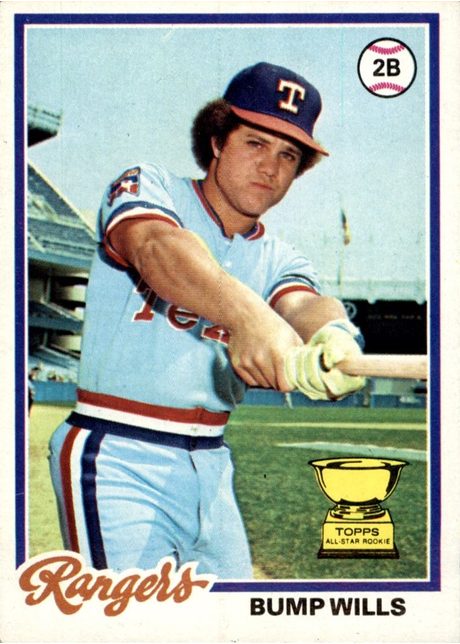
Two states of #23 are tracked individually: 23a - No Black Circle and 23b - Black Circle Present. The difference is on the front of the card (print flaw).
States catalogued by the Trading Card Database; each is tracked here individually.
As an eBay Partner Network affiliate, T206Cards.com may earn from qualifying purchases.
Graded population (PSA & SGC)
| Grader | Total | 10 | 9 | 8 | 7 | 6 | 5 | 1-4 | Auth |
|---|---|---|---|---|---|---|---|---|---|
| 23a - No Black Circle | |||||||||
| PSA | 227 | 39 | 127 | 41 | 11 | 5 | 2 | 2 | 0 |
| SGC | 7 | 1 | 1 | 3 | 2 | 0 | 0 | 0 | 0 |
| 23b - Black Circle Present | |||||||||
| PSA | 60 | 2 | 5 | 30 | 14 | 4 | 4 | 1 | 0 |
| SGC | 8 | 0 | 0 | 1 | 3 | 2 | 1 | 1 | 0 |
Graded population — a scarcity guide, not a price. Data as of 2026-10-19. Half grades fold down for both graders (8.5→8); PSA qualified slabs (OC, ST, PD, MC and the like) are not counted. Where a grader registers a variation separately its population is listed under that variation; PSA slabs whose label names no variation are counted under 23a - No Black Circle.
Find this card
Search T206 Cards Shop 1978 Topps cards Live auctions Buy It Now on eBay Sold prices
As an eBay Partner Network affiliate, T206Cards.com may earn from qualifying purchases.
Related cards
Team card: #659 Texas Rangers Team
More Texas Rangers cards:
- #44 Toby Harrah
- #67 Claudell Washington
- #92 Adrian Devine
- #110 Richie Zisk
- #131 Bert Blyleven
- #146 Doyle Alexander
- #172 Mike Hargrove
- #209 Dock Ellis
- #238 Juan Beniquez
- #260 Bert Campaneris
- #290 Willie Horton
- #314 Paul Lindblad
- #337 Tom Grieve
- #362 Dave May
Frequently asked questions
What is the 1978 Topps #23 card?
It is card #23 of the 726-card 1978 Topps Baseball set, picturing Bump Wills of the Texas Rangers.
Does 1978 Topps #23 have variations?
Yes. Two states are catalogued and tracked individually: 23a - No Black Circle (No black circle on the card - the corrected state and the more common of the two) and 23b - Black Circle Present (A black circle printed on the card, probably a proofing mark that was never removed - the error state and the less common of the two). Owning any one of them fills the #23 slot; the master set counts each state.
How many cards are in the 1978 Topps Baseball set?
726 cards, numbered 1 through 726 with none skipped and issued as a single series, and 728 collectible states: #23 Bump Wills comes with or without a black circle, and #374 Jose Morales with or without black stitching over the red laces, so the master set counts both states of each.
Sources: Trading Card Database, PSA CardFacts, BaseballCardPedia, Cardboard Connection, Baseball Almanac, Baseball-Reference, the SABR BioProject and the National Baseball Hall of Fame, PSA & SGC population reports. Card data compiled and maintained by T206Cards.com. Page last updated 2026-10-25.