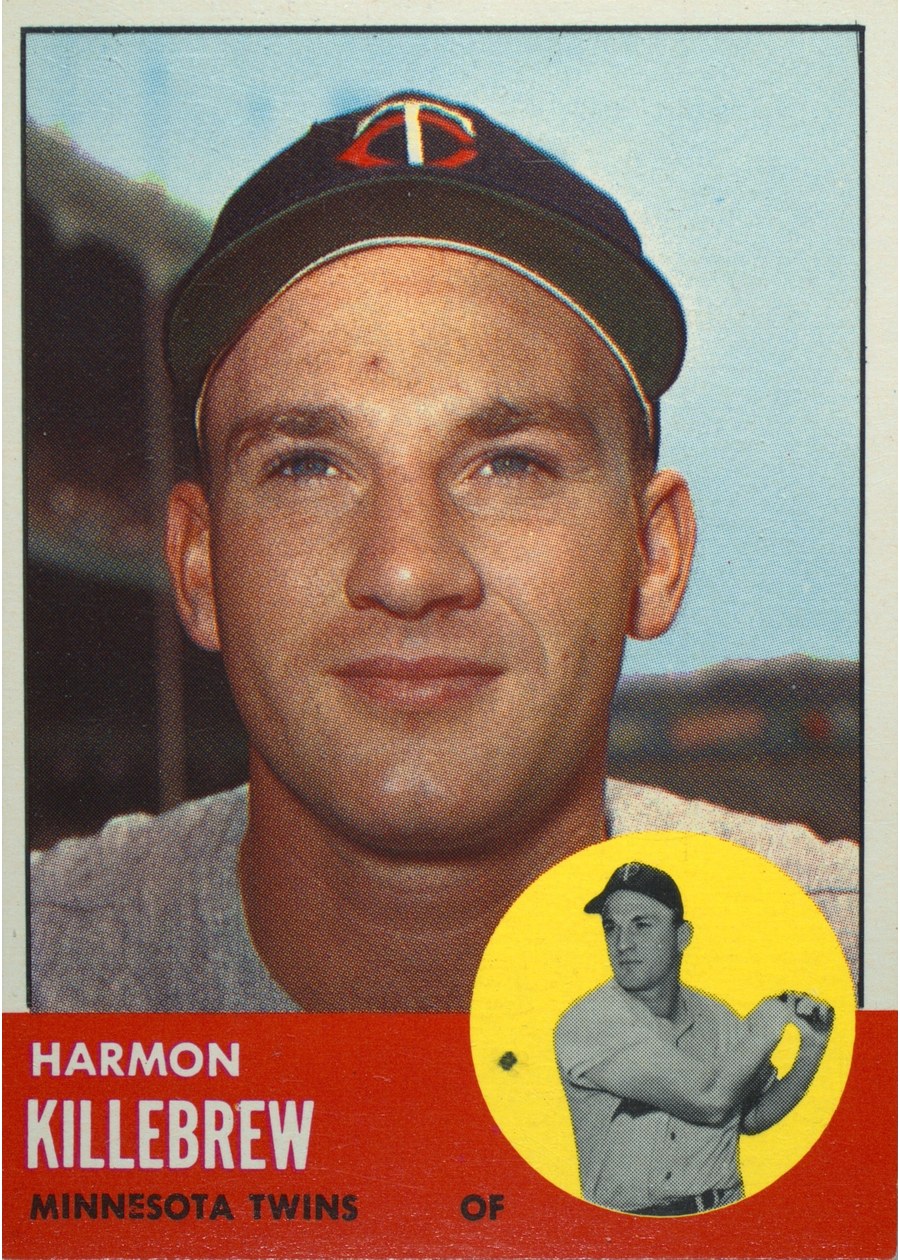
1963 Topps #500 Harmon Killebrew
Card 500 is short printed within the sixth series, which makes it harder to find than its neighbors.
About Harmon Killebrew
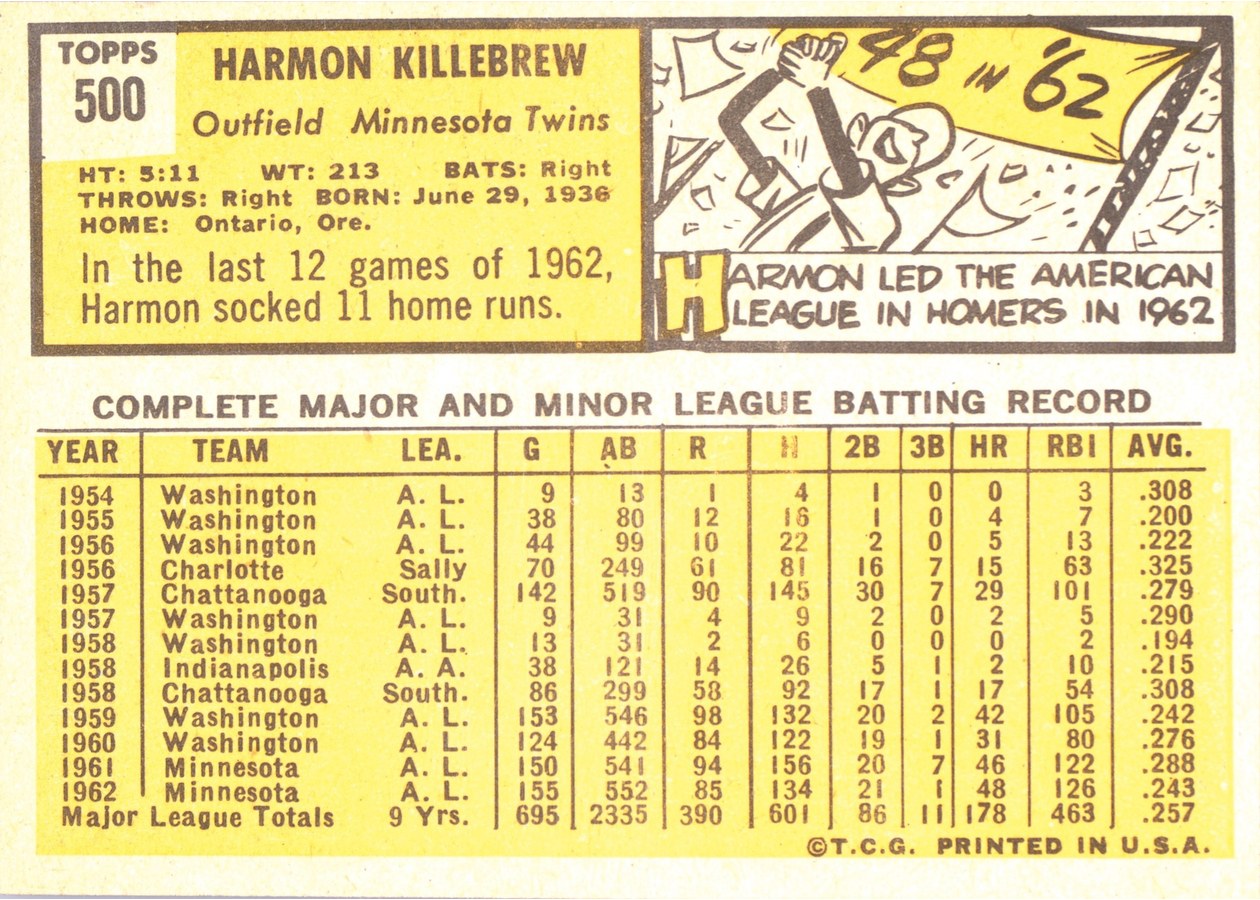
Killebrew led the American League in 1962 with 48 home runs, in a year when no one else in the league reached 40, and with 126 runs batted in, though his average fell to .243 and his 142 strikeouts also led the league. That August he became the first hitter to clear the left-field roof at Tiger Stadium, off Jim Bunning.
Harmon Killebrew signed with the Washington Senators out of Payette, Idaho in 1954, a bonus baby whose contract kept the seventeen-year-old on the big-league roster for two full seasons. He broke through in 1959, tying Rocky Colavito for the American League home run lead with 42. When the franchise moved to Minnesota for 1961 he became the middle of the Twins order for the next decade, shifting between first base, third base and left field as needed. A compact, quiet-tempered slugger built for pure power, he led the American League in home runs six times and in runs batted in three times, reached 40 homers in eight different seasons, and hit 393 home runs during the 1960s, more than any other player in the decade. His finest year was 1969: 49 home runs, 140 RBIs, the American League Most Valuable Player award and the Twins' first AL West title. He reached the World Series once, in 1965, a seven-game loss to the Los Angeles Dodgers. He was known as the Killer, though he was regarded as a kind man off the field. He finished with Kansas City in 1975, retiring with 573 home runs, fifth on the career list at the time, and the Twins retired his No. 3. Cooperstown elected him in 1984.
Sources: Wikipedia · SABR BioProject · Baseball-Reference · Baseball Almanac
Graded population (PSA & SGC)
| Grader | Total | 10 | 9 | 8 | 7 | 6 | 5 | 1-4 | Auth |
|---|---|---|---|---|---|---|---|---|---|
| PSA | 1,438 | 0 | 14 | 196 | 350 | 368 | 240 | 266 | 4 |
| SGC | 392 | 0 | 4 | 26 | 73 | 85 | 108 | 87 | 9 |
Graded population — a scarcity guide, not a price. Data as of 2026-09-04. Half grades fold down for both graders (8.5→8); PSA qualified slabs (OC, ST, PD, MC and the like) are not counted.
Find this card
Search T206 Cards Shop 1963 Topps cards Live auctions Buy It Now on eBay Sold prices
As an eBay Partner Network affiliate, T206Cards.com may earn from qualifying purchases.
Related cards
More Harmon Killebrew in this set: #4 League Leaders
Team card: #162 Minnesota Twins
More Minnesota Twins cards:
- #4 1962 American League Home Run Leaders
- #8 1962 American League Pitching Leaders
- #10 1962 American League Strikeout Leaders
- #26 Ray Moore
- #40 Vic Power
- #75 Bob Allison
- #89 Dick Stigman
- #110 Rich Rollins
- #127 Bill Tuttle
- #165 Jim Kaat
- #186 Jerry Zimmerman
- #198 Lenny Green
- #220 Camilo Pascual
- #228 1963 Rookie Stars
Frequently asked questions
What is the 1963 Topps #500 card?
It is card #500 of the 576-card 1963 Topps Baseball set, picturing Harmon Killebrew of the Minnesota Twins.
What are the key cards in the 1963 Topps set?
The #537 Rookie Stars card, Pete Rose's rookie card, leads the set. Beside it at the top sit #200 Mickey Mantle and #540 Bob Clemente, then #300 Willie Mays, #390 Hank Aaron, #210 Sandy Koufax, #340 Yogi Berra, #472 Lou Brock, #500 Harmon Killebrew (one of the five short prints) and the Rookie Stars cards with Willie Stargell (#553) and Tony Oliva (#228). The sixth and seventh series (#447-576) hold the short prints.
Why is #500 harder to find?
It is from the sixth print series, #447-511, where the set's short prints sit. Price guides band it as #447-522 and the high numbers as #523-576, while the uncut sheets put the break between #511 and #512. It is also a short print card. Five sixth-series cards - #466 Rookie Stars with Bill Freehan, #470 Tom Tresh, #484 Dale Long, #495 Frank Thomas and #500 Harmon Killebrew - were printed in smaller quantity than their neighbours.
How many cards are in the 1963 Topps Baseball set?
576 cards plus 7 variations (583 in the master set), issued in seven series. The full breakdown is on the 1963 Topps Baseball checklist page.
Sources: Trading Card Database, PSA CardFacts, Cardboard Connection, BaseballCardPedia, The Topps Archives, Baseball-Reference, the SABR BioProject and the National Baseball Hall of Fame, PSA & SGC population reports. Card data compiled and maintained by T206Cards.com. Page last updated 2026-11-02.